Edge banding machine
DW702 Edge Banding Machine | Technical Specifications
DW702 Automatic Edge Banding Machine, 3800W Total Power, 220V/380V, 0.3–3MM Edge Thickness...
View Details<p><strong>ST-50 Portable Edge Banding Machine</strong>, 0.3–3mm banding thickness, 220V/380V, curved and straight edge — designed for small workshops evaluating capacity before committing to a full line.</p> <ul> <li>Verify feed speed, tolerance, and panel thickness range against your actual substrate before ordering, as these define downstream assembly fit</li> <li>Supports MDF, particleboard, plywood, and solid wood with minimum sheet size 25×3cm, covering most small-part joinery requirements</li> <li>Request a factory test record on your specific material to confirm edge adhesion and alignment quality prior to shipment</li> </ul>
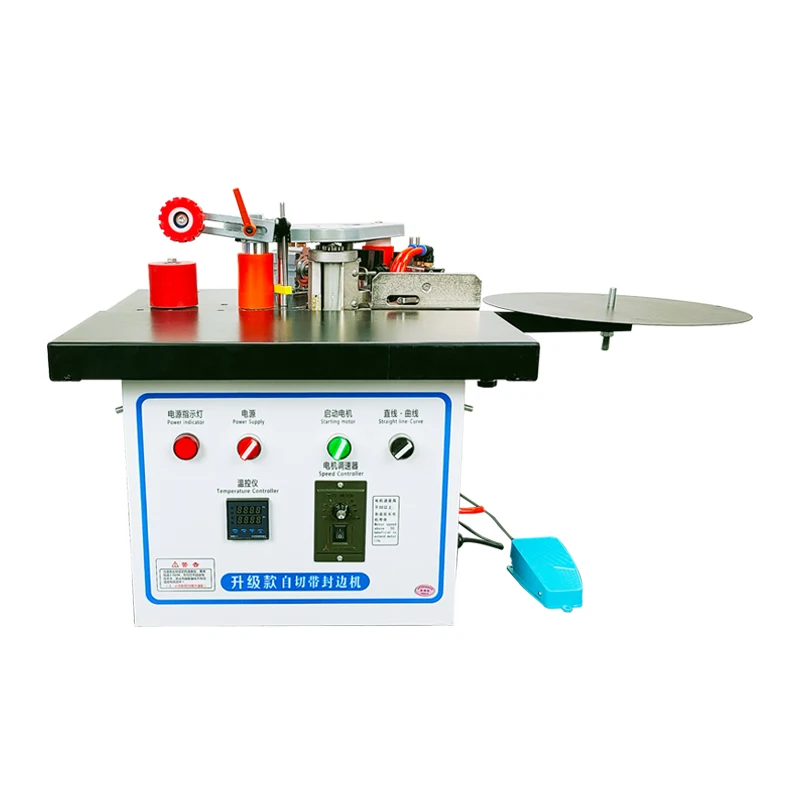
<p><strong>ST-50 Portable Edge Banding Machine</strong>, 0.3–3mm banding thickness, 220V/380V, curved and straight edge — designed for small workshops evaluating capacity before committing to a full line.</p> <ul> <li>Verify feed speed, tolerance, and panel thickness range against your actual substrate before ordering, as these define downstream assembly fit</li> <li>Supports MDF, particleboard, plywood, and solid wood with minimum sheet size 25×3cm, covering most small-part joinery requirements</li> <li>Request a factory test record on your specific material to confirm edge adhesion and alignment quality prior to shipment</li> </ul>
Quality Assured
Multi-stage QC inspection
Custom Config
Voltage, logo, language
Global Shipping
100+ countries served
After-Sales Support
Remote & spare parts
Spec-First Sourcing — Every ST-50 portable edge banding machine is quoted only after confirming your panel range, edge thickness, and local voltage, ensuring the machine fits your actual workshop conditions before it ships.
| Parameter | Value |
|---|---|
| Model | ST-50 |
| Product Type | Portable Edge Banding Machine |
| Total Power | 1000W |
| Edge Power | 20W |
| Voltage | 220V / 380V / customization available |
| Edge Banding Thickness | 0.3–3 mm |
| Edge Banding Height | 0–50 mm |
| Minimum Sheet Length | 25 cm |
| Minimum Sheet Width | 3 cm |
| Glue Pot Capacity | 1000 ml |
| Air Source Pressure | 0.5–0.8 MPa |
| Machine Dimensions | 50 × 50 × 47 cm |
| Net Weight | 22 kg |
| Edge Profile | Curved and straight |
| Language Options | Chinese and English standard; other languages customizable |
| Certifications | CE/ISO status to be confirmed with manufacturer |
| Application | Material or Output |
|---|---|
| Small cabinet shop edge sealing | MDF and particleboard panels with PVC or veneer edge banding |
| On-site furniture repair | Solid wood board and ecological board with curved or straight profiles |
| Home decoration production | Plywood and blockboard with thin PVC banding on shaped components |
| Joinery workshop semi-automation | Narrow stock and small offcuts down to 25 cm × 3 cm |
Locking down your facility's voltage and frequency before ordering prevents a portable edge banding machine from sitting idle for weeks while you source a transformer.
I once watched a custom cabinet shop take delivery of an edge bander only to find the motor was wound for a supply they did not have. The machine sat on the floor, wrapped in plastic, for three weeks until a step-down transformer arrived — and even then, the frequency mismatch caused the glue pot to heat unevenly. When evaluating edge banding machine specifications how to choose the right configuration starts with the electrical infrastructure already installed in your workshop, not with the brochure. Confirming whether your site runs single-phase 220V or three-phase 380V, and at what frequency, determines whether the ST-50 arrives ready to plug in or becomes a costly lesson in import logistics [NEED_CITE: voltage and frequency standards by export market].
The ST-50 accepts sheets as small as 25 cm long and 3 cm wide, a dimension envelope that matters when you are banding drawer sides, narrow cleats, or offcuts from a panel saw. Many portable edge banders struggle with short stock because the feed mechanism cannot grip the material, but this unit is configured for those smaller workpieces. Understanding edge banding machine specifications how to choose between a portable unit and a stationary model depends on the smallest part in your daily production mix, not just the largest panel.
Workshops that handle both radiused cabinet doors and standard carcass panels typically need two separate edge banding stations. The ST-50 handles curved and straight profiles within one portable frame, which reduces bench space and eliminates the need to move workpieces between machines. For a small operation producing custom furniture where batch sizes are low and profile variety is high, consolidating both functions into one unit simplifies the workflow. The trade-off is throughput: a portable machine will always feed slower than a full automatic line, so this configuration suits job shops rather than volume producers [NEED_CITE: typical throughput differences between portable and automatic edge banders].
Edge banding thickness of 0.3–3 mm covers most PVC, melamine, and real-wood veneer tapes used in furniture production, but thicker solid-wood lipping falls outside this range and requires a dedicated lipping machine. The 0–50 mm banding height accommodates standard 18 mm board with overhang on both faces for trimming, as well as thinner 9 mm stock. The 1000 ml glue pot is sized for intermittent use — it holds enough adhesive for a batch of small components but will require refilling during a full shift of continuous production. Air source pressure at 0.5–0.8 MPa means the unit needs a small compressor on the bench beside it; if your workshop air supply runs long hose lines, pressure drop at the machine can affect glue roller contact and trimming consistency. When studying edge banding machine specifications how to choose correctly, these physical boundaries define what the machine can and cannot process on your shop floor.
A portable unit sold into a production environment that demands continuous, eight-hour edge banding will overheat its glue pot and wear through feed rollers faster than the maintenance schedule accounts for. Operators forced to work outside the 0.3–3 mm banding thickness range often see delamination on thick veneer or poor adhesion on thin PVC — failures that only surface after the panel reaches the customer. Voltage mismatches, as mentioned earlier, do not just delay commissioning; running a 220V motor on a 110V supply through an undersized transformer degrades the winding insulation over time. These are not theoretical risks — they show up in warranty claims and rework logs [NEED_CITE: common causes of edge banding machine downtime in small workshops].
Every quotation is preceded by an engineer-led configuration review that confirms your panel dimensions, edge material, and local voltage before the order is placed. The ST-50 is part of a broader product family, so if your production volume eventually outgrows portable capacity, the same supplier can recommend a bench-top or full-line model without you starting the vendor evaluation from scratch. Four-stage quality control covers incoming material inspection through pre-shipment verification, and factory test records on your specific substrate can be requested before dispatch. Voltage, control language, and plug type are treated as standard customization points rather than afterthoughts, which reduces the chance of a machine arriving unusable.
To get an accurate configuration proposal for the ST-50, share the panel materials you run most often, the edge banding type and thickness you need to apply, and the smallest component dimensions in your production. Include your workshop voltage, frequency, and plug standard so the electrical specification is locked before quoting. If you are evaluating this portable unit against a larger automatic machine, describe your daily edge banding volume so the engineer can advise whether the ST-50 fits your throughput or a higher-tier model is more appropriate.
Q: What panel thickness and edge banding material does the ST-50 support, and how is this verified? A: The ST-50 handles edge banding thickness from 0.3 mm to 3 mm and banding heights up to 50 mm, covering PVC, melamine, and veneer tapes. Panel thickness range is not published in the current source, so request a factory test on your specific board stock — MDF, particleboard, or plywood — to confirm feed stability and glue adhesion before placing the order.
Q: How do I confirm the correct voltage and frequency before ordering? A: The ST-50 is available in 220V, 380V, or custom voltage configurations. Before production begins, provide your facility supply voltage, frequency, and plug type so the electrical schematic is built to match. This prevents the common problem of a machine arriving with a motor or heater element incompatible with local power infrastructure.
Q: What language options exist for the control interface? A: Chinese and English are standard on the ST-50 control panel. Additional operator languages can be configured during production upon request. Confirming the required language at the inquiry stage ensures the machine arrives with labels and display menus your operators can read from day one.
Q: At what point should a workshop move from a portable to an automatic edge banding line? A: The ST-50 suits small workshops, on-site repair, and job shops with varied panel sizes and low batch volumes. When daily edge banding shifts to continuous production with consistent panel dimensions, a bench-top or full-line automatic model delivers higher feed speeds and integrated trimming. Request a throughput comparison to determine the crossover point for your specific workload.
Q: What edge alignment tolerance can I expect, and is there a test method? A: Tolerance values for the ST-50 are not stated in the current listing and must be confirmed with the manufacturer. Request a factory test record or sample output on your substrate, then measure edge overhang and glue line consistency on the returned samples to verify alignment before committing to shipment.
20+ Years Experience
Trusted by 100+ countries worldwide
Full OEM/ODM
Custom logo, voltage & panels
Lifetime After-Sales
12-month warranty + spare parts
25-45 Day Lead Time
Flexible MOQ, on-time delivery
Fill in your requirements and our team will respond with a formal quotation within 24 hours. We speak English and Spanish.
Response within 24 hours on business days
Or WhatsApp us for instant reply
Serving 100+ countries globally
DW702 Automatic Edge Banding Machine, 3800W Total Power, 220V/380V, 0.3–3MM Edge Thickness...
View DetailsProducts DescriptionDW802 Automatic Edge banding machine with gluing.trimming.end cutting and buffing for...
View DetailsXZF-450 Automatic Edge Banding Machine, 9.5KW, 0-12M/min feed speed, 0.3-3mm edge thickness...
View DetailsDW102 Automatic Edge Banding Machine, 220V/380V, 0.3-3mm Edge Thickness, Dual 650W Trimming...
View DetailsOur global sales team is ready to assist. Get a formal quotation, technical specs, and OEM/ODM options within 24 hours.