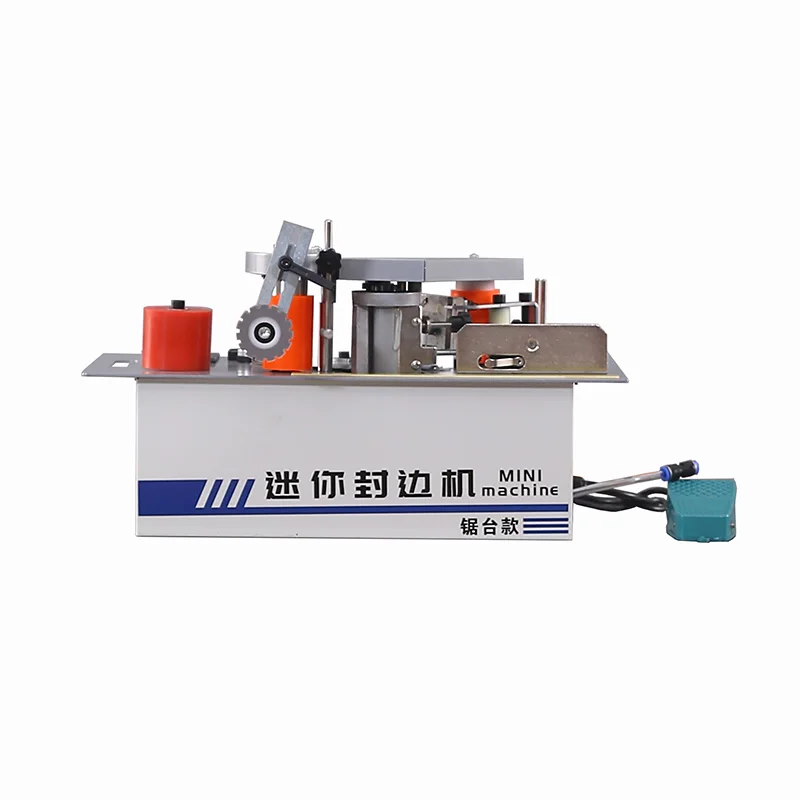
Specification-Led Configuration — every portable curve edge banding machine leaves our facility with a verified electrical schematic matched to your workshop's voltage and frequency supply.
Technical Specifications
| Parameter |
Value |
| Product Type |
Portable Curve Edge Banding Machine |
| Voltage |
220V |
| Rated Power |
825W |
| Heating Time |
5-10 min |
| Air Pressure Requirement |
0.4-0.6 MPa |
| Glue Pot Capacity |
1000 ml |
| Edge Banding Speed |
0-10 m/min |
| Edge Pattern Capability |
Curves, straight lines, special shaped profiles |
| Overall Dimensions |
50 × 30 × 27 cm |
Application Suitability
| Application |
Material or Output |
| Custom cabinet door edge finishing |
MDF and plywood panels with PVC edge banding |
| On-site carpentry and installation work |
Particleboard and blockboard with veneer banding |
| Small-batch curved furniture components |
Solid wood panels with melamine or PVC strips |
| Repair and rework of existing edged panels |
Various substrate densities with matching adhesive |
Why the Voltage Question Should Come Before the Price on Portable Edge Banders
Confirm your workshop's single-phase supply specifications before evaluating any portable curve edge banding machine specifications.
I have walked into workshops in Shandong where a brand-new portable unit sat in its crate for three weeks because the importer never checked whether the local supply matched the motor rating. The operator plugged it in, the heating element burned out within minutes, and the glue pot had to be replaced entirely. A portable curve edge banding machine specifications sheet means nothing if the voltage and frequency do not align with your facility [NEED_CITE: voltage and frequency standards by export market]. That 825W rated power draw also tells you whether your existing circuit can handle the load alongside other equipment running simultaneously, or whether a dedicated breaker is required before the machine ever arrives.

Mapping Edge Profiles to Feed Speed Control
The 0-10 m/min variable feed speed on this portable curve edge banding machine is not just a range figure — it directly governs how cleanly adhesive transfers onto tight-radius curves. When an operator slows the feed to the lower end of the range, the glue has adequate open time to wet the substrate before the banding is pressed home. On straight sections, the upper range keeps throughput practical without starving the glue line. Matching feed speed to curve radius is something experienced operators learn quickly, and having a continuously adjustable range rather than fixed speed steps makes that adjustment intuitive during a single pass around a complex profile.
Air Pressure Consistency and Adhesion Across Substrates
The specified 0.4-0.6 MPa operating window determines how firmly the pressure roller seats the banding against the panel edge. Denser substrates like high-grade plywood require pressure at the upper end of that range to squeeze out excess adhesive and achieve full contact. Lower-density particleboard, by contrast, can crush or delaminate if the pressure is set too aggressively [NEED_CITE: substrate density effects on edge banding adhesion]. A stable compressor supply is therefore not optional — fluctuating pressure mid-pass produces uneven glue lines that only reveal themselves when the panel reaches the assembly bench and the edge lifts under stress.
Reading the Spec Sheet Against Your Actual Production Needs
The 1000 ml glue pot capacity and 5-10 minute heating time together define your practical continuous run length. A smaller pot means more frequent refills during long production runs, but it also heats faster and wastes less adhesive when you are only edging a handful of panels. The overall footprint of 50 × 30 × 27 cm tells you this unit fits on a standard workbench without dedicated floor space, which matters in workshops where a full-size automatic edge bander would dominate the room. Glue temperature range, while determined by the heating element design, must be verified against your specific banding material — PVC, melamine, and real wood veneer each demand different melt temperatures for proper bonding, and running outside that window is the most common cause of edge failure on portable units.
The Cost of Skipping Specification Verification
When a portable edge banding unit arrives with a control panel in a language the operator cannot read, commissioning stalls immediately — the operator guesses at temperature settings, overheats the adhesive, and the first batch of panels fails adhesion tests. Mismatched voltage is worse: the machine either underperforms on a lower supply or destroys its heating element on a higher one. These are not theoretical risks [NEED_CITE: CE machinery directive requirements for industrial equipment]. They happen regularly when procurement decisions are made on price alone without cross-referencing the portable curve edge banding machine specifications against the actual workshop environment where the unit will operate daily.
What Distinguishes This Procurement Path
In-house manufacturing with proprietary cutting mechanisms means the edge trimming quality on this portable unit is controlled at the component level, not outsourced to third-party assemblies. The four-stage quality control process — incoming material, in-process, finished product, and pre-shipment verification — catches tolerance drift before the machine is crated. Voltage and multilingual control panel customization is treated as standard configuration, not an expensive add-on negotiated after the order is placed. An engineer reviews your panel materials and edge profile requirements before issuing a formal quotation, so the machine that arrives is genuinely suited to your workshop rather than being a generic unit pushed through a catalog. Factory visits are welcomed if you want to see the assembly process firsthand.
Documentation & Verification
- Electrical schematic confirming 220V compatibility with your single-phase workshop supply
- Machine specification sheet listing verified glue temperature range and banding material compatibility
- Operation and maintenance manual produced in your operator's working language
- Factory test record demonstrating edge adhesion on your specific MDF or plywood substrate
- Packing photographs documenting machine condition and accessory completeness before dispatch
Installation, Commissioning & Support
- Requires a dedicated 220V single-phase circuit rated for the 825W continuous power draw
- Connect to a compressor delivering stable 0.4-0.6 MPa air supply with an inline filter and regulator
- Benchtop placement on a stable surface accommodating the 50 × 30 × 27 cm footprint
- Initial heating cycle and glue temperature calibration performed against your chosen banding material
- Feed speed adjustment practiced on scrap panels covering both straight edges and tight curve radii
- Spare glue pot seals and pressure roller covers included for routine maintenance intervals
Preparing Your Inquiry for Accurate Configuration
Share the panel materials you work with most frequently — MDF, plywood, particleboard, or solid wood — along with the edge banding type and thickness you intend to apply. Specify your workshop's voltage and frequency so the electrical configuration is confirmed before production. Let us know whether your typical work involves primarily curved profiles, straight runs, or a mix of both, so the feed speed range and pressure settings can be validated against your output expectations.
Frequently Asked Questions
Q: How do I confirm this portable unit is compatible with my workshop electrical supply?
A: The standard configuration runs on 220V single-phase power at 825W. Before ordering, share your facility's exact voltage and frequency so an electrical schematic can be prepared and verified. If your supply differs, the voltage can be customized during production to match your local grid requirements, ensuring the heating element and motor operate within their designed parameters from the first startup.
Q: What edge banding materials and panel thicknesses does this machine accept?
A: This portable unit handles PVC and veneer edge banding on substrates including MDF, plywood, particleboard, and solid wood panels. The glue pot temperature range should be confirmed against your specific banding material before production runs begin. Panel thickness compatibility depends on the pressure roller adjustment range, which is documented in the machine specification sheet provided with your quotation.
Q: How does feed speed selection affect edge quality on curved versus straight sections?
A: On tight curves, reducing the feed speed within the 0-10 m/min range allows the adhesive adequate open time to bond properly before the banding is pressed against the substrate. Straight sections can be run at higher speeds without sacrificing adhesion. The variable speed control lets the operator adjust continuously during a single pass, adapting to changing profile geometry without stopping the machine.
Q: What air compressor specifications are needed for consistent operation?
A: The machine requires a stable air supply between 0.4 and 0.6 MPa to maintain consistent pressure roller force. Your compressor should deliver this range continuously, not just at peak output, and an inline regulator with a moisture filter is recommended to protect the pneumatic components. Fluctuating pressure during operation produces uneven glue lines and compromises edge adhesion quality across a production batch.
Q: How can I verify edge adhesion quality before committing to full production volumes?
A: Request a factory test record showing the machine running your specific panel material and edge banding combination. You can also submit sample panels for a processing test before shipment, allowing you to inspect the glue line quality and edge trimming accuracy on your own substrates. This verification step eliminates guesswork when the machine arrives at your workshop.