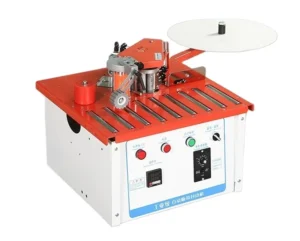
Verified Tolerance Control — every 802 unit undergoes four-stage inspection from incoming components to pre-shipment test, so the ±0.02mm edge finish claim holds up when your panels reach the assembly bench.
Technical Specifications
| Parameter |
Value |
| Model |
802 |
| Product Type |
Semi-Automatic Portable PVC Edge Banding Machine |
| Function Stations |
Automatic plate feeding, end cutting, upper and lower trimming, upper and lower polishing, integrated dust collector |
| Edge Type |
Straight line |
| Rated Voltage |
220V |
| Rated Power |
4 kW |
| Trimming Power |
800W × 2 (double high-speed motors) |
| Polishing Power |
180W × 2 |
| Suction Power |
1200W |
| Heating Power |
1000W (heat-up time 5–10 min) |
| Feed Speed |
0–10 m/min |
| Conveyor Belt Speed |
0–10 m/min |
| Strip Thickness Range |
0.5–2.5 mm |
| Sheet Thickness Range |
10–50 mm |
| Glue Pot Capacity |
4000 ml |
| Rated Air Pressure |
0.4–0.6 MPa |
| Pressure Beam |
One-piece integrated with double rows of pressure wheels |
| Conveyor Belt Material |
Silicone (scratch-resistant) |
| Belt Breaking Method |
Pneumatically controlled |
| Auxiliary Support |
Extendable fluent strips for large panels |
| Control Panel |
Digital display for glue pot temperature, independent switches |
| Overall Dimensions (L×W×H) |
130 × 65 × 75 cm |
| Machine Weight |
150 kg |
| Standards |
CE, ISO 9001 |
Application Suitability
| Application |
Material or Output |
| Custom cabinet carcass edging |
MDF and particleboard panels with 0.5–2.5mm PVC straight banding |
| Small-batch furniture production |
Plywood and solid wood panels up to 50mm thickness |
| Workshop relocation between work cells |
Portable 150kg unit on flat shop floor, no fixed foundation required |
| Joinery startup scaling from manual edging |
Straight-line PVC and veneer banding on standard sheet stock |
Why Voltage Confirmation Must Happen Before the Order Ships
A Semi-Automatic Portable Edge Banding Machine specified on paper but mismatched to local supply becomes dead weight on your floor. Confirming the 220V single-phase requirement against your workshop's actual outlet prevents a multi-week standstill.
I once saw a semi-auto edge bander arrive at a panel shop where the only available circuit was 380V three-phase. The heating element and feed motor could not energise, and the factory had to wait for a step-down transformer while the entire assembly line sat idle. Voltage mismatches remain one of the most common commissioning failures across exported woodworking equipment [NEED_CITE: voltage and frequency standards by export market]. The 802 draws 4 kW at rated load, which means the circuit must sustain that continuous draw without tripping — a detail worth verifying on your electrical single-line diagram before you sign the purchase order.

Matching Feed Speed to Your Panel Mix
The adjustable 0–10 m/min feed range on this Semi-Automatic Portable Edge Banding Machine gives operators room to slow down for thick 50mm MDF or speed up on standard 18mm particleboard runs. Running thin PVC at maximum speed can cause the trimming motors to chatter, leaving visible witness marks on the edge face. I recommend starting at mid-range and stepping up only after inspecting the first five panels for clean trim lines.
How Glue Pot Capacity Affects Continuous Runs
The 4000ml glue pot holds enough hot-melt adhesive to run extended batches without stopping for refills, which matters when a cabinet shop is pushing through a full kitchen order in one shift. The digital temperature readout lets the operator monitor melt condition in real time, preventing the charred glue that causes adhesion failures on melamine-faced chipboard [NEED_CITE: hot-melt adhesive temperature windows for PVC and veneer edge banding]. Heat-up from cold takes five to ten minutes at 1000W, so the machine can be ready before the first panel is staged.
Reading the Specifications Against Your Production Reality
The 10–50mm sheet thickness range covers most panel stock a custom furniture shop handles, from 12mm drawer bottoms to 36mm worktop cores. What matters is how the one-piece pressure beam with double rows of pressure wheels holds the panel flat through the feed zone — uneven pressure on a warped board leads to glue starvation on one edge and squeeze-out on the other. The 800W × 2 trimming motors cut the overhang flush, while the 180W × 2 polishing wheels remove the micro-burr left by trimming. If your panels regularly fail at the dowel or confirmat assembly stage, the edge squareness produced at this station is the first place to look. The integrated 1200W dust collector captures trim waste at source, keeping the conveyor belt clear of chips that could scratch the silicone surface over time.
The Hidden Cost of Skipping Pre-Shipment Verification
Ordering a compact edge bander without requesting a factory test on your own material means you accept the machine on faith. I have watched workshops discover that the trimming tolerance they were promised only reveals itself as a gap at the carcass joint during assembly — after the panels are cut, drilled, and edge-banded [NEED_CITE: woodworking assembly tolerance stack-up from edge banding deviation]. By then, rework means stripping the banding and running the panel again, doubling labour on every affected piece. A pre-shipment test record eliminates this gamble.
Why Sourcing This Machine Through Our Configuration Process Works
Every 802 leaves the factory after four-stage QC covering incoming material inspection, in-process checks, finished-product measurement, and a pre-shipment run. The patented cutting mechanism design behind the trimming station is manufactured in-house, so replacement cutters are available without third-party sourcing. Voltage is confirmed against your site supply before the electrical schematic is finalised — not assumed from a default setting. The operation manual ships in the language your operator reads, and a spare parts list covering the trimming motors, polishing wheels, and silicone belt is included in the crate.
Documentation & Verification
- CE declaration of conformity covering the 802 edge banding machine
- Electrical schematic confirming your site voltage before dispatch
- Factory test record run on your panel thickness and edge material
- Operation and maintenance manual delivered in your operator's language
- Spare parts list itemising trimming motors, polishing wheels, and belt
Installation, Commissioning & Support
- Requires a flat floor area of roughly 130 × 65 cm plus operator clearance on the feed side
- Dedicated 220V single-phase circuit rated for the 4 kW continuous draw
- Arrives as a single 150 kg unit; position with a pallet jack and level the feet
- First-run calibration of the pressure beam and trimming depth performed on your panel stock
- Operator training covers glue pot temperature settings and belt speed adjustment
- Silicone conveyor belt and trimming cutters listed in the included spare parts inventory
What to Include in Your Inquiry
Share the panel materials you run most often — MDF, particleboard, or plywood — along with typical sheet thicknesses and the edge banding type and width. Tell us your workshop's available voltage and frequency so the electrical configuration is locked before production. If you are replacing an existing machine or adding to a line, note the upstream saw and downstream boring setup so we can flag any feed-height or throughput mismatch.
Frequently Asked Questions
Q: How do I verify that the 0–10 m/min feed speed is achievable on my panel thickness and edge material?
A: Request a factory test record where the 802 runs your specific panel stock and PVC or veneer strip at target speed. The test shows actual trim quality and edge adhesion at the feed rate you plan to use, rather than a generic benchmark on standard material.
Q: The 802 is rated at 220V — can the motor and heating element be reconfigured for 110V or 380V supply?
A: Voltage customisation from 110V to 440V is available. Confirm your local voltage and frequency at inquiry stage so the motor winding and 1000W heating element are configured before assembly, avoiding the need for an external transformer on your shop floor.
Q: What control panel language options are available for the digital glue pot display?
A: The control panel supports multilingual labelling configured before shipment. Specify the language your operator reads during the quotation stage so the temperature display and independent switch labels arrive ready for immediate commissioning.
Q: How does the 10–50mm sheet thickness range map to my mix of 18mm particleboard and 36mm MDF panels?
A: Both thicknesses fall within the range. The one-piece pressure beam with double pressure wheel rows adjusts to hold each panel flat. Slow the feed speed on the 36mm MDF to let the 800W trimming motors cut cleanly through the denser core material.
Q: What are the floor space, air supply, and electrical prerequisites for installing the 802?
A: Plan for the 130 × 65 cm footprint plus operator clearance, a compressed air line delivering 0.4–0.6 MPa, and a dedicated 220V circuit supporting 4 kW. The extendable fluent strips need additional length on the infeed side for large-format panels.