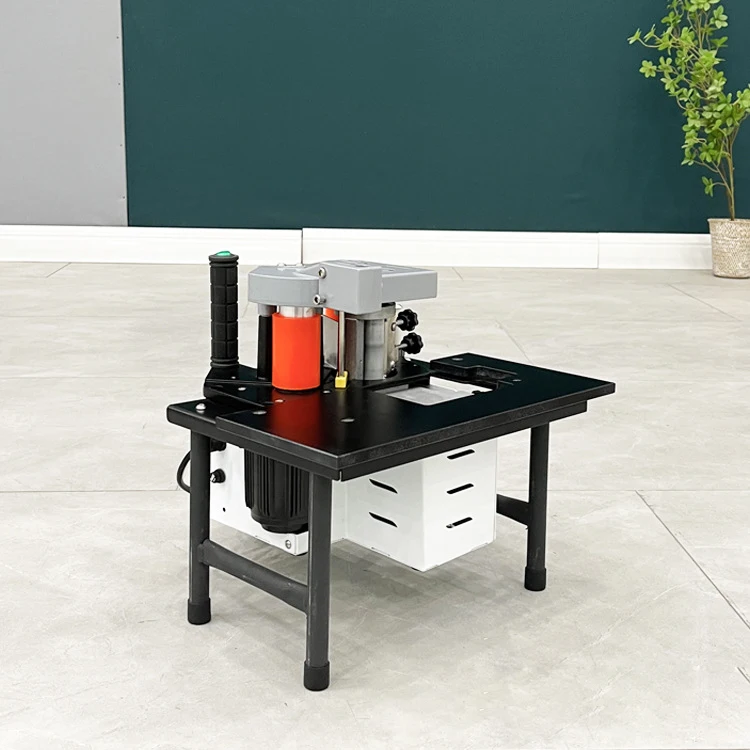
Small Portable Edge Banding Machine for Cabinet Board – Technical Guide
Voltage-First Configuration — every portable edge banding machine specification, from plug type to control panel language, is confirmed against your workshop's electrical standard before the quotation is issued.
Technical Specifications
| Parameter |
Value |
| Product Type |
Portable Edge Banding Machine |
| Shape of Edge-banding Plates |
Curved, Straight and Special-shaped Sheet |
| Edge Thickness |
0.3–3mm |
| Edge Sealing Speed |
0–6 m/min |
| Edge Sealing Height |
7–60mm |
| Gluing Method |
Double-sided gluing |
| Glue Pot Volume |
1000ml |
| Machine Weight |
14kg |
| Overall Dimensions (L×W×H) |
440×410×450mm (source value — verify whether this is package size or machine footprint) |
| Plug Options |
EU / AU / UK / USA / CN plug available |
| Logo Customization |
Available |
Application Suitability
| Application |
Material or Output |
| Small workshop edge finishing |
MDF, plywood, and particleboard panels with PVC edge banding |
| Custom cabinet curved edges |
Solid wood panels and shaped components with veneer banding |
| On-site installation repair |
Pre-cut panels requiring field edge sealing with PVC or veneer strips |
| Joinery startup transition |
Low-to-medium volume panel processing moving from manual trimming |
What "0–6 m/min" Actually Means for Your Panel Quality
Feed speed on a portable edge bander defines glue penetration time, not just throughput.
When I first moved from the assembly floor into technical sales, I saw operators push these small units to the top of their speed range on dense particleboard, only to find the adhesive hadn't bonded properly by the time the panel reached the trimming station. The edge would peel during the next handling step. Matching portable edge banding machine specifications to your actual substrate density and banding material matters more than the maximum number on the data sheet [NEED_CITE: adhesive open time requirements for wood-based panel edge banding].

Matching Edge Thickness Capacity to Your Banding Inventory
The 0.3–3mm edge thickness range covers standard PVC strips used in cabinet production as well as thicker veneer banding for visible furniture edges. A portable edge banding machine in this class handles the majority of materials a small workshop stocks, but operators must adjust feed speed downward as banding thickness increases to maintain consistent glue transfer across the full width of the strip.
Double-Sided Gluing and Substrate Behaviour
Double-sided gluing applies adhesive to both the panel edge and the banding strip simultaneously, which addresses the weak bond lines common when only one surface is coated. On porous substrates like particleboard, the panel edge absorbs adhesive quickly, so coating the strip as well ensures sufficient adhesive remains at the interface for a lasting bond. This method becomes critical when working with melamine-faced boards where single-sided application often leaves visible glue starvation [NEED_CITE: wood adhesive bond strength testing standards for panel furniture].
How Sealing Height and Speed Interact With Assembly Tolerances
The 7–60mm sealing height range accommodates standard cabinet shelf thicknesses up to thicker worktop panels. Within this range, the feed speed must be reduced as panel height increases because the glue contact area grows and requires longer curing time under pressure. Panels that leave this station with insufficient bond strength will fail at the assembly stage, where clamp pressure during carcass construction stresses the edge before the adhesive has fully cured. The ±0.02mm tolerance standard on larger stationary machines is not typically published for portable units, so requesting a factory test on your specific panel thickness range before dispatch provides the only real verification of edge alignment quality.
The Hidden Cost of Skipping Voltage Confirmation
Units shipped without confirming local voltage and frequency arrive at workshops where they either trip breakers on startup or run motors at incorrect speeds, degrading glue temperature consistency. A portable edge banding machine that runs on mismatched voltage will overheat its glue pot element or underperform on feed drive torque, producing inconsistent edge quality that operators blame on the adhesive rather than the power supply [NEED_CITE: voltage and frequency standards by export market].
Why Procurement Should Start With Your Panel Profile
Manufacturing depth here means the cutting mechanism and feed components are produced in-house with precision-ground surfaces and multi-stage inspection, not assembled from sourced sub-assemblies. The four-stage quality control process covers incoming material, in-process assembly, finished product testing, and pre-shipment verification against your confirmed panel thickness and banding material. Voltage, plug type, and control panel language are treated as standard configuration items rather than special requests, so the unit that arrives matches your workshop's electrical infrastructure and operator language from day one. Engineer-led configuration recommendations are provided within a formal quotation cycle, ensuring the portable edge banding machine specifications align with your actual production requirement rather than a generic catalogue entry.
Documentation & Verification
- CE declaration of conformity covering the portable edge banding unit and its electrical components
- Machine specification sheet listing confirmed edge thickness range, sealing height, and glue pot capacity
- Electrical schematic with voltage and plug type matching your workshop's standard
- Factory test record using your specified panel material and banding type before dispatch
- Operation and maintenance manual in your operator's language with illustrated adjustment procedures
Installation, Commissioning & Support
- Requires a single-phase circuit matching the confirmed plug type with adequate amperage for the glue pot heater and feed motor
- Compact 440×410×450mm footprint allows benchtop placement without dedicated floor space or foundation
- 14kg weight permits two-person positioning without lifting equipment during workshop rearrangement
- First commissioning includes glue temperature calibration for your specific PVC or veneer banding material
- Spare parts list covers consumable glue pot elements and feed rollers with recommended replacement intervals
Preparing Your Enquiry
To receive an accurate configuration, specify the panel substrates you process most frequently, the edge banding materials in your current inventory, and your local voltage and frequency standard. Note whether your operators require a specific control panel language and if the unit needs to handle predominantly curved profiles or straight cabinet components.
Frequently Asked Questions
Q: How do I verify edge sealing tolerance before accepting delivery?
A: Request a factory test record showing the machine running your actual panel thickness and banding material, with measurements taken on edge overhang and glue line consistency. Tolerance on portable units is not always published in the same format as stationary machines, so a pre-shipment test on your specific material provides the only verifiable confirmation of output quality.
Q: Which voltage and plug options are available for my region?
A: The unit is configurable for EU, AU, UK, USA, and CN plug standards with voltage matched to your local supply. Confirm your workshop's exact voltage and frequency before the order is placed, as running the glue pot heater on incorrect voltage affects adhesive temperature consistency and bond strength.
Q: How should I match feed speed to my daily panel output?
A: The 0–6 m/min speed range should be set based on your banding material thickness and substrate porosity rather than target throughput alone. Thicker veneer banding and dense particleboard require slower feed rates to allow adequate adhesive penetration, so calculate daily capacity around the speed your material combination actually requires for reliable bonding.
Q: What materials are compatible with the double-sided gluing system?
A: The system applies adhesive to both panel edge and banding strip, making it suitable for MDF, plywood, particleboard, and solid wood panels paired with PVC or veneer edge banding. Porous substrates benefit most from double-sided application, as single-sided gluing on particleboard often produces glue starvation visible after trimming.