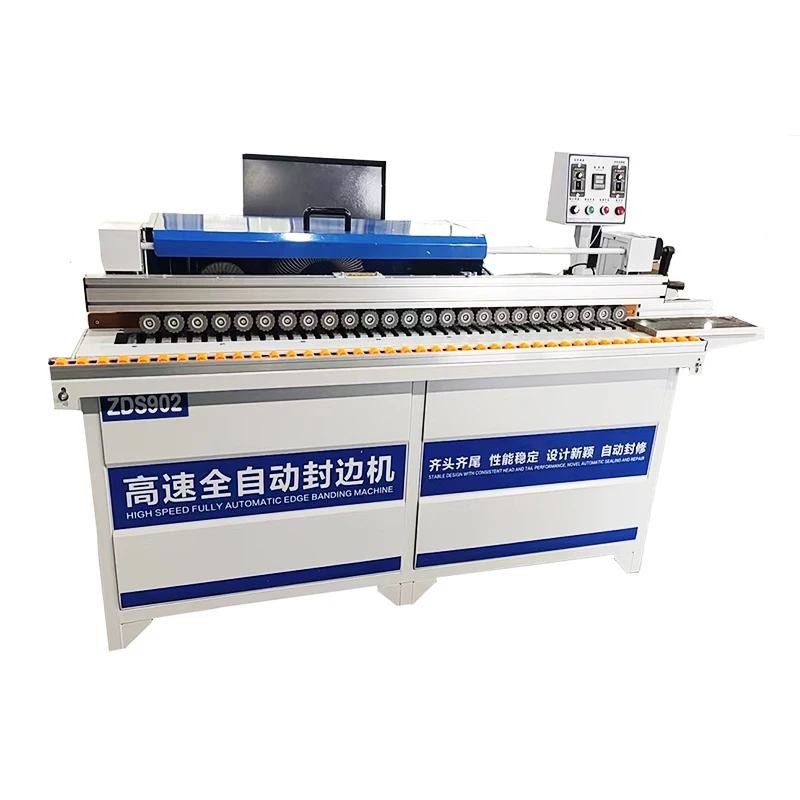
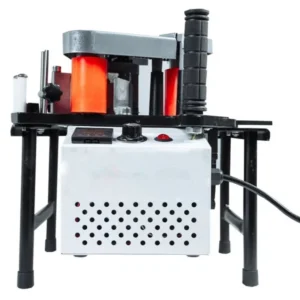
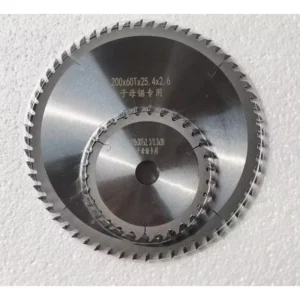
Verified tolerance capability — proprietary cutting mechanisms and a four-stage QC process underpin the ±0.02 mm edge banding tolerance you can audit before committing to a production order.
Technical Specifications
| Parameter |
Value |
| Product Type |
Automatic Edge Banding Machine |
| Edge Banding Type |
Linear Edge Banding Machine |
| Voltage |
220V (frequency 50Hz/60Hz to confirm; 110V–440V customization available) |
| Total Power |
4200W |
| Equipment Size |
207 × 60 × 122 cm |
| Weight |
245 kg |
| Edge Band Height Range |
0–35 mm |
| Edge Band Thickness Range |
0.5–2.5 mm |
| Glue Pot Capacity |
4000 ml |
| Trimming Stations |
Double high-speed trimming motors (up and down) |
| Polishing Stations |
Up and down two polishing motors |
| Pressure System |
Integrated pressure beam, double rows of pressure wheels |
| Conveyor Belt |
Silicone material |
| Edge Strip Cutting |
Pneumatically controlled |
| Pressure Beam Adjustment |
Manual handle for board height adjustment |
| Control System |
Intelligent temperature control |
| Key Features |
High-speed sealing and repair, double-sided gluing, independent operating platform |
Application Suitability
| Application |
Material or Output |
| Cabinet door and drawer front edge finishing |
MDF and particleboard with PVC edge banding |
| Custom furniture panel edge sealing |
Plywood panels with veneer or melamine banding |
| Small to medium workshop linear production runs |
Solid wood panels requiring trimming and polishing |
| Shelving and worktop edge treatment |
Chipboard substrates with 0.5–2.5 mm band thickness |
Why the Voltage Question Must Come Before the Quotation
Confirming your local voltage and frequency eliminates the single most common reason exported edge banders sit idle on arrival.
I have watched a full-function edge bander arrive at a European joinery shop, still in its crate, because the motor was wound for 380V three-phase while the workshop only had 220V single-phase available. The operator could not even power the control panel to check the language settings. Every automatic edge banding machine specifications sheet should state voltage and frequency explicitly, yet many quotations skip this detail entirely. When the machine is already built, rewinding a motor or swapping a transformer is neither quick nor inexpensive [NEED_CITE: voltage and frequency standards by export market].

Mapping Power and Feed to Your Panel Portfolio
With 4200W total power distributed across trimming, polishing, gluing, and conveyor motors, this automatic edge banding machine is configured for small-to-medium furniture workshops that run MDF, plywood, and particleboard in the 0.5–2.5 mm band thickness range. The 4000 ml glue pot reduces refill interruptions during continuous runs, which matters when a batch of cabinet sides cannot pause mid-panel without risking glue-line inconsistency. The double-sided gluing function ensures adhesive coverage on both the panel edge and the banding strip, a detail that becomes critical when working with porous substrates like particleboard where single-side application often leaves starved joints.
Pressure Beam and Conveyor Stability
The integrated pressure beam with double rows of pressure wheels holds panels flat against the silicone conveyor belt throughout the feed path. Silicone material resists glue adhesion, so residual adhesive does not build up and pull subsequent panels off-line. Manual handle adjustment for board height means the operator sets the clearance once per batch thickness and the beam maintains constant downward pressure. This arrangement is particularly relevant when a workshop alternates between 18 mm MDF shelving and 25 mm plywood worktops within the same shift [NEED_CITE: conveyor belt material selection for edge banding].
What the Trimming and Polishing Configuration Actually Delivers
Double high-speed trimming motors positioned up and down remove excess banding from both the top and bottom edges in a single pass, which directly affects downstream assembly accuracy. If trimmed edges are uneven, the gap between a door front and its carcass panel will be visible once hinges are fitted. The two polishing motors then smooth the trimmed edge to remove scoring marks left by the trimming cutters. The edge band height range of 0–35 mm covers standard furniture panel thicknesses, while the pneumatically controlled edge strip cutting device ensures each band is severed cleanly at the panel end without manual intervention. Pneumatic cutting also maintains consistent end-trim length across hundreds of panels in a batch.
The Cost of Overlooking Operator Language and Control Panel Familiarity
A control panel in a language the operator cannot read stalls commissioning before the first panel is fed. I have seen edge banders of this class sit for days because the temperature settings, feed speed adjustments, and fault codes were all displayed in a script the local technician did not recognize. The intelligent temperature control on this machine manages glue pot heating, but the operator still needs to set target temperatures appropriate for PVC versus veneer banding materials. When the manual and on-screen prompts do not match the operator's working language, even simple adjustments become guesswork, and guesswork with hot adhesive is how workshops end up with scorched panels and visible glue lines [NEED_CITE: machinery directive requirements for operator interface language].
What Distinguishes This Procurement Channel
Engineer-led configuration recommendations arrive as a formal quotation within 24 hours, including a specification sheet that maps voltage, frequency, and control language to your confirmed requirements. The four-stage QC process covers incoming material inspection, in-process checks, finished product verification, and pre-shipment testing — meaning the machine is run on panels similar to your actual substrate before it leaves the factory. In-house manufacturing with patented cutting mechanisms supports verified tolerance claims rather than catalog promises. Voltage customization from 110V to 440V is built into the production process, not treated as a special request. Factory visits are welcomed so you can witness the pre-shipment test with your own edge banding material.
Documentation & Verification
- CE declaration of conformity covering the full machine assembly
- ISO 9001 certificate for the manufacturing quality management system
- Machine specification sheet with confirmed voltage, frequency, and language
- Electrical schematic showing motor wiring and control circuit layout
- Factory test record using panel thickness matching your production range
- Operation and maintenance manual in your operator's agreed language
Installation, Commissioning & Support
- 207 × 60 × 122 cm footprint requires a level concrete floor with clear access on the feed and discharge sides
- 4200W total power demands a dedicated circuit matching confirmed voltage and frequency
- KD packing for selected components requires on-site assembly guided by video or manual
- First-run parameter setting for glue temperature, feed speed, and trimming depth
- Pneumatically controlled cutting device requires connection to workshop compressed air supply
- Double trimming and polishing motors inspected for alignment during commissioning
Preparing a Configuration Inquiry
Provide your panel substrate types, the edge banding materials you run, and the thickness ranges that dominate your daily output. Specify your workshop voltage and frequency so the motor winding and control transformer match your supply before the machine is built. Indicate whether your operators need a control panel in a specific language and whether you want to send sample panels for a pre-shipment processing test.
Frequently Asked Questions
Q: How can I verify edge banding tolerance before placing the order?
A: Request a factory test record where the machine runs panels of your actual thickness and substrate. The four-stage QC process includes pre-shipment verification, and the specification sheet will document measured tolerance values. You may also arrange a factory visit or send sample panels for a processing test before committing to production.
Q: What voltage and frequency details do I need to provide?
A: State your workshop supply voltage, phase configuration, and frequency so the motor, transformer, and control panel are matched accordingly. The machine supports customization from 110V to 440V. Confirming these details at the quotation stage prevents rewinding or transformer replacement after delivery.
Q: How do I match feed speed and panel thickness to my production volume?
A: Share your daily panel count, average panel dimensions, and the thickness range you process most often. An engineer-led configuration proposal maps these figures to the machine's feed capability and the 0–35 mm edge band height range, ensuring the unit is not under-specified for your actual throughput.
Q: What trimming and polishing setup do I need for my edge finish quality?
A: The double high-speed trimming motors and two polishing motors handle standard PVC and veneer banding in the 0.5–2.5 mm thickness range. If your finish specification requires buffing beyond standard polishing, note this in your inquiry so the station configuration can be reviewed against your edge quality target.
Q: Can I see a sample processing test before the machine ships?
A: Yes. You can send your own panel and banding material for a factory processing test. The pre-shipment verification stage includes running the machine on material that matches your production substrate, and the test record is included in the documentation package shipped with the unit.