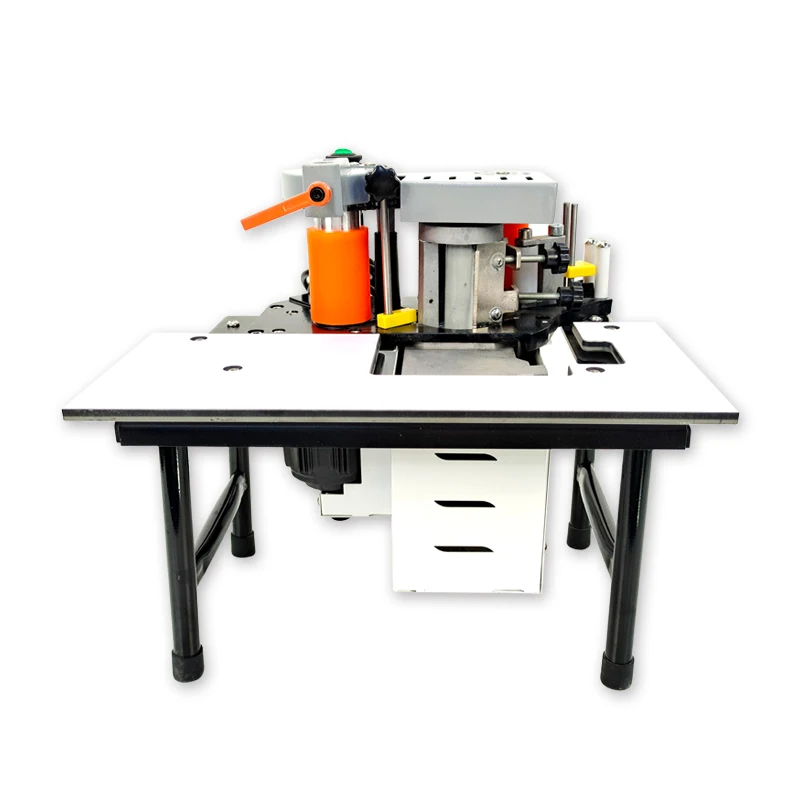
Customizable Voltage and Control Interfaces — Every ST-30 portable edge banding machine ships with confirmed electrical schematics and language settings matched to the buyer's local supply and operator requirements.
Technical Specifications
| Parameter |
Value |
| Model |
ST-30 |
| Product Type |
Portable Edge Banding Machine |
| Rated Power |
1000 W (total) |
| Voltage & Frequency |
220V / 380V / customizable |
| Overall Dimensions (L×W×H) |
38 × 35 × 35 cm |
| Net Weight |
12 kg |
| Minimum Sheet Length |
25 cm |
| Minimum Sheet Width |
3 cm |
| Edge Banding Height Range |
0–50 mm |
| Edge Banding Thickness Range |
0.3–3 mm |
| Glue Pot Capacity |
1000 ml |
| Air Supply Requirement |
0.5–0.8 MPa |
| Edge Types |
Straight and curved |
| Control System |
Manual operation |
| Plug Options |
EU, USA, AU, UK |
| Language Options |
Chinese, English (other languages customizable) |
| Compatible Edge Materials |
ABS, PVC, Melamine, Veneer |
| Assembly State |
Portable, single-unit |
Application Suitability
| Application |
Material or Output |
| Custom cabinet edge finishing |
MDF and particleboard panels with PVC or ABS edging |
| On-site interior installation |
Plywood and blockboard cut to field dimensions, melamine tape |
| Small-batch curved furniture components |
Shaped solid wood and MDF panels with veneer banding |
| Prototype and sample production |
Mixed substrates for design validation runs |
| Repair and rework of damaged edges |
Replacement banding on installed furniture and joinery |
Why Voltage Must Be Confirmed Before Portable Edge Bander Specifications Are Finalized
A portable edge banding machine that arrives with the wrong voltage is dead weight on the workshop floor until a transformer shows up.
I once watched a Chilean workshop sit idle for three weeks because a 380V motor was shipped to a site running 440V three-phase. The entire production line stalled while a step-down transformer was sourced locally. That delay cost more than the machine itself in missed delivery penalties. When evaluating portable edge banding machine specifications how to choose the right electrical configuration should be the first question, not an afterthought at the packing stage [NEED_CITE: voltage and frequency standards by export market].
The ST-30 is available with voltage configurable from 220V to 380V, but the exact local supply — including frequency at 50 Hz or 60 Hz — must be specified at the order stage so the motor winding and control circuit are matched before the unit leaves the factory.
Matching the Working Envelope to Your Actual Panels
The ST-30 handles a minimum sheet length of 25 cm and minimum width of 3 cm, which covers most cabinet component offcuts and narrow drawer fronts that larger automatic edge banders cannot grip. When reviewing portable edge banding machine specifications how to choose between models often comes down to whether the minimum workpiece dimensions match the smallest panel your workshop processes regularly.
Edge banding height spans 0–50 mm, accommodating standard panel thicknesses used in furniture and interior fit-out work. The 0.3–3 mm tape thickness range covers PVC, ABS, melamine paper, and real wood veneer — the four materials most small workshops rotate through on a weekly basis.
Straight and Curved Edges Without a Second Machine
Most entry-level edge banders handle only straight edges, forcing workshops to buy a separate curved-edge unit or return to hand application for shaped panels. The ST-30 processes both geometries from one portable chassis, which matters for custom furniture makers who produce curved cabinet doors, rounded shelf ends, and organic-shaped tabletops in the same batch as standard rectangular components.
The 1000 ml glue pot capacity is sized for intermittent runs rather than continuous production shifts, aligning with how small workshops actually use a portable unit — short runs of five to twenty panels, then a move to the next task. This is where portable edge banding machine specifications how to choose the right capacity becomes a practical question rather than a theoretical one [NEED_CITE: CE machinery directive requirements for small woodworking equipment].
Reading the Numbers That Actually Matter
The 12 kg net weight and 38 × 35 × 35 cm footprint place the ST-30 on a standard workbench without requiring dedicated floor space or structural reinforcement. For on-site interior installers, this means the unit travels in a vehicle and operates wherever the panels are being cut, eliminating the back-and-forth to a fixed workshop.
The 0.5–0.8 MPa air supply requirement is compatible with standard small workshop compressors, though buyers should verify their existing compressor can sustain this pressure range continuously during edge banding cycles. An undersized compressor causes intermittent pressure drops that affect glue application consistency and trimming quality.
Edge banding thickness from 0.3 mm melamine paper up to 3 mm ABS covers the full material spectrum a custom furniture shop encounters, from budget cabinet carcasses to premium exposed panels where thicker ABS hides substrate edges more effectively.

The Hidden Cost of Skipping Specification Verification
Workshops that order a portable unit without confirming minimum sheet dimensions often discover their narrowest drawer sides fall below the machine's minimum width, leaving those pieces to be banded by hand anyway. The inconsistency between machine-finished and hand-finished edges shows up clearly under LED lighting in installed kitchens.
Similarly, buying a machine rated for straight edges only, then encountering curved panels mid-project, forces a choice between improvised hand banding and an emergency equipment purchase at full retail pricing [NEED_CITE: common procurement errors in small woodworking machinery].
Voltage mismatches are the most expensive oversight: the machine is physically present but electrically unusable, and return shipping for rewinding or replacement often exceeds the unit cost.
What You Get When You Source Through This Channel
Engineers review your panel sizes, edge materials, and local electrical supply before issuing a formal quotation within 24 hours, ensuring the portable edge banding machine specifications how to choose align with your actual production requirements rather than a generic catalog listing.
Voltage, frequency, plug type, and control panel language are confirmed in writing before production begins — not discovered at the commissioning stage. The ST-30 ships with a factory test record run on panel material matching your stated thickness range.
Four-stage quality control covers incoming material inspection, in-process assembly checks, finished product testing, and pre-shipment verification. Documentation includes electrical schematics, an operation manual in the agreed language, and a spare parts list with part numbers for direct reorder.
Documentation & Verification
- Machine specification sheet confirming all ST-30 parameters against your stated requirements
- Electrical schematic with voltage and frequency confirmation matching your local supply
- Factory test record on your specified panel thickness and edge material before dispatch
- Operation and maintenance manual provided in your agreed language
- Spare parts list with individual part numbers for direct reorder
Installation, Commissioning & Support
- Bench-top placement requires a stable surface supporting at least 12 kg plus workpiece weight
- Single-phase 220V models connect to a dedicated 10A circuit separate from other machinery
- Air compressor must sustain 0.5–0.8 MPa continuously during banding cycles
- First-run glue temperature and feed pressure calibrated to your specified edge material
- Operator training covers straight and curved edge setup, glue pot refilling, and trimming adjustment
- Spare glue rollers and trimming blades listed for initial inventory stocking
Before You Request a Quote
Send your most common panel dimensions, the edge banding materials you use most frequently, and your workshop's confirmed voltage and frequency. If you run both straight and curved edges, indicate the approximate ratio so the engineer can assess whether the ST-30's capacity matches your workflow or whether a higher-tier model better fits your throughput.
Frequently Asked Questions
Q: How do I confirm the ST-30 handles my smallest panel sizes?
A: The minimum sheet length is 25 cm and minimum width is 3 cm. Measure the narrowest and shortest components in your regular production. If any pieces fall below these dimensions, they will still require hand banding. Request a sample processing test with your actual offcuts to verify feed stability and edge finish quality before placing a production order.
Q: What electrical details must I provide at the order stage?
A: Supply your exact local voltage, phase configuration, and frequency — for example, 220V single-phase 60Hz or 380V three-phase 50Hz. Also specify the plug type needed at your site. These details are confirmed on the electrical schematic before production so the motor and control circuit match your supply upon arrival.
Q: Can the ST-30 apply veneer edge banding on curved panels?
A: Yes. The machine handles veneer within the 0.3–3 mm thickness range on both straight and curved edges. Veneer requires careful glue temperature control to prevent cracking during application. Specify the veneer species and backing type when ordering so the factory can pre-set the glue pot temperature and verify adhesion during the pre-shipment test.
Q: When should I consider a full automatic edge bander instead?
A: If your daily volume involves hundreds of linear meters of edging across identical panel sizes, a portable unit becomes a bottleneck. The ST-30 suits small batches, custom one-off panels, on-site work, and workshops transitioning from hand banding. For high-volume repetitive production with tight tolerance requirements across every piece, an automatic inline machine is the appropriate choice.
Q: Is the operation manual available in Spanish or French?
A: Yes. The standard language options are Chinese and English, but the control panel labels and the operation and maintenance manual can be produced in Spanish, French, or other languages specified at the order stage. Confirm the required language during the quotation process to ensure all documentation arrives ready for your operators on day one.