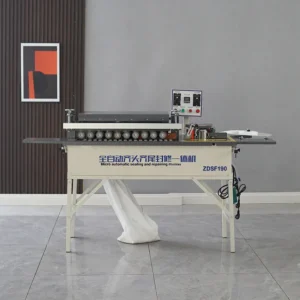
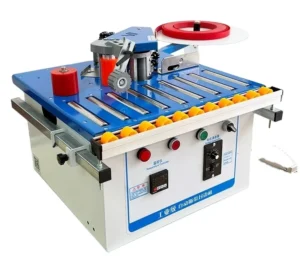
Verified Tolerance on Every Spec Sheet — ZDS-280 automatic edge banding machine parameters are listed with measurable values and testing conditions, not marketing approximations, so technical buyers can evaluate fit before committing to an order.
Technical Specifications
| Parameter |
Value |
| Model |
ZDS-280 |
| Product Type |
Automatic Straight Edge Banding Machine |
| Main Functions |
Gluing, End Trimming, Fine Trimming, Scraping, Cleaning, Buffing |
| Conveyor Belt Speed |
9–12 m/min |
| Total Power |
9 kW |
| Voltage |
380V / 3-Phase |
| Working Pressure |
0.65 MPa |
| Panel Thickness Range |
10–60 mm |
| Edge Thickness Range |
0.3–3 mm |
| Min. Panel Width |
60 mm |
| Min. Panel Length |
120 mm |
| Weight |
860 kg |
| Overall Dimensions (L×W×H) |
3000 × 750 × 1270 mm |
| Control System |
Taiwan Delta PLC, Touch Screen, Frequency Converter |
| Electrical Components |
Schneider Electric Contactors |
| Motor Type |
UFC High Speed Motor |
| Buffing Motor |
0.37 kW × 2 |
| Glue Pot Design |
Teflon spraying process with scientific glue back design |
| Pressing System |
Pneumatic double-wheel adjustable stroke |
| End Trimming System |
Air pressure balance device |
| Assembly State |
Fully assembled |
| Warranty |
1 year |
| Certification |
CE (referenced in company profile — verify model-specific declaration), ISO 9001 |
Application Suitability
| Application |
Material or Output |
| Custom furniture and cabinet panel edge banding |
MDF, particleboard, plywood substrates |
| PVC edge banding processing |
0.3–3 mm PVC edge banding material |
| Veneer edge banding processing |
Natural and engineered wood veneer strips |
| Small to mid-scale panel processing workshops |
Straight edge finishing for batch production runs |
| Furniture factories upgrading from manual to automated edge banding |
Replacing hand-held trimmers and manual glue application |
Why the Voltage Question Should Come Before the Price
Confirming local voltage and frequency compatibility before signing a contract prevents the most expensive type of machine failure — the one that happens on day one.
I have watched a 440V/60Hz contract go to a workshop running 400V/50Hz, and the main motor burned out before the first panel cleared the conveyor. With the ZDS-280 edge banding machine specifications listing 380V/3-phase, buyers in markets with 415V, 400V, or 220V industrial supplies need to confirm whether a transformer or motor rewinding is required [NEED_CITE: voltage and frequency standards by export market]. A specification sheet that states a single voltage figure without confirming frequency compatibility leaves the buyer holding the risk. This machine's 9 kW total power draw also means the workshop panel must have a dedicated circuit rated for continuous industrial load, not a shared line feeding multiple machines.

Mapping Feed Speed to Daily Throughput
The ZDS-280 runs at 9–12 m/min conveyor belt speed, which defines the upper boundary of edge length processed per shift. At the lower end of this range, the machine handles shorter panels and tighter batch changeovers typical of custom furniture orders. At the upper end, it suits longer runs of standardized cabinet panels where feed continuity is maintained. Technical buyers comparing ZDS-280 edge banding machine specifications against workshop targets should factor in loading and unloading time between panels, which reduces effective throughput below the raw feed speed figure.
Six-Station Configuration and What Each Station Delivers
The gluing, end trimming, fine trimming, scraping, cleaning, and buffing sequence covers the complete edge banding process chain for straight edges. End trimming with an air pressure balance device maintains consistent cut depth across panel thickness variations within the 10–60 mm range. Fine trimming removes the residual edge overhang left after end trimming. Scraping eliminates the fine ripple marks from the trimming cutters, and buffing restores surface finish on PVC and veneer edges [NEED_CITE: edge banding station functions and surface quality standards]. Buyers processing high-gloss PVC should verify whether the buffing stations produce the required surface clarity or whether an additional polishing unit is necessary.
Reading the Numbers That Matter for Installation
The 3000 × 750 × 1270 mm footprint and 860 kg weight set the baseline for workshop planning. The 750 mm width is narrow enough to position against a wall or in a line of machines, but operators need clearance on both sides for panel feeding and retrieval. The 9 kW total power requirement at 380V/3-phase demands a dedicated breaker and properly sized cable run from the workshop distribution board. Taiwan Delta PLC control with touch screen interface means parameter adjustments — feed speed, glue temperature, trimming depth — are made through the HMI rather than manual dials, reducing setup error when switching between panel thicknesses within the 10–60 mm range. The pneumatic pressing system requires a stable 0.65 MPa air supply, so the workshop compressor must be sized to sustain that pressure across the double-wheel adjustable stroke mechanism without dropping during continuous operation.
What Happens When Specifications Are Ignored at Purchase
A machine quoted without confirming local voltage arrives and the motor will not start, or worse, starts and burns within hours. Control panels delivered in a language the operator cannot read stall commissioning for weeks while translated documentation is sourced. Edge banding quality that looks acceptable on MDF may show visible glue lines on plywood if the glue pot temperature and pressing pressure were not matched to the substrate [NEED_CITE: substrate-specific edge banding adhesion requirements]. Buyers who skip the specification confirmation step often discover these mismatches after the machine is crated, shipped, and installed — when the cost of correction has already multiplied several times over.
Why This Machine Is Built for Specification-Led Procurement
In-house manufacturing with a patented cutting mechanism means the tolerance values stated on the ZDS-280 specification sheet are derived from the actual production tooling, not borrowed from a generic catalog. Voltage configuration available from 110V to 440V allows the machine to be built to the buyer's confirmed supply before it leaves the factory. The four-stage quality control process — incoming material, in-process, finished product, and pre-shipment verification — includes a factory test record run on actual panel stock. Engineer-led configuration recommendation means the formal quotation specifies the exact motor winding, transformer ratio, and HMI language rather than leaving these as assumptions. A one-year warranty covers the core mechanical and electrical assemblies against manufacturing defects.
Documentation & Verification
- CE declaration of conformity covering the ZDS-280 mechanical and electrical safety requirements
- Electrical schematic confirming the 380V/3-phase wiring and Schneider contactor layout
- Factory test record showing edge banding results on your specified panel thickness range
- Operation and maintenance manual in the agreed language for the Delta PLC touch screen interface
- Spare parts list identifying consumable cutters, buffing wheels, and glue pot components
Installation, Commissioning & Support
- Floor must support 860 kg static load across the 3000 × 750 mm machine footprint with leveling clearance
- Dedicated 380V/3-phase circuit with breaker rated for 9 kW continuous draw required at the installation point
- Machine ships fully assembled; position, level, connect power and 0.65 MPa air supply before first run
- Delta PLC touch screen parameter setup includes feed speed calibration, glue temperature, and trimming depth for your panel range
- First-batch test run with your actual MDF, particleboard, or plywood panels to verify edge quality across all six stations
- Spare cutter and buffing wheel inventory sized to your monthly production volume and edge thickness range
What to Include in Your Technical Inquiry
Provide your panel substrate types, thickness range within the 10–60 mm envelope, and the edge banding material you run most frequently. Confirm your workshop supply voltage and frequency with a photo of the distribution board nameplate. State the HMI language your operators require and whether your existing compressor can sustain 0.65 MPa continuously. If you are replacing a manual process or integrating into an existing line, share the upstream and downstream equipment so the feed height and conveyor direction can be matched.
Frequently Asked Questions
Q: How do I verify the ZDS-280 voltage matches my workshop supply?
A: Send a photo of your workshop distribution board nameplate showing voltage, phase, and frequency. The standard specification lists 380V/3-phase, but the motor and transformer can be configured to match your actual supply before production. Shipping a machine with mismatched voltage is a preventable failure that we avoid by confirming electrical compatibility at the quotation stage.
Q: Can the six stations handle high-gloss PVC edge banding without surface marks?
A: The scraping and buffing stations are designed to remove trimming ripples and restore surface finish on PVC edges. For high-gloss materials, the buffing motor output and wheel compound should be tested on your specific edge banding stock. Request a sample processing test using your PVC material before finalizing the order to confirm the surface quality meets your standard.
Q: What panel dimensions define the minimum and maximum working range?
A: The ZDS-280 processes panels from 60 mm minimum width and 120 mm minimum length, with thickness from 10 to 60 mm. Edge banding thickness ranges from 0.3 to 3 mm. Panels smaller than the minimum dimensions cannot be fed reliably through the pneumatic pressing system. Confirm your smallest panel size falls within these boundaries before selecting this model.
Q: Does the Delta PLC touch screen support multiple operator languages?
A: The Delta PLC HMI can be configured with the operator language you specify at the time of order. Confirming this before production ensures the machine arrives with menus, alarms, and parameter labels your team can read. Language changes after delivery may require a technician visit or remote software update depending on the HMI firmware version.
Q: What are the floor and utility requirements for installation?
A: The machine weighs 860 kg and measures 3000 × 750 × 1270 mm, requiring a level concrete floor that can sustain this static load. A dedicated 380V/3-phase electrical circuit rated for 9 kW and a compressed air supply maintaining 0.65 MPa are required at the installation point. Allow operator clearance on both sides of the machine for panel feeding and edge retrieval.


![` 标签,因为回答本身就是最终内容。 * 使用标准连字符 `-` 代替 en dash `–` 以防编码问题,或者直接使用 `-`。 * `Automatic Wood Panel Edge Banding Machine - Specifications` (57 chars) * 再确认一下结构3: `[应用或物料] [品类词] – [站点修饰词]` * Wood Panel (应用或物料) Edge Banding Machine (品类词) - (分隔) Specifications (站点修饰词) * 完美。](https://ruiqiwoodmachine.com/wp-content/uploads/2026/05/H40e3bbcdfadb464da23e3e88c6ee3d0dB-1-300x300.webp)