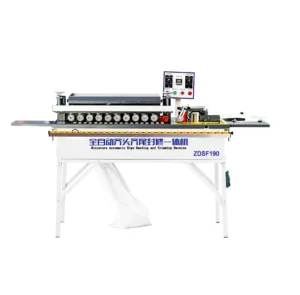
In-House Precision Manufacturing — The ZDS280D fuselage is machined from 14 mm national standard high-strength steel plate and subjected to high-temperature quenching, ensuring structural rigidity that holds tolerance under sustained feed loads rather than relying on catalog claims alone.
Technical Specifications
| Parameter |
Value |
| Model |
ZDS280D |
| Product Type |
Automatic Edge Banding Machine |
| Main Functions |
Gluing, End Trimming, Fine Trimming, Scraping, Buffing |
| Panel Thickness Range |
10–55 mm |
| Edge Thickness Range |
0.4–3 mm |
| Conveyor Belt Speed (Feed Speed) |
15 m/min |
| Min. Panel Width |
60 mm |
| Min. Panel Length |
150 mm |
| Working Pressure |
0.6–0.8 MPa |
| Voltage & Frequency |
380V-3HP (frequency to be confirmed for destination market) |
| Rated Power |
7.5 kW |
| Net Weight |
700 kg |
| Overall Dimensions (L×W×H) |
3100×700×1400 mm |
| Control System |
Delixi/Chint air switches and contactors; Japanese Omron travel switches |
| Pneumatic System |
German Festo or Taiwan AirTAC cylinder and safety valve; AirTAC magnetic switch |
| Head Guide Rail |
Taiwan brand |
| Conveyor Belt Guide Rail Material |
HT260 |
| Conveying Motor |
Customized Taiwan brand with thermal protection system |
| Fuselage Construction |
14 mm national standard high-strength steel plate, frame-type structure, high-temperature quenching treatment |
| Warranty |
1 year |
| Delivery Time |
25–30 days (basis to be confirmed by model variant and order quantity) |
Application Suitability
| Application |
Material or Output |
| Custom furniture panel edging |
MDF and particleboard with PVC edge banding |
| Cabinet door and carcass production |
Plywood panels with veneer or PVC strips |
| Small to mid-volume workshop output |
Solid wood panels up to 55 mm thickness |
| Office furniture and shelving fabrication |
Particleboard substrates with 0.4–3 mm edge material |
Why Voltage Confirmation Must Precede Every Automatic Edge Banding Machine Specification Sheet
A machine wired for the wrong frequency will run — until the motor overheats on the first full production shift.
I watched a buyer in the Middle East receive a 380V edge bander that was technically the correct voltage but mismatched on frequency. The conveyor motor ran hotter than expected from day one, and the thermal protection tripped twice during the first week. The factory replaced the motor at their own cost, but two weeks of stoppages had already pushed their delivery schedule into penalty territory. When evaluating Automatic Edge Banding Machine specifications, electrical compatibility is the single most overlooked line item because it does not appear on any performance comparison chart [NEED_CITE: voltage and frequency standards by export market].

How the ZDS280D Stations Map to Real Edge Quality
The ZDS280D routes each panel through five sequential stations — gluing, end trimming, fine trimming, scraping, and buffing — completing a full edge cycle in a single pass. This sequence matters because skipping any intermediate station forces the operator to compensate manually downstream, which introduces inconsistency across batches. For a workshop producing cabinet components where every edge must seat flush against an adjoining panel, the scraping and buffing stages remove the micro-ridges that fine trimming alone leaves behind. Buyers comparing Automatic Edge Banding Machine specifications should check whether every station is included in the base configuration or offered as an add-on module.
Structural Rigidity and What It Means for Tolerance Retention
The fuselage is built from 14 mm high-strength steel plate in a frame-type structure, then subjected to high-temperature quenching treatment. This process relieves internal stresses that would otherwise cause the frame to warp gradually under continuous vibration and thermal cycling. A warped fuselage shifts the trimming head alignment by fractions of a millimeter — invisible on a single panel but compounding across a production run until panels fail assembly. The HT260 conveyor belt guide rail paired with a thermal-protected Taiwan conveying motor maintains a steady 15 m/min feed without drift, which is the baseline condition for any trimming station to hold its set tolerance [NEED_CITE: effect of fuselage rigidity on edge trimming accuracy in woodworking machinery].
Reading the Specifications That Actually Determine Edge Finish
The panel thickness range of 10–55 mm covers the full spectrum from thin shelving stock to heavy solid-wood worktops, meaning the feed mechanism and pressure beam must accommodate significant variation without losing grip or crushing softer substrates. The edge thickness range of 0.4–3 mm allows the same machine to handle thin PVC foil for carcass components and thicker veneer strips for visible door edges, though glue pot temperature and feed speed require adjustment between material changes. The 0.6–0.8 MPa working pressure requirement means the workshop compressor must deliver clean, dry air consistently — fluctuating pressure causes the pneumatic cylinders to hesitate at trimming stations, leaving chatter marks on the edge. The Omron travel switches control station activation timing, and their repeatability directly affects where each trimming cut begins and ends along the panel edge. Buyers who focus only on feed speed often discover that the pneumatic supply and switch quality are the real determinants of consistent output.
The Cost of Skipping a Material Test Before Configuration
I once configured an edge bander for a customer processing PVC onto MDF without requesting a sample of their actual board stock. The MDF density was lower than the standard test material, and the glue penetration was excessive, leaving visible squeeze-out along the edge line. The customer received the machine, ran their first batch, and had to reject an entire production lot of cabinet sides. Every Automatic Edge Banding Machine specification sheet should be validated against the buyer's specific substrate and edge material combination before the order is finalized — catalog tolerance values assume ideal conditions that rarely match the workshop floor [NEED_CITE: MDF density variation and its effect on glue adhesion in edge banding].
Why Technical Buyers Source This Model Here
The ZDS280D is manufactured in-house with a patented cutting mechanism, not assembled from third-party sub-assemblies, so tolerance claims trace back to verifiable production records. The five-station configuration is complete within the base model — gluing through buffing — so there is no hidden cost for stations that competitors list as optional. Voltage, control panel language, and specification adjustments are confirmed during the quotation stage rather than discovered after arrival. Every unit passes through four-stage quality control covering incoming material, in-process assembly, finished product testing, and pre-shipment verification with documented results. An engineer reviews the buyer's production requirements and delivers a formal configuration proposal within 24 hours, ensuring the machine matches the workshop's actual throughput and substrate mix.
Documentation & Verification
- CE declaration of conformity verified for the ZDS280D model specifically, not only at company level
- Machine specification sheet listing measured trimming values on buyer-supplied panel samples
- Electrical schematic confirming 380V-3HP wiring and component ratings before shipment
- Factory test record documenting feed stability and edge finish quality on agreed substrates
- Operation and maintenance manual produced in the buyer's required language
- Spare parts list identifying wear items with part numbers for reordering
Installation, Commissioning & Support
- The 3100×700×1400 mm footprint requires a clear floor area with level concrete and clearance for panel infeed
- A dedicated 380V circuit rated for the 7.5 kW load with proper earthing must be installed before delivery
- Partially assembled on arrival — guide rails, trimming heads, and conveyor sections require on-site alignment per manual
- First-run commissioning includes verifying 0.6–0.8 MPa air supply stability and calibrating Omron travel switch positions
- Thermal protection on the Taiwan conveying motor is tested under load to confirm trip settings match production feed rates
- Spare trimming blades and scraper inserts are identified in the parts list for routine replacement cycles
Before You Request a Quotation
Share your primary panel substrate, typical thickness range, and the edge material you run most often — PVC, ABS, or veneer — so the glue pot and trimming tooling can be specified correctly. Confirm your local voltage and frequency, the available compressed air capacity, and whether your existing conveyor or feeding equipment needs to interface with the ZDS280D infeed height. If you are evaluating this machine as part of a larger line, indicate your current and target daily throughput so the engineer can confirm whether 15 m/min feed speed aligns with upstream and downstream stations.
Frequently Asked Questions
Q: How can I verify the actual edge trimming tolerance before committing to the ZDS280D?
A: Request a factory test record run on your own panel samples, not generic catalog data. The pre-shipment verification includes measured trimming values and edge finish photographs taken under production-equivalent feed conditions. You may also arrange a factory visit to witness a live test on your substrate and edge material combination before the machine is crated.
Q: Is the 380V-3HP configuration compatible with my local power supply?
A: The listed voltage must be confirmed alongside your local frequency — 50 Hz or 60 Hz — because motor winding and speed characteristics differ between the two. The manufacturer configures the electrical system and control components to match your grid specification before assembly. Always provide a copy of your local supply standard during the quotation stage to avoid field rewiring.
Q: Which edge materials and substrates do the five trimming stations handle effectively?
A: The station sequence covers PVC, ABS, and veneer edge banding on MDF, particleboard, plywood, and solid wood panels within the 10–55 mm thickness range. Glue pot temperature and feed speed are adjusted based on the specific material pairing. Confirm your most common combination so the tooling profile and scraping blade geometry are set accordingly before dispatch.
Q: What workshop preparations are needed before the ZDS280D arrives?
A: Ensure a level concrete floor area accommodating the 3100×700×1400 mm footprint with infeed clearance, a dedicated 380V electrical circuit rated for 7.5 kW, and a compressed air supply delivering stable 0.6–0.8 MPa. The machine arrives partially assembled, so plan for on-site alignment of guide rails and trimming heads using the provided manual and video guidance.