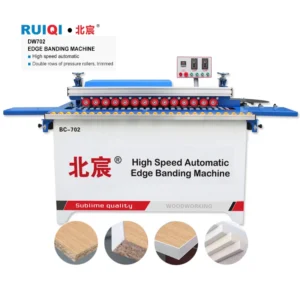
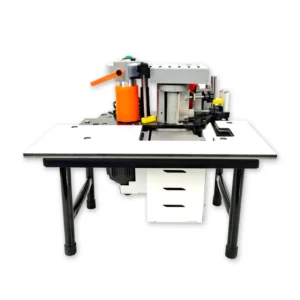
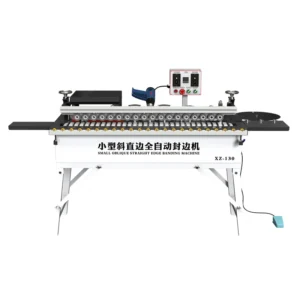
Verified Tolerance & Voltage Matching — DW602 edge banding parameters confirmed against panel substrate before order, avoiding post-delivery electrical incompatibility that stalls commissioning for weeks.
Technical Specifications
| Parameter |
Value |
| Model |
DW602 |
| Product Type |
Automatic Edge Banding Machine |
| Total Power |
3800W |
| Voltage |
220V / 380V (customization available) |
| Control System |
PLC |
| Standard Functions |
Edge banding, trimming, polishing, automatic head and tail cutting, vacuum hold-down |
| Edge Power |
20W |
| Trimming Power |
650W × 2 |
| Polishing Power |
180W × 2 |
| Vacuum Power |
1200W |
| Transmission Power |
60W |
| Air Source Pressure |
0.5–0.8 MPa |
| Glue Pot Capacity |
1000 ml |
| Edge Banding Height |
0–50 mm |
| Edge Banding Thickness |
0.3–3 mm |
| Minimum Sheet Length |
25 cm |
| Minimum Sheet Width |
5 cm |
| Overall Dimensions (L×W×H) |
128 × 47 × 69 cm |
| Net Weight |
90 kg |
| Assembly State |
Fully assembled |
Application Suitability
| Application |
Material or Output |
| Cabinet door edge finishing |
MDF and particleboard with PVC or melamine strips |
| Small-part custom furniture |
Plywood panels down to 25 cm length |
| Polymer door production |
Polymer substrates with thin veneer or PVC banding |
| Workshop transition setup |
Mixed panel runs in joinery shops moving from manual to automated edging |
Why Voltage Confirmation Must Precede the Order
Matching local frequency to the control cabinet transformer is non-negotiable for any automatic edge banding machine specifications review.
I have seen workshops lose weeks of production because a PLC would not initialize on an unverified 60Hz supply when the machine was configured for 50Hz. The DW602 operates on a PLC control system that expects a precise transformer match; when the input voltage or frequency is off, the entire logic sequence fails to boot. This is not a blown fuse situation — the operator simply stares at a dark screen while the installation schedule collapses [NEED_CITE: voltage and frequency standards by export market]. Technical buyers need to verify this before the machine leaves the factory floor, not after it arrives at the dock.

Power Distribution Across Processing Stations
The 3800W total power allocation reveals how the DW602 divides energy across its automatic edge banding machine specifications profile. The dual trimming motors draw 650W each, accounting for over a third of total consumption, which indicates substantial cutting force reserved for flush-trimming operations on thicker banding materials. The polishing stations at 180W × 2 follow downstream, while the 1200W vacuum system runs continuously to maintain panel registration on the conveyor bed. This distribution pattern tells a technical buyer that the machine prioritizes trimming aggression and workpiece stability over high feed speed.
Compact Footprint and Small-Part Processing Limits
At 128 cm in length with a 90 kg net weight, this unit targets workshops where floor space constrains equipment layout. The minimum sheet dimensions — 25 cm length and 5 cm width — define the lower boundary for production runs. Cabinet makers producing narrow drawer fronts or small shelving components can reference these limits against their typical part lists. The 0–50 mm edge banding height range and 0.3–3 mm thickness acceptance cover standard PVC, ABS, and veneer profiles without requiring tooling changes between common furniture applications [NEED_CITE: edge banding material thickness standards for panel furniture].
Interpreting the Specification Sheet for Production Planning
The air source pressure requirement of 0.5–0.8 MPa establishes the compressor specification that must exist upstream of the machine — undersized air supply causes inconsistent cylinder actuation during head and tail cutting, producing ragged ends on the banding strip. The 1000 ml glue pot capacity limits continuous runtime on thick 3 mm edge banding before refill is needed; production managers running full shifts should calculate glue consumption rate against this reservoir volume. The PLC control system requires confirmation of brand and model for spare part sourcing, and the control language must be specified at order time to match operator literacy. Edge banding height at 0–50 mm and thickness at 0.3–3 mm together define the profile envelope — buyers processing oversized solid wood lipping beyond 50 mm height must look at a larger machine class. Feed speed and panel thickness range remain unconfirmed in the available documentation and must be requested directly before comparing throughput against upstream panel saws.
The Cost of Skipping Specification Verification
Machines quoted without confirming local voltage and frequency arrive at the customer site and simply cannot power on, requiring transformer replacement that delays production by weeks. Control panels delivered in a language the operator cannot read force the factory to halt commissioning and wait for translated documentation or remote support. Tolerance claims that cannot be verified against the buyer's specific panel material result in assemblies that fail during furniture construction, with edge gaps visible after the trimming pass [NEED_CITE: panel edge tolerance requirements for cabinet assembly]. These are not minor inconveniences — they represent lost contract deadlines and strained customer relationships.
Why Technical Buyers Source This Configuration
In-house manufacturing with proprietary cutting mechanisms allows tolerance claims to be traced back to verifiable machining processes rather than third-party assembly. Voltage customization from 220V to 380V with plug options across EU, USA, AU, and UK standards means the electrical cabinet is configured before dispatch, not improvised on-site. Four-stage quality control with pre-shipment verification generates factory test records that document performance on the buyer's specified panel material before the machine is crated. Engineer-led configuration recommendations arrive within 24 hours of inquiry, addressing feed speed matching and upstream compatibility questions that prevent line bottleneck issues. The complete product family — from entry-level to full-function — allows a workshop to scale capacity without changing suppliers or retraining operators on unfamiliar interfaces.
Documentation & Verification
- CE declaration of conformity referencing machinery directive compliance for edge processing equipment
- Machine specification sheet with confirmed feed speed and panel thickness range before order placement
- Electrical schematic showing transformer configuration matched to buyer's local voltage and frequency
- Factory test record documenting edge quality on buyer's submitted panel sample before dispatch
- Operation and maintenance manual in the agreed language for shop floor reference
Installation, Commissioning & Support
- Dedicated circuit required for 3800W total draw with appropriate breaker sizing for continuous duty
- Air supply line delivering 0.5–0.8 MPa must be plumbed before commissioning to prevent cylinder stall
- Machine arrives fully assembled at 128 × 47 × 69 cm requiring only conveyor belt tensioning and glue pot charge
- PLC parameter setup during first power-on must verify language selection and trimming depth offsets
- Spare trimming cutters and polishing wheels should be stocked based on daily banding volume to avoid downtime
Inquiry Preparation for Technical Evaluation
Provide your panel material type, typical sheet dimensions, and edge banding profile specifications so the engineering team can confirm whether the 0.3–3 mm thickness range and 0–50 mm height envelope match your production requirements. Specify your facility voltage, frequency, and plug standard to ensure the electrical cabinet is configured correctly before shipment. If you operate upstream panel saws or downstream boring machines, share their cycle times so feed speed compatibility can be assessed against your line throughput targets.
Frequently Asked Questions
Q: How can I verify the edge banding tolerance on my specific panel material?
A: Request a factory test record that documents trimming and polishing results on a sample of your actual panel substrate and thickness. The DW602 can be tested with your supplied material before dispatch, generating measurable edge gap and flush data that confirms whether the claimed precision translates to your production environment. This eliminates guesswork during commissioning and establishes a baseline for ongoing quality checks.
Q: What voltage and frequency configuration does my facility need for the DW602?
A: The machine supports 220V and 380V configurations with plug options for EU, USA, AU, and UK markets, but the critical variable is frequency — 50Hz or 60Hz must match your local grid. The PLC control cabinet transformer must be wound for your exact supply; a mismatch prevents system initialization entirely. Confirm these values at order time and request the electrical schematic showing the configured transformer specification.
Q: How does the DW602 feed speed align with my existing production line equipment?
A: Feed speed for this model is not published in standard documentation and must be confirmed through a specification request. Once obtained, compare it against your panel saw cutting cycle and boring machine indexing time to identify whether the DW602 becomes the line constraint or operates with margin. Matching throughput across stations prevents material pile-up between machines.
Q: What panel thickness range does the DW602 accept and how does it affect glue application?
A: The panel thickness range is not stated in available specifications and requires direct confirmation from the engineering team. This value directly affects glue roller pressure settings and pot temperature requirements — thicker panels with heavy banding demand more adhesive volume, which interacts with the 1000 ml glue pot capacity to determine continuous runtime between refills.
Q: Can the control panel language be set to match my operators?
A: The DW602 ships with Chinese and English as standard language options, with other languages available through customization at order time. Specify your operator's preferred language during inquiry so the PLC interface displays all menus, error codes, and parameter fields correctly. This prevents commissioning delays caused by operators unable to navigate the control system during initial setup.