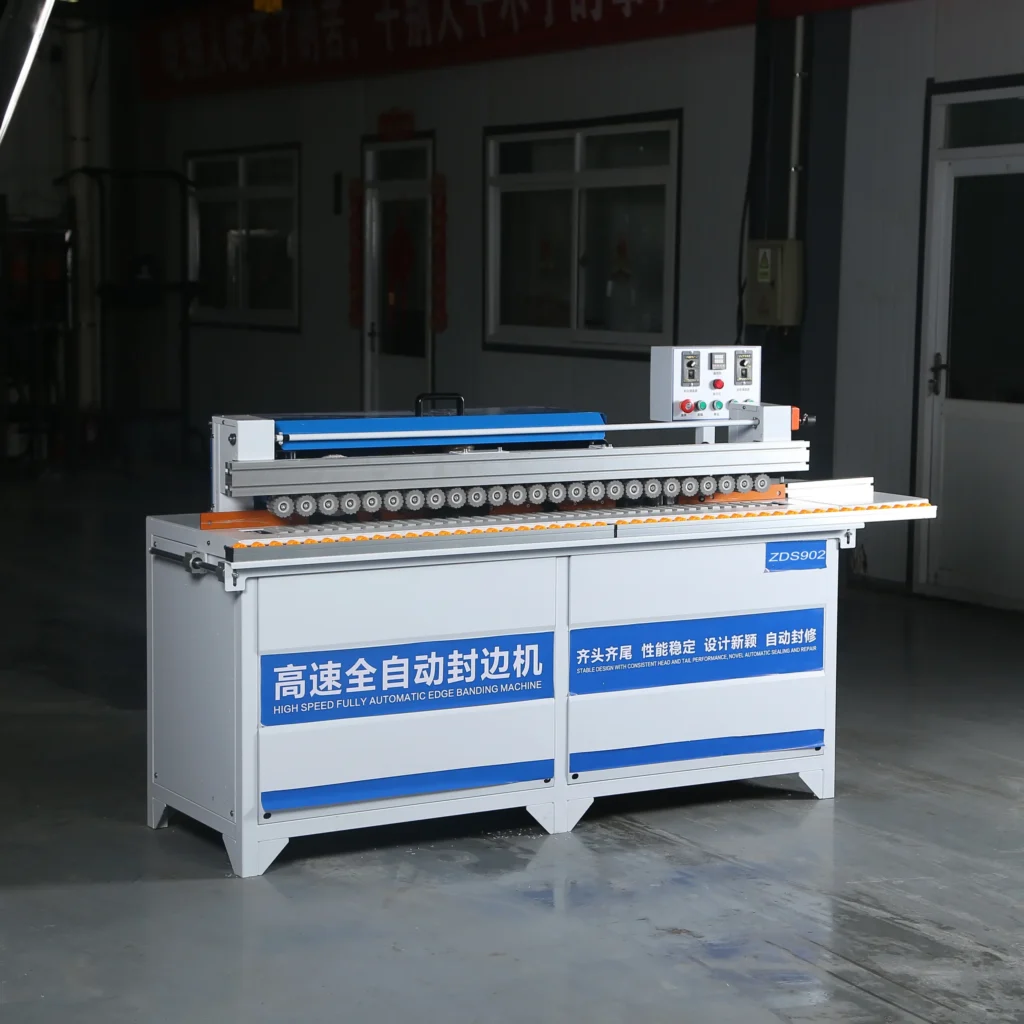
Specification-Led Configuration — every voltage, tolerance, and panel thickness parameter confirmed in writing before this automatic edge banding machine enters production.
Technical Specifications
| Parameter |
Value |
| Product Type |
Automatic Edge Banding Machine |
| Voltage |
220V (frequency and phase to be confirmed for target market) |
| Total Power |
4200W |
| Equipment Size |
207 × 60 × 122 cm |
| Weight |
245 kg (net or gross basis to be confirmed) |
| Edge Banding Type |
Linear Edge Banding Machine |
| Edge Band Height Range |
0–35 mm |
| Edge Band Thickness Range |
0.5–2.5 mm |
| Glue Pot Capacity |
4000 ml |
| Trimming Stations |
Double high-speed trimming motors (up and down) |
| Polishing Stations |
Up and down dual polishing motors |
| Pressure Beam |
Integrated adjustable pressure beam with handle |
| Conveyor Belt |
Silicone material, double rows of pressure wheels |
| Edge Strip Cutting |
Pneumatically controlled cutting device |
| Key Features |
High-speed sealing and repair, double-sided gluing, independent operating platform, intelligent temperature control, polishing and trimming top to bottom |
| Warranty |
One year |
Application Suitability
| Application |
Material or Output |
| Custom cabinet door edge banding |
MDF and particleboard with PVC or ABS edge band |
| Wardrobe panel finishing |
Plywood and melamine-faced board with 0.5–2.5 mm banding |
| Office furniture linear edges |
Particleboard substrates with veneer or melamine strips |
| Small-batch joinery production |
Solid wood panels requiring trimming and polishing in one pass |
| Shelving and storage unit edges |
MDF panels up to 35 mm edge band height |
Why the Language on the Control Panel Matters Before the Price
A control panel in the wrong language halts commissioning on day one.
I spent years on the buying side, sourcing woodworking machinery for European workshops, and the specification sheet always looked complete until the machine arrived. Now, running demos at trade shows across North America and Europe, I have watched technical buyers narrow down an automatic edge banding machine on feed speed and trimming stations, only to discover during installation that the operator interface defaults to a language their floor staff cannot read. The delay is not measured in hours — it stretches into days while firmware packages are sourced and flashed [NEED_CITE: multilingual control panel standards for exported industrial machinery]. Commissioning schedules slip, and the production manager who championed the purchase has to answer for the downtime.
Matching Feed Speed to Your Daily Panel Volume
Feed speed is the single specification that determines whether an automatic edge banding machine keeps pace with your cutting station or becomes the bottleneck. A workshop running nested MDF panels for custom cabinets needs sustained throughput across varying board widths, and the conveyor system must maintain consistent pressure without marking the panel surface. The silicone belt with double-row pressure wheels on this configuration addresses exactly that scenario, keeping boards flat against the fence through the glue application and trimming sequence.
Trimming and Polishing Station Configuration Explained
The trimming stage defines the edge quality your assembly department will receive downstream. This machine carries double high-speed trimming motors operating on both top and bottom edges simultaneously, which means a single pass removes excess banding material from both faces without requiring a second operation. Following that, the dual polishing motors smooth the trimmed edge to a finish suitable for visible cabinet surfaces. For production managers comparing spec sheets, the number of trimming and polishing stations directly correlates with the edge finish grade achievable on PVC and ABS materials [NEED_CITE: edge banding finish quality standards in furniture manufacturing].
How Glue Pot Capacity and Pressure Beam Design Affect Output Continuity

The 4000 ml glue pot capacity allows extended production runs before refill interruption becomes necessary. In a workshop processing batch after batch of wardrobe panels, a smaller pot would force the operator to stop, let the temperature stabilise after topping up, and then resume — introducing inconsistency in glue viscosity across the batch. The integrated pressure beam with an adjustable handle accommodates board height changes without tooling swaps, so switching from 18 mm particleboard to 25 mm MDF shelving stock requires only a handle turn rather than a mechanical recalibration. The pneumatically controlled edge strip cutting device severs the banding material cleanly at the panel end, reducing the manual cleanup that slower machines leave behind.
What Happens When Specifications Are Assumed Rather Than Confirmed
The most costly mistakes in edge banding machine procurement happen in the gaps between what the buyer assumed and what the factory built. A workshop operating on 440V three-phase power receives a machine wired for 220V single-phase, and the local electrician refuses to connect it until a transformer is sourced. An edge band thickness range that tops out below the 3 mm solid wood veneer the joinery uses means the machine simply cannot process their primary material. These are not warranty claims — they are specification mismatches that fall outside any service agreement [NEED_CITE: common causes of commissioning failure in imported woodworking equipment].
Why Technical Buyers Source This Equipment Here
The specification sheet you receive reflects tested parameters, not aspirational numbers pulled from a catalogue. Every automatic edge banding machine leaves the factory with a documented test record run on panel material matching your stated thickness range. Voltage and frequency are confirmed against your local supply standard before the electrical cabinet is wired, and the control panel language is set to your operator's requirement as a line item on the order confirmation. The four-stage quality control process — incoming material, in-process assembly, finished product, and pre-shipment verification — means tolerance and edge finish are checked before packing, not after arrival. Patented cutting mechanisms in the trimming stations maintain the stated precision across the production run, and the configuration recommendation comes from an engineer rather than a catalogue algorithm.
Documentation & Verification
- CE declaration of conformity matching this edge bander configuration
- ISO 9001 certificate covering the manufacturing process
- Machine specification sheet with confirmed voltage and panel thickness range
- Electrical schematic and voltage confirmation document for your facility
- Factory test record run on your specified edge band material before dispatch
- Operation and maintenance manual in your agreed operator language
Installation, Commissioning & Support
- Requires level concrete floor with clearance around the 207 × 60 × 122 cm footprint for material infeed and outfeed
- Dedicated electrical circuit matching confirmed voltage and frequency specification before machine arrival
- Machine ships partially assembled with pressure beam and conveyor belt requiring on-site alignment
- First-run commissioning includes glue temperature calibration to your specific banding material type
- Operator training covers the independent operating platform and intelligent temperature control interface
- Spare parts list includes trimming motor brushes and polishing pads sized to this configuration
Preparing Your Specification Enquiry
To receive an accurate configuration proposal, share your primary panel substrate and thickness range, the edge banding materials you run most frequently, and your local voltage and frequency standard. Specify the control panel language your operators require and whether your upstream cutting station dictates a minimum feed speed. If you have existing dust extraction infrastructure, note the available port size so the connection can be matched at the factory.
Frequently Asked Questions
Q: How can I verify the edge banding tolerance before placing an order?
A: Request a sample processing test using your own panel material and edge band specification. The factory runs your material through the machine, measures the trimmed edge against your tolerance requirement, and ships the finished samples along with a test record. This confirms the trimming stations and pressure beam perform on your actual substrate before production begins.
Q: What voltage and frequency options are available for my market?
A: This automatic edge banding machine supports voltage configurations from 110V to 440V. The exact frequency and phase must match your facility supply, so provide your local electrical standard at the enquiry stage. The factory confirms compatibility in writing and documents it on the electrical schematic before the machine enters assembly.
Q: How do I know if the feed speed suits my production volume?
A: Share your daily panel count and average board dimensions when requesting a quotation. The engineering team maps your throughput requirement against this model's feed speed and determines whether it matches your cutting station output or whether a higher-tier configuration within the same product family better serves your volume.
Q: Which spare parts ship with the machine and how are consumables sourced?
A: A spare parts list accompanies every shipment, typically including trimming motor consumables, polishing pads, and pneumatic seals specific to this configuration. Long-term consumable sourcing is addressed at the order stage, with part numbers and specifications documented so replacements can be ordered directly or through a regional distributor.
Q: What does the four-stage quality control process cover for this machine?
A: Incoming material inspection verifies component specifications before assembly begins. In-process checks confirm alignment of the pressure beam, conveyor, and trimming stations. Finished product testing runs actual panel material through all functions. Pre-shipment verification repeats the full test cycle and generates the factory test record before the machine is packed [NEED_CITE: quality control stages in woodworking machinery manufacturing].