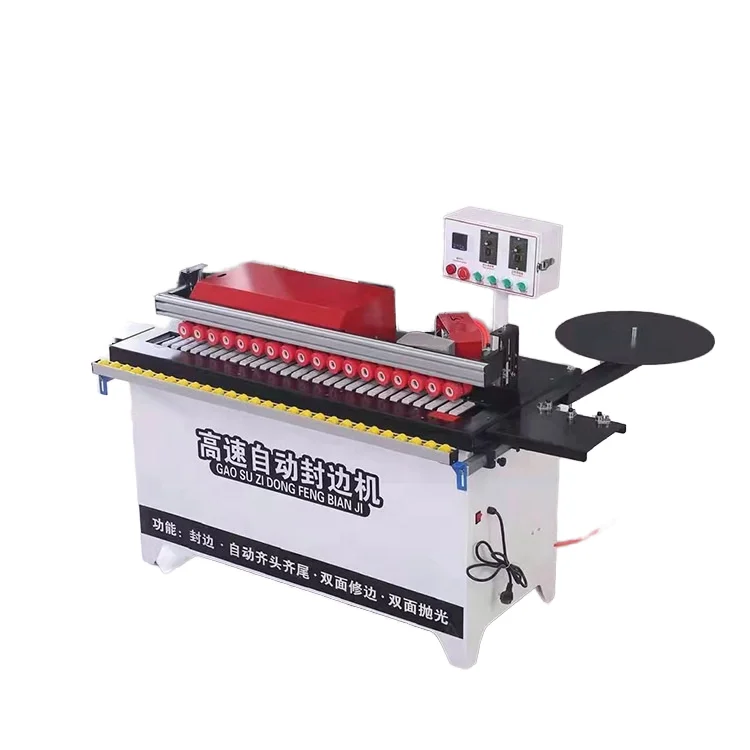
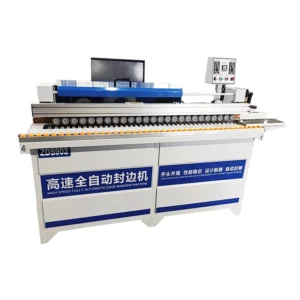
Precision-ground feed mechanics — The ZDSF802 achieves its transport stability through a one-piece integrated pressure beam and double-row pressure wheels, a configuration verified in pre-shipment testing rather than assumed from catalog claims.
Technical Specifications
| Parameter |
Value |
| Model |
ZDSF802 |
| Product Type |
Automatic Edge Banding Machine |
| Function Sequence |
Gluing, End Cutting, Vacuuming, Trimming, Polishing |
| Edge Type |
Straight Line |
| Rated Voltage |
220V (frequency to be confirmed with local supply) |
| Rated Power |
4 kW |
| Trimming Power |
800W × 2 (dual high-speed motors) |
| Polishing Power |
180W × 2 |
| Suction Power |
1200W (built-in vacuum) |
| Heating Power |
1000W (5–10 min heat-up) |
| Strip Thickness Range |
0.6–2.0 mm |
| Sheet Thickness Range |
10–50 mm |
| Feed Speed |
0–10 m/min |
| Glue Pot Capacity |
4000 ml |
| Rated Air Pressure |
0.4–0.6 MPa |
| Overall Dimensions |
190×65×75 cm (verify footprint against floor plan before ordering) |
| Machine Weight |
150 kg |
| Control Panel |
Digital temperature display, independent switches |
| Pressure Beam |
One-piece integrated, double rows of pressure wheels |
| Conveyor Belt |
Silicone material, pneumatically controlled breaking |
| Extension Support |
Extendable fluent strips for large plate stabilization |
Application Suitability
| Application |
Material or Output |
| Custom cabinet door edge finishing |
Melamine and PVC strips on MDF and particleboard |
| Small-batch wardrobe panel production |
Veneer edge banding on plywood substrates |
| Furniture workshop straight-line edging |
Panel boards 10–50 mm thick with 0.6–2.0 mm strip stock |
| Joinery startup scaling from manual to machine |
Mixed substrate runs requiring quick changeover |
Why the Voltage Question Must Precede the Purchase Order
A 220V-rated edge bander is not universally compatible — frequency and phase configuration vary between facilities, and a mismatch stalls commissioning for weeks.
I once specified an automatic edge banding machine for a workshop in Colombia where the local grid ran 220V/60Hz three-phase. The unit shipped configured for a different standard, and the on-site electrician spent considerable time rewiring before the machine could power up [NEED_CITE: voltage and frequency standards by export market]. That delay cost the buyer far more than a pre-order voltage confirmation would have. The ZDSF802 Automatic Edge Banding Machine specifications list 220V rated voltage, but frequency and phase must be verified against your facility's actual supply before production scheduling begins. Buyers who skip this step often discover the incompatibility only when the crate arrives on the shop floor.

Matching Feed Speed to Panel Thickness and Daily Volume
The 0–10 m/min feed speed range on this unit covers the typical throughput envelope for small-to-medium furniture workshops. Running at the upper end of that range suits thinner panels where glue transfer and trimming loads remain moderate, while heavier boards near the 50 mm ceiling demand slower travel to maintain edge contact quality. The silicone conveyor belt and pneumatically controlled breaking system reduce surface marking across repeated runs. When evaluating Automatic Edge Banding Machine specifications against your daily output target, factor in not just feed speed but also the glue heat-up interval and the loading rhythm your operator can sustain.
How Trimming and Polishing Configuration Shapes Edge Quality
The dual 800W high-speed trimming motors perform up-and-down trimming in a single pass, which addresses the visible glue line problem that surfaces when only a single-direction trim is applied. Following that, the pair of 180W polishing motors condition the edge to a finished state [NEED_CITE: edge banding quality standards for panel furniture assembly]. For workshops running both PVC and veneer strip materials, this two-stage finishing sequence reduces the need for manual touch-up downstream. The built-in 1200W vacuum unit captures trim debris at the source, keeping the work zone clear without requiring an external dust extraction connection.
What the Numbers Actually Mean for Your Production Line
The 4000 ml glue pot capacity with 1000W heating element and a 5–10 minute warm-up window means operators spend less time refilling adhesive during a shift, though the actual refill interval depends on strip width and glue application rate. The 0.4–0.6 MPa air pressure requirement is within the range of standard workshop compressors, but confirm your existing air supply can sustain that pressure continuously rather than at peak only [NEED_CITE: pneumatic requirements for edge banding machinery]. The 10–50 mm sheet thickness range accommodates most panel-based furniture components, from thin shelving to thick worktops, while the 0.6–2.0 mm strip thickness range covers standard PVC, melamine, and thin veneer stock. If your substrate mix includes boards outside these boundaries, a different model tier may be required.
The Cost of Specifying Without Verifying the Full Configuration
Purchasing an edge bander on feed speed alone, without confirming voltage, language, and air pressure compatibility, creates a cascade of hidden costs. Operators confronted with a control panel in an unfamiliar language cannot adjust parameters during commissioning, which delays first production run [NEED_CITE: operator interface language requirements for exported industrial machinery]. A machine rated for one voltage standard but installed into a different supply requires transformer upgrades or rewiring that was never budgeted. And when the trimming motors are configured for a feed speed the workshop never actually runs at, edge quality drifts outside acceptable tolerance — a problem discovered only when panels fail at the assembly bench.
What This Supplier Brings to the Configuration Decision
The engineering team provides a formal configuration proposal within 24 hours of receiving your panel specifications, voltage details, and production volume targets. The four-stage quality control process includes incoming material inspection, in-process checks, finished product verification, and a pre-shipment test run using your specified substrate and edge strip material. Voltage, control language, and dimensional customization are treated as standard order parameters rather than special requests. Factory visits are welcomed, allowing your technical team to witness the ZDSF802 running your actual panel stock before it is crated.
Documentation & Verification
- CE declaration of conformity covering the ZDSF802 electrical and mechanical safety systems
- Electrical schematic confirming voltage and phase matched to your facility supply
- Factory test record using your specified panel thickness and edge strip material
- Operation and maintenance manual in the language your operators will use
- Spare parts list with part numbers for trimming motors, polishing wheels, and conveyor belt segments
Installation, Commissioning & Support
- Confirm 4 kW dedicated electrical circuit at verified voltage and frequency before machine arrival
- Allocate floor space for 190×65×75 cm footprint plus operator access on feed and exit sides
- Connect compressed air supply rated for continuous 0.4–0.6 MPa at the machine inlet
- Allow 5–10 minutes for glue pot heat-up during first commissioning and daily start-up
- Schedule operator training on digital temperature display and independent switch functions
- Stock replacement silicone conveyor belt segments and trimming motor brushes as first-order spares
What to Include in Your Inquiry
To receive a configuration-accurate quotation, provide your standard panel material and thickness range, the edge strip types you run, and your facility's voltage and frequency from the distribution board nameplate. Include your target daily linear meter output so the engineering team can confirm whether the 0–10 m/min feed envelope aligns with your volume. If you operate upstream panel saws or downstream boring machines, share their throughput data so the line balance can be assessed.
Frequently Asked Questions
Q: How do I verify whether the 0–10 m/min feed speed range matches my daily production volume?
A: Calculate your required linear meters per shift based on panel count and average edge length per board. Compare that total against the effective feed speed, subtracting time for loading, glue heat-up, and strip changeover. If your target volume approaches the upper boundary, a higher-tier model with faster feed capability may be more appropriate for sustained daily operation.
Q: Is the 220V rating compatible with my facility, and what should I confirm before ordering?
A: Photograph your distribution board nameplate showing voltage, frequency in Hz, and phase configuration, then share it during the inquiry stage. The 220V rating on the ZDSF802 must match not just voltage but also frequency and phase. Voltage customization across different standards is available, and confirming this before production avoids costly on-site rewiring delays.
Q: What control panel language options are available for the ZDSF802?
A: Language configuration is treated as a standard order parameter. Specify your operator's preferred language during the quotation stage so the digital display and switch labels are set before shipment. This prevents commissioning delays caused by operators unable to read temperature settings or function indicators on an unfamiliar interface.
Q: How does the ZDSF802 throughput align with upstream panel saws and downstream boring machines?
A: Share the output rate of your panel saw in boards per hour and your boring machine cycle time. The engineering team maps the ZDSF802 feed speed against those stations to identify bottlenecks. If your saw produces boards faster than the edge bander can process them at sustainable quality, a line rebalance or model upgrade is recommended.
Q: What does the one-year warranty cover, and how are spare parts sourced afterward?
A: The warranty covers manufacturing defects in the trimming motors, polishing units, glue pot, and control electronics. The spare parts list shipped with the machine includes part numbers for wear items like polishing wheels, conveyor belt segments, and trimming cutters. Confirm spare part ordering channels and typical dispatch lead times before installation.