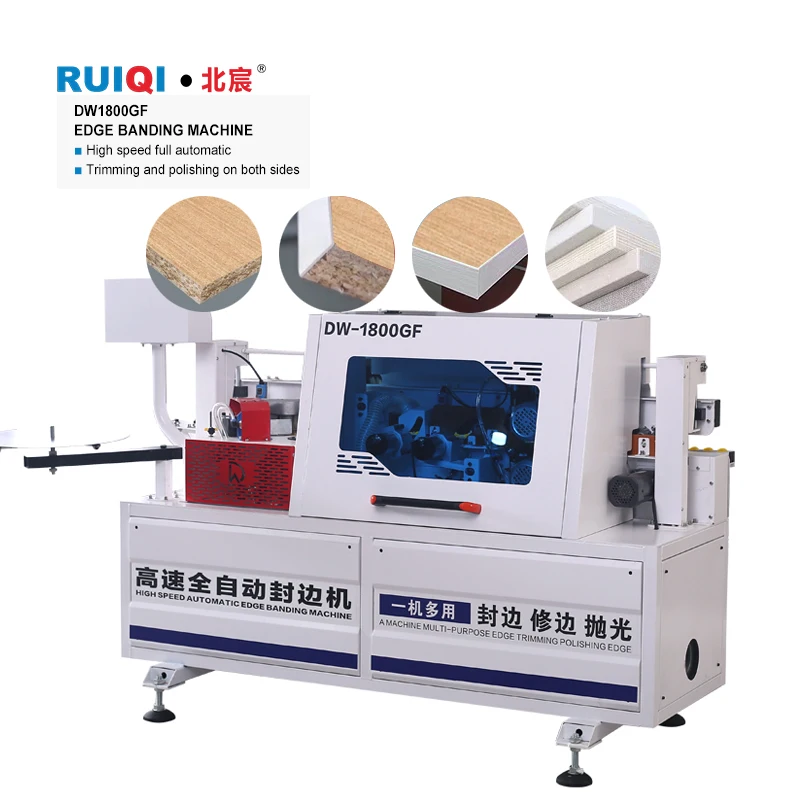
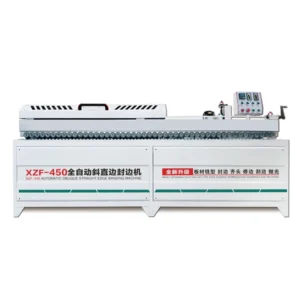
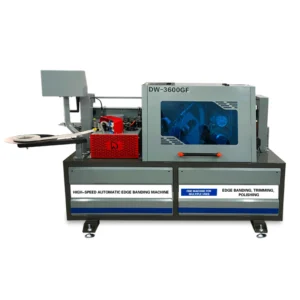
Multi-voltage and multilingual readiness — every DW1800 unit ships with confirmed electrical schematics and a control panel in the operator's language, eliminating the commissioning stalls I used to see when machines arrived with unreadable interfaces.
Technical Specifications
| Parameter |
Value |
| Model |
DW1800 |
| Product Type |
Automatic Edge Banding Machine |
| Rated Power |
4.9 kW |
| Voltage Options |
380V / 220V / 415V (50Hz / 60Hz to confirm) |
| Control System |
PLC |
| Overall Dimensions |
220 × 65 × 125 cm |
| Net Weight |
320 kg |
| Feed Speed |
0–14 m/min |
| Edge Banding Height |
0–50 mm |
| Edge Banding Thickness |
0.3–3 mm |
| Minimum Sheet Length |
20 cm |
| Minimum Sheet Width |
10 cm |
| Glue Pot Capacity |
4000 ml |
| Gluing System |
Double-sided gluing |
| Trimming Stations |
Top and bottom trimming, 800W × 2, 24000 r/min |
| Polishing Stations |
Top and bottom polishing, 380W × 2 |
| Profile Tracking |
Corner rounding |
| Edge Scraping |
Flexible edge scraping |
| Dust Extraction Port |
550W vacuum power |
| Air Supply Requirement |
0.4–0.6 MPa |
| Language Options |
Chinese and English (other languages customizable) |
| Key Features |
Double-sided gluing, front and rear alignment, flexible edge scraping, dust suction, fully assembled delivery |
Application Suitability
| Application |
Material or Output |
| Cabinet door edge banding |
MDF and particleboard with PVC or ABS edge tape |
| Custom furniture panel finishing |
Plywood and melamine-faced boards with veneer banding |
| Small-batch joinery production |
Solid wood panels with 0.3–3 mm edge material |
| Workshop-scale shelving and carcass work |
ABS boards and organic glass plates with matching edge profiles |
| Prototype and sample runs |
Mixed substrate batches requiring quick changeover between band thicknesses |
Why Voltage and Language Must Be Locked Down Before You Compare Automatic Edge Banding Machine Specifications
A spec sheet only matters if the machine can actually run in your workshop on day one.
I once shipped a PVC edge bander to a workshop in Lahore without confirming the control panel language. The operator saw Chinese characters on the PLC screen and froze — we spent the entire first commissioning day on a video call, translating each button one by one. The machine itself was fine; the oversight cost the customer three production days. That experience reshaped how I approach every quotation. Before discussing feed speed or trimming stations, I now verify local voltage, frequency, and operator language first, because automatic edge banding machine specifications mean nothing if the electrical supply or interface creates a barrier before the first panel is fed [NEED_CITE: voltage and frequency standards by export market].

Matching Feed Speed to Your Panel Mix
The DW1800 runs from 0 to 14 m/min with variable control. In practice, this range matters most when a workshop processes both thin MDF shelves requiring slower feeds for clean glue application and thicker particleboard carcass panels where throughput becomes the priority. A single fixed speed forces compromise on one material or the other. The variable range lets production managers set feed rates that match the substrate and edge band thickness combination currently on the table, rather than forcing all panels through one speed setting regardless of material behaviour.
Double-Sided Gluing and Substrate Consistency
The 4000 ml glue pot with double-sided application addresses one of the most common edge quality failures I have seen in small workshops: uneven adhesive transfer on porous substrates like raw particleboard. When glue only contacts one surface, the board edge absorbs adhesive faster than the PVC or ABS tape, leaving starved glue lines that fail during assembly. Double-sided gluing coats both the panel edge and the banding material independently, producing a more consistent bond across MDF, plywood, and particleboard alike [NEED_CITE: adhesive transfer behaviour on porous wood-based substrates].
Interpreting the Trimming and Tracking Configuration for Actual Edge Finish
The top and bottom trimming stations at 24000 r/min paired with 800W motors define how cleanly the excess banding is removed after the glue sets. On PVC and ABS materials up to 3 mm thick, this spindle speed produces a flush cut without the chatter marks that slower trimming heads leave on harder substrates. Profile tracking — the corner rounding function — then softens the sharp edges left by straight trimming, which matters directly for cabinet doors and drawer fronts where operators handle panels repeatedly. Flexible edge scraping follows to remove any remaining adhesive residue, and the 380W polishing stations deliver the final surface finish. The 550W dust extraction port ties into workshop dust collection, pulling trimming debris away before it settles on freshly glued surfaces. For workshops processing organic glass or acrylic-faced panels, the scraping and polishing sequence prevents the hazing that aggressive trimming alone can cause on transparent or high-gloss materials.
The Hidden Cost of Skipping Specification Verification
When a workshop buys an edge bander based on a single headline number — usually feed speed or price — the mismatches surface during the first week of production. Panels that fall below the minimum sheet width jam the feed mechanism. Control panels in an unfamiliar language turn simple adjustments into guesswork. Machines configured for 380V three-phase arrive in workshops running 220V single-phase and sit idle until a transformer is sourced locally. Each of these failures is preventable at the quotation stage, yet I see them repeatedly because the specification cross-check was rushed or skipped entirely [NEED_CITE: common commissioning failures in imported woodworking machinery].
Why Technical Buyers Source This Configuration Here
The DW1800 sits within a full edge banding product family, so a workshop can start with this specification level and move to higher-throughput models from the same manufacturer without retraining operators on a different control architecture. Voltage is confirmed in writing before production begins, with electrical schematics provided as standard documentation — not as an afterthought. The PLC control panel ships in the language agreed at quotation stage, with the operation manual translated to match. Every unit goes through a four-stage quality check covering incoming material, in-process assembly, finished product testing, and pre-shipment verification on actual panel samples. Engineer-led configuration recommendations arrive within 24 hours of an inquiry that includes your factory scale, panel types, and budget parameters.
Documentation & Verification
- CE declaration of conformity covering the DW1800's electrical and mechanical safety requirements
- Machine specification sheet listing verified feed speed, trimming power, and dimensional tolerances
- Electrical schematic with voltage and frequency confirmation matched to your local supply
- Factory test record using your specified panel material and edge band thickness before dispatch
- Operation and maintenance manual delivered in the language confirmed at quotation stage
- Spare parts list identifying consumable trimming cutters and polishing wheels with replacement intervals
Installation, Commissioning & Support
- Requires a level floor area accommodating the 220 × 65 cm footprint with clearance for panel infeed and outfeed
- Dedicated circuit matching confirmed voltage option (380V / 220V / 415V) with appropriate breaker rating for the 4.9 kW load
- Arrives fully assembled — position, connect power and compressed air at 0.4–0.6 MPa, and run calibration panels
- First-run commissioning includes glue temperature setting for your specific PVC, ABS, or veneer edge material
- Operator training covers PLC navigation in the confirmed language, feed speed adjustment, and trimming station alignment
- Wear parts including trimming cutters and polishing wheels included in initial spare parts package
Preparing Your Inquiry for a Fast Configuration Match
Send your panel material types, the edge banding materials you use most frequently, and the range of board thicknesses your workshop processes. Include your local voltage and frequency so the electrical configuration is matched before quotation. If you have existing upstream saws or downstream boring machines, note their throughput so the DW1800's feed speed range is evaluated against your line balance rather than in isolation.
Frequently Asked Questions
Q: How can I verify edge banding tolerance on my specific panel material before committing to an order?
A: Request a factory test record processed on your actual substrate — MDF, particleboard, or plywood — with the edge band material and thickness you intend to run. The test documents trimming accuracy and glue line consistency under controlled conditions. This record ships with the machine, so you can compare incoming production output against a verified baseline from day one.
Q: What documentation confirms the machine matches my local electrical supply?
A: You receive an electrical schematic and a written voltage confirmation document matched to your declared supply. The DW1800 supports 380V, 220V, and 415V configurations, but frequency must also be confirmed — 50Hz or 60Hz — before production begins to ensure motor speeds and PLC timing are calibrated correctly.
Q: How does the trimming station setup affect edge quality across different substrates?
A: The top and bottom trimming heads run at 24000 r/min with 800W motors, producing clean flush cuts on PVC and ABS up to 3 mm thick. Profile tracking rounds corners to prevent sharp edges on cabinet components. On harder materials like acrylic-faced boards, the flexible scraping and polishing stages remove residue and restore surface clarity after trimming.
Q: What language options are available for the control panel and documentation?
A: The standard PLC interface covers Chinese and English, with additional languages configurable at the quotation stage. The operation and maintenance manual is delivered in the same language confirmed for the control panel, ensuring operators can reference procedures without translation gaps during commissioning and daily use.
Q: How do the minimum sheet dimensions affect my production panel range?
A: The DW1800 accepts sheets down to 20 cm in length and 10 cm in width, covering most cabinet shelving, drawer sides, and small joinery components. Panels below these minimums may not feed reliably through the pressure zone. If your production mix includes very small offcuts, confirm those dimensions during the configuration stage so alternative feeding strategies can be discussed.