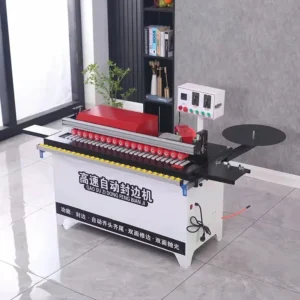

Wood Based Panels Machinery
Curved Edge Banding Machine W-1 W-2 W-3 | Specifications
W-1 / W-2 / W-3 Automatic Curved Edge Banding Machine, 220V 50Hz,...
View Details<p><strong>DW102 Mini Automatic Edge Banding Machine, 3800W, 220V/380V, 0.3–3mm Edge Thickness</strong> — compact 128×47×69cm footprint with dual 650W trimming and 180W polishing stations for straight and curved PVC or veneer banding on MDF, particleboard, and plywood panels.</p> <ul> <li>Banding height 0–50mm, minimum sheet 25×5cm, air pressure 0.5–0.8 MPa</li> <li>Voltage, frequency, plug type (EU/US/AU/UK), and control panel language confirmed to your local standard before order</li> </ul> <p>Specification sheets with verified tolerance values and factory test records provided for pre-shipment review, ensuring the DW102 matches your panel mix and downstream assembly requirements.</p>
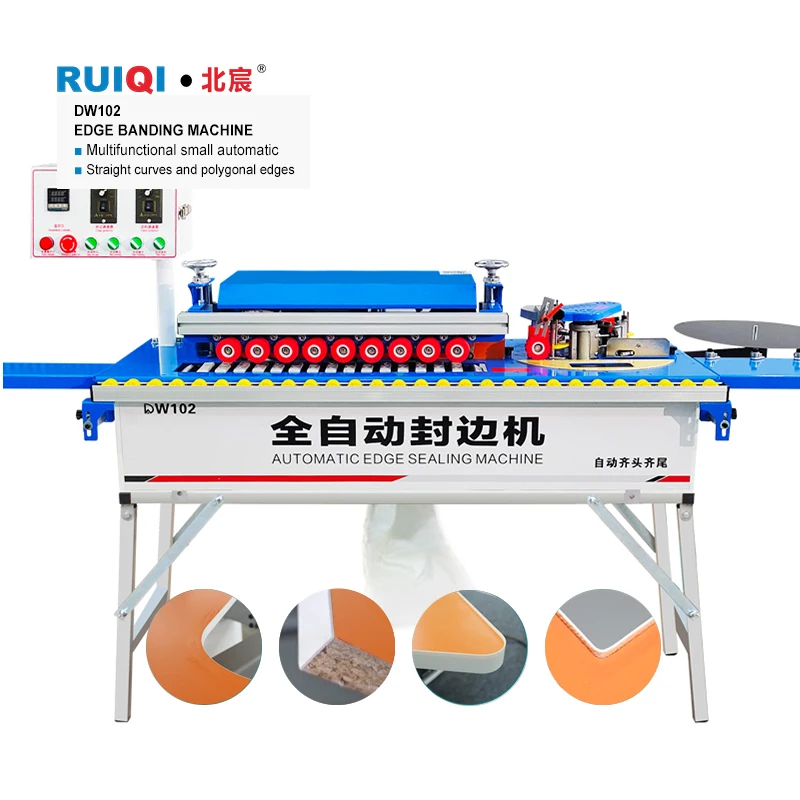
<p><strong>DW102 Mini Automatic Edge Banding Machine, 3800W, 220V/380V, 0.3–3mm Edge Thickness</strong> — compact 128×47×69cm footprint with dual 650W trimming and 180W polishing stations for straight and curved PVC or veneer banding on MDF, particleboard, and plywood panels.</p> <ul> <li>Banding height 0–50mm, minimum sheet 25×5cm, air pressure 0.5–0.8 MPa</li> <li>Voltage, frequency, plug type (EU/US/AU/UK), and control panel language confirmed to your local standard before order</li> </ul> <p>Specification sheets with verified tolerance values and factory test records provided for pre-shipment review, ensuring the DW102 matches your panel mix and downstream assembly requirements.</p>
Quality Assured
Multi-stage QC inspection
Custom Config
Voltage, logo, language
Global Shipping
100+ countries served
After-Sales Support
Remote & spare parts
Voltage-Configurable Compact Edge Bander — DW102 supports 220V/380V with region-specific plug options and a 128×47×69 cm footprint, letting space-constrained workshops match local electrical standards without rewiring the shop floor.
| Parameter | Value |
|---|---|
| Model | DW102 |
| Product Type | Mini Automatic Edge Banding Machine |
| Rated Power | 3800 W |
| Voltage & Frequency | 220V / 380V / customization (frequency not specified in source) |
| Control System | Manual operation panel (source value — verify against manufacturer catalog) |
| Overall Dimensions (L×W×H) | 128 × 47 × 69 cm |
| Net Weight | 75 kg |
| Minimum Sheet Length | 25 cm |
| Minimum Sheet Width | 5 cm |
| Edge Banding Height | 0–50 mm |
| Edge Banding Thickness | 0.3–3 mm |
| Edge Feed Power | 20 W |
| Transmission Power | 60 W |
| Trimming Power | 650 W × 2 |
| Polishing Power | 180 W × 2 |
| Vacuum Power | 1200 W |
| Air Source Pressure | 0.5–0.8 MPa |
| Glue Pot Capacity | 1000 ml |
| Standard Features | Curved and straight edge banding, edge trimming, polishing, automatic head and tail cutting, with vacuum |
| Language Options | Chinese and English standard; Spanish or other languages customizable |
| Plug Options | EU, USA, AU, UK |
| Feed Speed | (basis to be confirmed) |
| Panel Thickness Range | (basis to be confirmed) |
| Tolerance | (basis to be confirmed) |
| Dust Extraction Port | (basis to be confirmed) |
| Certification | CE (unit-level declaration to verify); ISO 9001 (manufacturer-level) |
| Assembly State | Fully assembled (source value — verify against manufacturer catalog) |
| Application | Material or Output |
|---|---|
| Furniture panel edge banding | MDF, particleboard, plywood panels with PVC edge banding |
| Cabinet door and carcass production | Melamine-faced boards and veneer edge materials |
| Custom joinery with curved profiles | Solid wood panels and blockboard on radius cuts |
| Small-batch polymer door components | Polymer door panels requiring curved and straight edge finishing |
A machine that cannot plug into your workshop's existing supply is not a machine — it is a 75 kg crate occupying floor space.
I once watched a joinery shop owner wait nearly four weeks for an electrician to rewire a dedicated circuit because the edge bander arrived with a fixed voltage that did not match the shop's panel board. The DW102 mini automatic edge banding machine specifications list 220V and 380V options, but frequency is equally critical in markets running 60 Hz versus 50 Hz. Mismatched frequency affects motor speed, which in turn alters feed rate and trimming behavior. Confirming these details before order placement avoids commissioning delays that no specification sheet can recover. [NEED_CITE: voltage and frequency standards by export market]
The DW102 draws 3800 W total, distributed across trimming motors, polishing wheels, vacuum extraction, and the transmission drive. In workshops where a sliding table saw and a boring machine already occupy available breaker capacity, adding another 3.8 kW load requires a dedicated circuit evaluation. The compact 128×47×69 cm frame fits into tight production cells, but electrical planning must account for simultaneous operation with upstream and downstream equipment rather than treating this unit in isolation.
The dual 650 W trimming stations handle automatic head-and-tail cutting, removing excess banding material flush with the panel face and edge. Downstream, the two 180 W polishing wheels smooth the trimmed profile. For a technical buyer comparing the DW102 mini automatic edge banding machine specifications against other compact banders, these motor ratings directly indicate which banding thicknesses and substrate densities the stations can process without stalling or leaving visible score lines. [NEED_CITE: edge banding trimming motor sizing for PVC and veneer materials]
The 0.3–3 mm banding thickness range covers thin PVC foils typically used on melamine cabinet carcasses as well as thicker veneer strips applied to solid wood furniture components. The 1000 ml glue pot capacity supports continuous runs on standard panel widths without frequent refill interruptions. Panel minimums of 25 cm length and 5 cm width allow small offcut pieces — common in custom furniture shops — to be edge-banded without manual feeding workarounds. The 0–50 mm banding height accommodates standard 18 mm panels as well as thicker blockboard and polymer door sections, though operators should verify panel thickness range with the manufacturer before processing non-standard stock.
Ordering an edge bander without confirming feed speed, panel thickness range, or tolerance values leaves the buyer discovering limitations only after panels fail assembly. Loose edge joints, visible glue lines on certain substrates, and trimming marks that require secondary sanding are typical symptoms of a machine whose capabilities were assumed rather than verified. Requesting the factory test record and machine specification sheet before shipment closes this gap. [NEED_CITE: CE machinery directive requirements for industrial equipment]
The DW102 occupies the entry point of automated edge banding, where buyers often accept quoted specifications without cross-referencing them against their actual production mix. In-house manufacturing with patented cutting mechanisms and verified tolerance data — available upon request — gives technical buyers a basis for comparison beyond brochure claims. Voltage, language, and plug configuration are confirmed per order rather than left as defaults. The four-stage QC process includes pre-shipment verification with a factory test record matched to the buyer's panel material. Engineer-led configuration recommendations and formal quotations within 24 hours mean specification gaps can be resolved before production begins, not after the machine arrives.
Provide your panel material types, typical panel dimensions, and the edge banding materials you run most often. Confirm your workshop's available voltage, frequency, and whether a dedicated circuit exists near the intended machine location. Specify your preferred control panel language and plug type so the quotation reflects your actual installation conditions rather than generic defaults.
Q: How is edge banding tolerance verified on the DW102 before shipment? A: The factory test record documents trimming flushness and polishing finish on the buyer's specified panel material and banding thickness. Tolerance values are measured after head-and-tail cutting and recorded in the pre-shipment report. Buyers can request a sample processing test using their own stock or review standardized test results from the four-stage QC process before authorizing dispatch.
Q: What voltage and frequency combinations are available, and how is compatibility confirmed? A: The DW102 supports 220V and 380V configurations with customizable frequency. Before order confirmation, the buyer provides local electrical standards including voltage, frequency, and plug type. An electrical schematic is issued for review, and the factory test verifies motor behavior at the specified frequency to prevent feed rate or trimming speed deviations on arrival.
Q: How does the DW102 panel dimension range fit a custom furniture workshop's production mix? A: The 25 cm minimum sheet length and 5 cm minimum width handle small offcuts typical in cabinet and custom furniture work. The 0–50 mm banding height covers standard 18 mm particleboard as well as thicker blockboard. Buyers processing non-standard thicknesses should confirm the panel thickness range with the manufacturer before ordering to avoid feed mechanism limitations.
Q: What is the difference between the trimming and polishing stations and their effect on assembly quality? A: The dual 650 W trimming stations cut banding flush with the panel edge and remove head-and-tail overhang automatically. The two 180 W polishing wheels then smooth the trimmed profile. Inconsistent trimming leaves visible ridges that interfere with panel-to-panel joints during assembly, while insufficient polishing creates rough edges that catch during handling and installation.
Q: How should the DW102 throughput be matched with upstream saws and downstream boring machines? A: Feed speed determines how many panels per hour the DW102 can process, which must align with the cutting rate of upstream panel saws and the cycle time of downstream boring stations. Buyers should confirm the feed speed specification and compare it against their existing equipment to identify whether the DW102 becomes the line bottleneck or integrates smoothly into current workflow.
20+ Years Experience
Trusted by 100+ countries worldwide
Full OEM/ODM
Custom logo, voltage & panels
Lifetime After-Sales
12-month warranty + spare parts
25-45 Day Lead Time
Flexible MOQ, on-time delivery
Fill in your requirements and our team will respond with a formal quotation within 24 hours. We speak English and Spanish.
Response within 24 hours on business days
Or WhatsApp us for instant reply
Serving 100+ countries globally
W-1 / W-2 / W-3 Automatic Curved Edge Banding Machine, 220V 50Hz,...
View DetailsDW102 Automatic Edge Banding Machine, 3800W Total Power, 0.3–3mm Edge Thickness —...
View DetailsModel 802 Automatic Edge Banding Machine, 220V 4kW, 10-50mm Panel Thickness —...
View DetailsProduct Parameters Automatic breaking beltCurved & Straight dual-purposeDouble sides gluingMore stability on...
View DetailsOur global sales team is ready to assist. Get a formal quotation, technical specs, and OEM/ODM options within 24 hours.