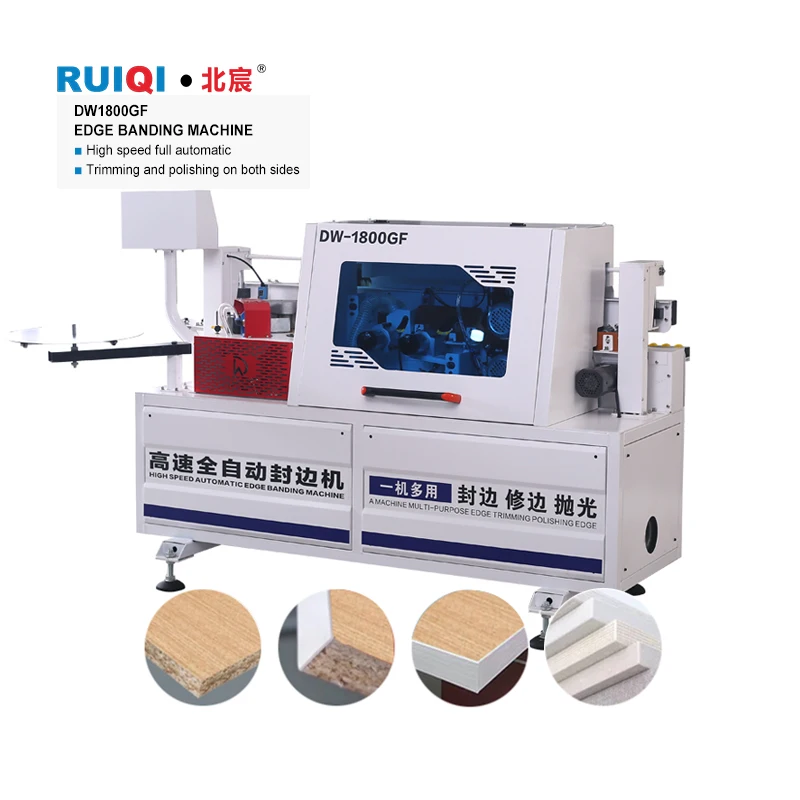
Voltage-First Quoting Protocol — every DW1800 configuration is validated against your facility's electrical schematic before a formal quotation is issued, eliminating the three-week transformer delay that stalls panel lines.
Technical Specifications
| Parameter |
Value |
| Model |
DW1800 |
| Product Type |
Automatic Edge Banding Machine |
| Total Power |
4.9 kW |
| Voltage Options |
380V / 220V / 415V (frequency to confirm at order) |
| Feed Speed |
0–14 m/min |
| Edge Banding Thickness Range |
0.3–3 mm |
| Edge Banding Height Range |
0–50 mm |
| Minimum Sheet Length |
200 mm |
| Minimum Sheet Width |
100 mm |
| Glue Pot Capacity |
4000 ml |
| Air Source Pressure |
0.4–0.6 MPa |
| Trimming Motor |
800 W × 2 at 24,000 r/min |
| Polishing Motor |
380 W × 2 |
| Vacuum Power |
550 W |
| Edge Feed Power |
160 W |
| Transmission Power |
180 W |
| Overall Dimensions (L×W×H) |
2200 × 650 × 1250 mm |
| Net Weight |
320 kg |
| Guide Rail Structure |
Roll-ball differential with extruded aluminum alloy, oxidized surface |
| Standard Functions |
Double-sided gluing, end cutting, rough trimming, fine trimming, profile tracking, flexible edge scraping, top and bottom polishing, dust extraction |
| Language Options |
Chinese and English standard; Spanish and others on request |
| Plug Options |
EU / USA / AU / UK |
Application Suitability
| Application |
Material or Output |
| Custom cabinet door edge finishing |
MDF and particleboard with PVC or melamine banding |
| Wardrobe panel edge sealing |
Plywood panels with veneer or ABS edge strips |
| Office furniture component banding |
Laminated particleboard up to 50 mm thickness |
| Small-batch joinery production |
Solid wood panels requiring profile tracking on corners |
| Shelving and rack panel processing |
Organic glass plates and specialty substrates within thickness range |
Why the Voltage Question Should Precede Every Automatic Edge Banding Machine Specification
Confirming your facility's supply voltage and frequency before model selection prevents the most common commissioning failure in cross-border equipment procurement.
I once supported a customer in Lagos who ordered a PVC edge bander without verifying the local three-phase supply. The machine arrived configured for a voltage standard that did not match the workshop's transformer output, leaving the entire panel line idle while a step-down unit was sourced locally. That three-week gap cost far more than the transformer itself. When evaluating Automatic Edge Banding Machine specifications, electrical compatibility must be the first checkpoint, not an afterthought at shipment [NEED_CITE: voltage and frequency standards by export market]. The DW1800 is configurable across 380V, 220V, and 415V inputs, but the correct configuration only gets locked in once your single-line diagram is reviewed against the motor winding layout.

Mapping Feed Speed to Your Daily Panel Volume
The DW1800 runs at 0–14 m/min, which places it in the bracket suited to small and medium workshops processing furniture components in batch runs rather than continuous high-volume lines. Choosing the right Automatic Edge Banding Machine specifications means matching this feed range to the number of linear meters of edge your shop actually bands per shift. A workshop cutting 80 to 120 cabinet sides per day will find headroom here, while facilities running dedicated panel lines at higher throughput should evaluate whether a faster model better serves their cycle time.
Trimming Station Configuration and Edge Finish Quality
Two 800 W trimming motors running at 24,000 r/min handle rough and fine trimming in sequence, followed by profile tracking and flexible scraping stations. This multi-stage arrangement addresses the visible glue lines and chipped edges that appear when a single trimming pass tries to do all the work. On MDF substrates, the fine trim at high RPM produces a clean edge that reduces sanding time downstream. For particleboard with melamine banding, the profile tracking function follows the corner radius to prevent the flat-spot defect that causes assembly gaps [NEED_CITE: edge finish requirements for panel furniture assembly tolerances].
How Core Parameters Affect Your Production Floor
The 4000 ml glue pot with double-sided gluing determines how long the machine runs between refills — a factor that directly affects operator attention and batch continuity during long production runs. The 0.3–3 mm edge banding thickness range covers PVC, veneer, melamine, and ABS strips, meaning a workshop stocking multiple banding materials does not need separate machines for each. The roll-ball differential guide rail with oxidized aluminum alloy surface maintains panel alignment across the feed path, which is where tolerance drift typically originates on machines with simpler rail constructions. Panel dimensions as small as 200 × 100 mm can be processed, opening up edge banding for narrow drawer sides and small shelving components that larger machines cannot grip reliably. Understanding these Automatic Edge Banding Machine specifications in relation to your actual board stock prevents the mismatch where a machine is technically capable but practically inefficient for your specific component mix.
The Hidden Cost of Specifying Without Context
A machine quoted on feed speed alone, without confirming the trimming motor configuration against your primary board material, arrives with the wrong cutting geometry for your substrate. Operators compensate by slowing the feed rate, which then creates a bottleneck that was never part of the original throughput calculation. Control panels delivered in a language the floor team cannot read delay commissioning further, as basic parameter adjustments require translation before each setup change. These compounding delays are what turn a straightforward equipment purchase into a multi-week disruption [NEED_CITE: common causes of commissioning delays in imported woodworking machinery].
Why Source This Model Through Our Configuration Process
Every DW1800 quotation begins with an engineer reviewing your panel material, edge banding type, and facility voltage before recommending a configuration — not a catalog price sent in response to a model number. The four-stage quality control process covers incoming component inspection through pre-shipment verification, with a factory test record generated using board material matching your specification. Voltage confirmation and electrical schematic review happen before production starts, which is the step most often skipped in standard export transactions. Custom control panel language and plug type are addressed at the quotation stage rather than discovered as problems at the crate. Spare parts lists include part numbers for trimming blades, scraping tools, and glue pot components so your maintenance team can reorder without measuring worn parts.
Documentation & Verification
- CE declaration of conformity covering the DW1800 safety and EMC requirements
- Factory test record run on your specified panel thickness and edge banding material
- Electrical schematic confirming voltage, frequency, and plug type for your facility
- Operation and maintenance manual delivered in your agreed language before shipment
- Spare parts list with part numbers for trimming blades, scrapers, and glue pot assemblies
Installation, Commissioning & Support
- Floor space planning based on the 2200 × 650 mm footprint with operator clearance on the infeed side
- Dedicated circuit sizing for the 4.9 kW total load with correct breaker rating for your voltage configuration
- Air supply connection at 0.4–0.6 MPa with moisture trap installed upstream of the machine
- First-run parameter setup covering glue temperature, feed speed, and trimming depth for your board stock
- Operator training on control panel functions in the configured language with setup sheets for common materials
- Scheduled maintenance intervals for guide rail lubrication, trimming blade inspection, and glue pot cleaning
What to Include in Your Inquiry
Provide your primary panel materials and thickness range, the edge banding types and widths you run most frequently, and your facility's confirmed voltage and frequency. Include your target daily output in linear meters or panel count so the feed speed can be evaluated against your actual production rhythm. If your workshop operates with a specific control panel language requirement or plug standard, note that at the inquiry stage.
Frequently Asked Questions
Q: How do I confirm the correct voltage and frequency before ordering the DW1800?
A: Share your facility's single-line electrical diagram or a photo of your main distribution board showing the supply rating. The engineer reviews this against the motor winding specification and confirms whether 380V, 220V, or 415V matches your three-phase supply, along with the correct frequency setting. This verification is completed before the formal quotation is issued.
Q: Which edge banding materials are compatible with the 0.3–3 mm thickness range?
A: The DW1800 handles PVC, ABS, melamine, and wood veneer strips within the 0.3–3 mm range, with the height capacity reaching 50 mm. The double-sided gluing system and 4000 ml pot support continuous runs across these materials. Confirming your specific banding supplier and adhesive type at the inquiry stage ensures the glue temperature and feed parameters are preset correctly.
Q: How does the profile tracking function improve corner finish on panel components?
A: Profile tracking follows the corner radius of the panel edge after rough and fine trimming, removing the flat spot that a straight trimming pass leaves behind. This is particularly relevant on MDF and particleboard where corner gaps become visible after assembly. The flexible scraping station then cleans residual adhesive from the profiled edge before polishing.
Q: What language options are available for the DW1800 control panel?
A: Chinese and English are standard configurations. Spanish and other languages are available on request and must be specified at the quotation stage so the correct firmware and label set are installed before factory testing. This prevents commissioning delays caused by operators unable to navigate setup menus in an unfamiliar language.
Q: How do I match the 0–14 m/min feed speed to my production volume?
A: Calculate the total linear meters of edge banding your workshop processes per shift and compare this against the feed speed range at your typical setup time per panel. The DW1800 suits small to medium batch operations where setup changes between different panel sizes occur regularly. For continuous high-volume runs, a higher feed speed model may be more appropriate.