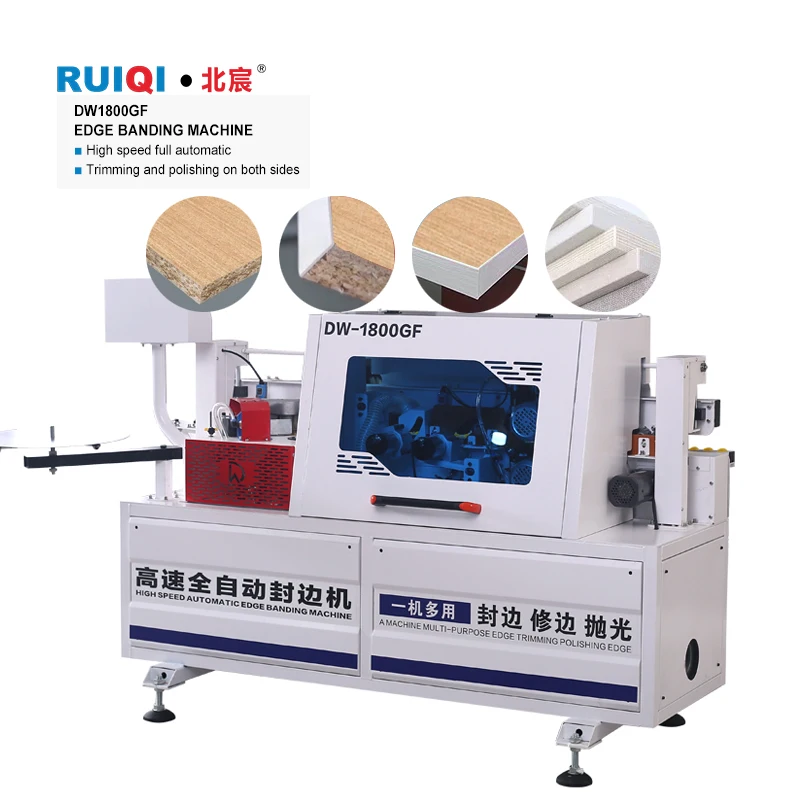
Configurable Voltage and Frequency — The DW1800 ships with 220V, 380V, or 415V winding options and plug configurations for EU, USA, AU, and UK markets, locked in before production starts.
Technical Specifications
| Parameter |
Value |
| Model |
DW1800 |
| Product Type |
Automatic Edge Banding Machine |
| Total Power |
4.9 kW |
| Voltage Options |
220V / 380V / 415V (frequency to be confirmed per destination) |
| Overall Dimensions (L×W×H) |
220 × 65 × 125 cm |
| Net Weight |
320 kg |
| Minimum Sheet Length |
20 cm |
| Minimum Sheet Width |
10 cm |
| Edge Banding Height |
0–50 mm |
| Edge Banding Thickness |
0.3–3 mm |
| Feed Speed |
0–14 m/min |
| Edge Feed Power |
160 W |
| Transmission Power |
180 W |
| Trimming Power / Speed |
800 W × 2, 24,000 r/min |
| Polishing Power |
380 W × 2 |
| Vacuum Power |
550 W |
| Glue Pot Capacity |
4,000 ml |
| Air Source Pressure |
0.4–0.6 MPa |
| Trimming Stations |
Top and bottom trimming, flexible edge scraping, profile tracking |
| Standard Features |
Double-sided gluing, front and rear alignment, dust extraction |
| Control Panel Language |
Chinese and English standard; Spanish or other languages on request |
| Plug Options |
EU, USA, AU, UK |
Application Suitability
| Application |
Material or Output |
| Custom cabinet door edge banding |
MDF and particleboard with PVC or melamine strips 0.3–3 mm |
| Plywood shelving edge finishing |
Plywood panels with wood veneer or PVC edge banding |
| Small-batch furniture component edging |
Solid wood and ABB boards requiring flexible scraping |
| Joinery workshop production runs |
Organic glass plates and similar hardness wood-based panels |
| Panel processing plant output |
MDF and particleboard sheets within the 0–50 mm banding height range |
Why the Voltage Question Should Come Before the Edge Banding Machine Specifications
A machine wired for the wrong frequency will burn its main motor before the first panel is edged.
I learned this the hard way on a commissioning call in South Asia. The workshop ran 415V at 60Hz, but the machine left the factory configured for 380V at 50Hz. The main motor overheated within the first hour, and the line sat idle for weeks while a replacement drive shipped overseas. That single oversight cost the customer an entire production cycle and nearly derailed the contract [NEED_CITE: voltage and frequency standards by export market]. When you review Edge Banding Machine specifications, the electrical supply match must be the first checkpoint, not an afterthought buried in the shipping documents.

Feed Speed and Motor Separation
The DW1800 delivers feed speed across a 0–14 m/min range, driven by a dedicated 180W transmission motor and a separate 160W edge feed motor. This separation matters because the transmission motor handles panel conveyance while the edge feed motor controls strip delivery into the glue zone. When both functions share a single drive, speed adjustments for one affect the other, causing mismatched feed rates on heavier panels. With independent motors, a production manager can set the Edge Banding Machine specifications to match the panel weight and edge material without compromising strip alignment.
Trimming Station Configuration and Edge Finish
The trimming section runs two 800W motors at 24,000 r/min, covering top and bottom trimming, flexible edge scraping, and profile tracking for corner rounding. The high rotational speed allows clean cuts on PVC and melamine without tearing the edge material, which is a common defect at lower RPMs. Flexible scraping removes the slight ridge left by the trimming cutters, and profile tracking rounds the corners so the finished edge feels smooth to the touch. Each station performs a distinct function, and skipping any one of them leaves visible marks that show up under lamplight during final inspection [NEED_CITE: edge banding finish quality standards for furniture manufacturing].
Specifying the Right Parameters for Your Panel Mix
The glue pot holds 4,000 ml, which supports sustained runs without frequent refills on standard PVC and melamine edge banding. Air pressure at 0.4–0.6 MPa drives the pneumatic cylinders that press the edge strip against the panel during the gluing and trimming stages. If your workshop uses thicker veneer banding near the 3 mm upper limit, the pressure setting and feed speed must be coordinated to prevent the strip from lifting before the adhesive cures. The minimum sheet dimensions of 20 cm by 10 cm mean the DW1800 handles small offcuts and narrow components that larger machines cannot feed, which is a practical advantage for custom cabinet shops cutting varied panel sizes throughout the day.
The Cost of Skipping Pre-Shipment Electrical Verification
When a machine arrives with the wrong voltage winding, the options are limited. Rewinding a motor on-site is rarely feasible, and shipping a replacement drive internationally adds weeks of downtime. The cost extends beyond the component itself — the customer loses production capacity, misses delivery commitments, and may face contractual penalties. In some cases, the local electrician attempts a workaround with a step-down transformer, which introduces heat and voltage drop that shorten motor life across the entire machine [NEED_CITE: CE machinery directive requirements for industrial equipment]. These consequences are entirely avoidable if the supply voltage and frequency are confirmed in writing before the machine enters assembly.
Why Procurement Through This Channel Works
The DW1800 is configured against your written voltage and frequency confirmation, not a default setting. The four-stage quality process covers incoming material inspection, in-process checks during assembly, finished product testing, and a pre-shipment verification run on your specified panel material. Trimming tolerance and edge finish are validated before the machine is crated, so you see the results before payment balance is due. The control panel language is set to match your operators — whether that is English, Spanish, or another language — eliminating the commissioning delay of translating button labels on the shop floor. An engineer reviews your production requirements and issues a formal configuration proposal within one working day.
Documentation & Verification
- Machine specification sheet listing confirmed voltage, frequency, and plug type for your facility
- Electrical schematic showing motor wiring matched to your local supply before dispatch
- Factory test record on your panel material and edge banding thickness range
- Operation and maintenance manual printed in the agreed operator language
- Spare parts list with part numbers for trimming cutters, polishing wheels, and pneumatic seals
Installation, Commissioning & Support
- Requires a level concrete floor supporting the 320 kg net weight across the 220 × 65 cm footprint
- Dedicated circuit matching the confirmed voltage option with appropriate breaker rating for the 4.9 kW total draw
- Arrives partially assembled; trimming and polishing stations require alignment verification on-site
- First-run calibration covers feed speed, glue temperature, and pneumatic pressure for your edge material
- Trimming cutter replacement interval depends on banding material hardness and daily run hours
What to Include With Your Inquiry
Send your panel material type, typical sheet dimensions, and the edge banding materials in your product mix so the configuration covers your actual production range. Confirm your workshop supply voltage and frequency from the main distribution board, not the equipment nameplate of an older machine. Specify the control panel language your operators read, and note any upstream or downstream equipment the DW1800 must feed speed-match with.
Frequently Asked Questions
Q: How is the 0–14 m/min feed speed verified under load with different panel thicknesses?
A: Feed speed is tested during pre-shipment verification using panel stock at the thickness you specify. The transmission and edge feed motors are measured under actual conveyance load, not free-run. The test record documents the speed setting, panel material, and edge banding type used, so you can cross-reference against your production requirements before the machine ships.
Q: Which voltage and frequency combination should I specify for my facility?
A: Check the supply at your main distribution board and confirm both the line-to-line voltage and the frequency in Hz. Common industrial supplies include 380V/50Hz, 415V/50Hz, and 220V/60Hz, but local variations exist. Provide these two values in writing so the motor winding and transformer configuration match your actual supply before assembly begins.
Q: What control system is installed, and can the interface language be changed after delivery?
A: The control system type is confirmed during the configuration proposal stage based on your requirements. The interface language is set before shipment to match your operators. Changing the language after delivery may require a control panel update or replacement membrane, which is possible but adds lead time compared to specifying it upfront.
Q: How does the 0.3–3 mm edge banding thickness range perform on PVC versus wood veneer?
A: PVC at 0.3–1 mm feeds cleanly through the trimming stations at standard feed speed. Wood veneer near the 3 mm upper limit requires slower feed speed and adjusted pneumatic pressure to prevent splintering during trimming. A sample processing test on your actual veneer stock confirms the parameter settings before the machine leaves the factory.
Q: Can I request a sample edge banding test on my own panel stock before ordering?
A: Yes. Send representative panel samples and the edge banding material you plan to use. The factory runs them through the DW1800 at your target feed speed and documents the edge finish, trimming quality, and adhesion results. You receive the test record and, if requested, the edged samples for your own inspection before committing to the order.