
Edge banding machine
Mini Automatic Edge Banding Machine DW102 | Technical Guide
DW102 Mini Automatic Edge Banding Machine, 220V, 3800W, 0.3–3mm Edge Thickness —...
View Details<p>Engine-led configuration ensures every specification is confirmed against your actual production need before order placement.</p>
<p>Engine-led configuration ensures every specification is confirmed against your actual production need before order placement.</p>
Quality Assured
Multi-stage QC inspection
Custom Config
Voltage, logo, language
Global Shipping
100+ countries served
After-Sales Support
Remote & spare parts
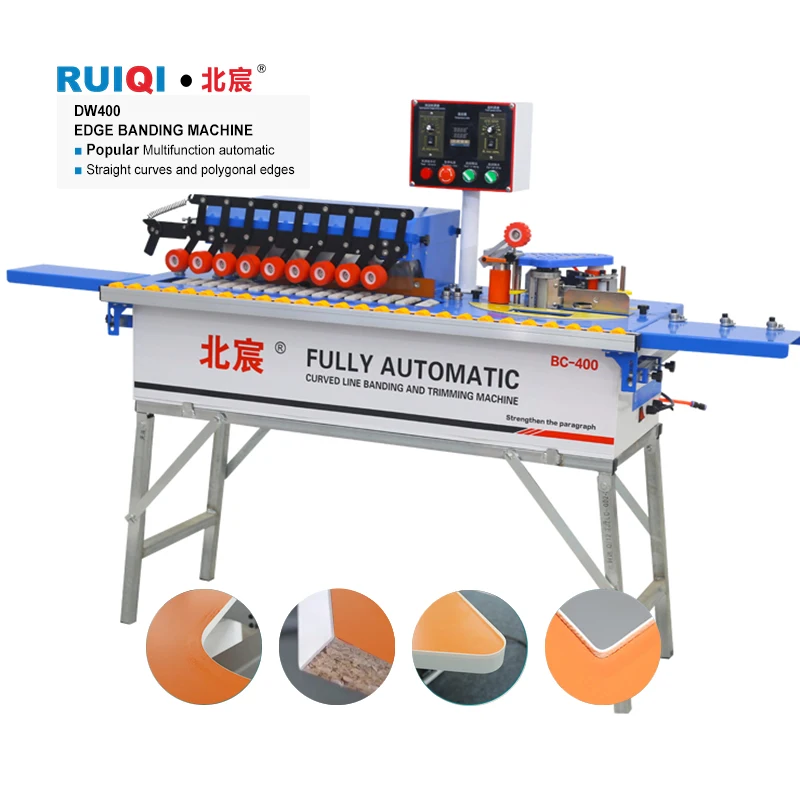
Voltage-Confirmed Builds — every DW400 edge bander leaves the Ningjin facility only after the motor wiring and control transformer match the buyer's documented supply frequency and plug standard.
| Parameter | Value |
|---|---|
| Model | DW400 |
| Product Type | Edge Banding Machine |
| Total Power | 3.8 kW (3800 W) |
| Voltage Options | 220V / 380V / customization available |
| Trimming Power | 650 W × 2 |
| Polishing Power | 180 W × 2 |
| Vacuum Power | 1200 W |
| Transmission Power | 60 W |
| Edge Feed Power | 20 W |
| Glue Pot Capacity | 1000 ml |
| Edge Banding Thickness | 0.3–3 mm |
| Edge Banding Height | 0–50 mm |
| Minimum Sheet Length | 25 cm (source value — verify against manufacturer catalog) |
| Minimum Sheet Width | 10 cm (source value — verify against manufacturer catalog) |
| Air Source Pressure | 0.5–0.8 MPa |
| Overall Dimensions (L×W×H) | 116 × 47 × 69 cm |
| Net Weight | 70 kg |
| Standard Functions | Straight edge banding, trimming, polishing |
| Control Panel Language | Chinese, English (other languages on request) |
| Plug Options | EU, USA, AU, UK |
| Application | Material or Output |
|---|---|
| Cabinet door edge finishing | MDF and particleboard with PVC or ABS banding |
| Office furniture panel edging | Melamine-faced chipboard with 0.4–2 mm PVC strips |
| Small-batch joinery production | Plywood and blockboard with wood veneer banding |
| Polymer door frame trimming | Polymer composite panels with matching edge strips |
| Workshop upgrade from manual trimming | Furniture-grade boards requiring consistent edge profiles |
An edge bander wired for the wrong supply frequency will run — but the glue pot heater and feed motor will not reach their rated performance, leaving visible glue lines and uneven trimming on every panel.
I have watched workshops receive machines that physically powered on, yet the glue never reached proper melting temperature because the heating element was spec'd for 50 Hz while the local grid ran at 60 Hz. The operator blamed the glue, then the banding material, then the machine itself — when the real fault was a specification mismatch that should have been caught before the order was placed [NEED_CITE: voltage and frequency standards by export market]. Asking the right edge banding machine specifications questions early prevents this class of failure entirely.
The DW400 allocates 650 W to each trimming motor and 180 W to each polishing motor, a distribution that reflects the mechanical load each station carries during a typical pass. Trimming encounters the full thickness of the edge strip and must shear it cleanly without chipping the substrate surface, which demands substantially more torque than the final buffing stage. When evaluating how to choose edge bander configurations, verify that the trimming wattage is adequate for the hardest material in your production mix.
A 0.3–3 mm banding thickness window covers thin PVC foils used on budget cabinet carcasses as well as thicker ABS and veneer strips specified for visible furniture faces. The lower boundary matters when your supplier ships pre-glued melamine tape at 0.4 mm, while the upper boundary determines whether you can run solid wood lipping on exposed shelving. Confirm that your three most-used banding SKUs all fall within this range before locking in a machine selection.
The glue pot at 1000 ml capacity determines how long the machine can run between refills during a continuous batch — for a small workshop processing several dozen panels per session, this volume typically covers a full morning run without interruption. The air pressure requirement of 0.5–0.8 MPa defines the compressor class needed on the shop floor; undersizing the compressor causes the pneumatic feed rollers to slip on heavier boards [NEED_CITE: pneumatic pressure requirements for edge banding equipment]. Total power draw of 3.8 kW places this edge banding machine within the capacity of a standard single-phase or three-phase workshop circuit, but the dedicated breaker must be rated above the combined inrush current of all motors starting simultaneously. Panel thickness handling up to 50 mm means standard 18 mm chipboard and 25 mm MDF both pass through without adjustment, though boards approaching the upper limit should be test-run to verify feed roller clearance.
A workshop that connects this machine to an undersized compressor or runs air through undersized hose will experience intermittent feed slippage and inconsistent trimming pressure. The pneumatic cylinders controlling the pressure beam and trimming units depend on stable pressure within the 0.5–0.8 MPa band; when pressure dips below the lower threshold during peak demand from other shop tools, the edge strip may not bond uniformly. I have traced mysterious edge quality failures back to nothing more than a shared air line feeding both the edge bander and a nail gun station [NEED_CITE: compressed air system sizing for woodworking shops].
In-house manufacturing with patented cutting mechanisms means the trimming stations on this edge bander are built and inspected under one roof rather than assembled from third-party sub-assemblies. Voltage, plug type, and control panel language are configured as standard line items on the quotation, not treated as special requests after the order is confirmed. Four-stage quality control covering incoming material through pre-shipment verification catches wiring mismatches and pneumatic leaks before the crate is sealed. Engineer-led configuration review ensures the machine proposed matches the actual panel materials and banding types in your production schedule. Factory visits are actively welcomed so buyers can witness test runs on their own substrate samples before authorizing shipment.
Share your three most-used panel materials with thicknesses, the banding types and thicknesses you run most frequently, and your local voltage and frequency so the configuration can be confirmed before quotation. If you have existing upstream saws or downstream boring equipment, mention their feed height and throughput so compatibility can be checked. Specify the control panel language your operators need and whether a sample processing test on your actual board stock would help you evaluate edge quality before committing.
Q: How do I verify edge banding tolerance on my specific panel material before purchase? A: Request a sample processing test using your actual panel substrate and banding material before shipment authorization. The factory runs your material through the machine and documents edge quality, glue line visibility, and trimming accuracy in a test record. This confirms whether the edge banding machine specifications meet your assembly requirements under real conditions rather than theoretical tolerances.
Q: What voltage and frequency configurations are available, and how is this confirmed before production? A: The machine is available in 220V and 380V configurations with additional customization on request. Before production begins, the buyer provides local supply voltage, frequency, and plug type, and the factory issues a formal electrical schematic confirming the wiring matches those parameters. This prevents the common failure of machines arriving with incompatible motor and heater specifications.
Q: How does the 0.3–3 mm edge thickness range map to PVC, ABS, and veneer banding materials? A: Thin PVC foils typically fall between 0.4 and 1.0 mm, ABS strips used on higher-grade cabinet doors range from 1.0 to 2.0 mm, and wood veneer lipping can reach up to 3.0 mm. Verify that your specific banding SKUs sit within this window, and confirm during the sample test that the feed mechanism handles your thickest strip without slippage or misalignment.
Q: What compressor capacity and air line setup is needed to meet the 0.5–0.8 MPa requirement? A: Your compressor must deliver stable pressure within the 0.5–0.8 MPa range at the machine inlet under continuous demand, accounting for pressure drop across the hose length. Use properly sized air hose and avoid sharing the same line with high-consumption tools. A regulator and moisture trap at the machine inlet help maintain consistent pneumatic performance during extended production runs.
Q: Can the control panel be configured in a language other than Chinese or English? A: Chinese and English are standard language options, with additional languages available on request at the quotation stage. Specify the required language when submitting your inquiry so the control panel interface and the operation manual are both prepared in the correct language before the machine ships. This avoids commissioning delays caused by operators unable to read the interface.
20+ Years Experience
Trusted by 100+ countries worldwide
Full OEM/ODM
Custom logo, voltage & panels
Lifetime After-Sales
12-month warranty + spare parts
25-45 Day Lead Time
Flexible MOQ, on-time delivery
Fill in your requirements and our team will respond with a formal quotation within 24 hours. We speak English and Spanish.
Response within 24 hours on business days
Or WhatsApp us for instant reply
Serving 100+ countries globally
DW102 Mini Automatic Edge Banding Machine, 220V, 3800W, 0.3–3mm Edge Thickness —...
View DetailsProducts DescriptionBeichen DW102 edge banding machine with auto gluing and trimming buffing...
View DetailsDW400 Manual Edge Banding Machine, 3800W Total Power, 0.3–3mm Edge Thickness —...
View DetailsProducts Description DW802 Automatic Edge banding machine with gluing.trimming.end cutting and buffing...
View DetailsOur global sales team is ready to assist. Get a formal quotation, technical specs, and OEM/ODM options within 24 hours.