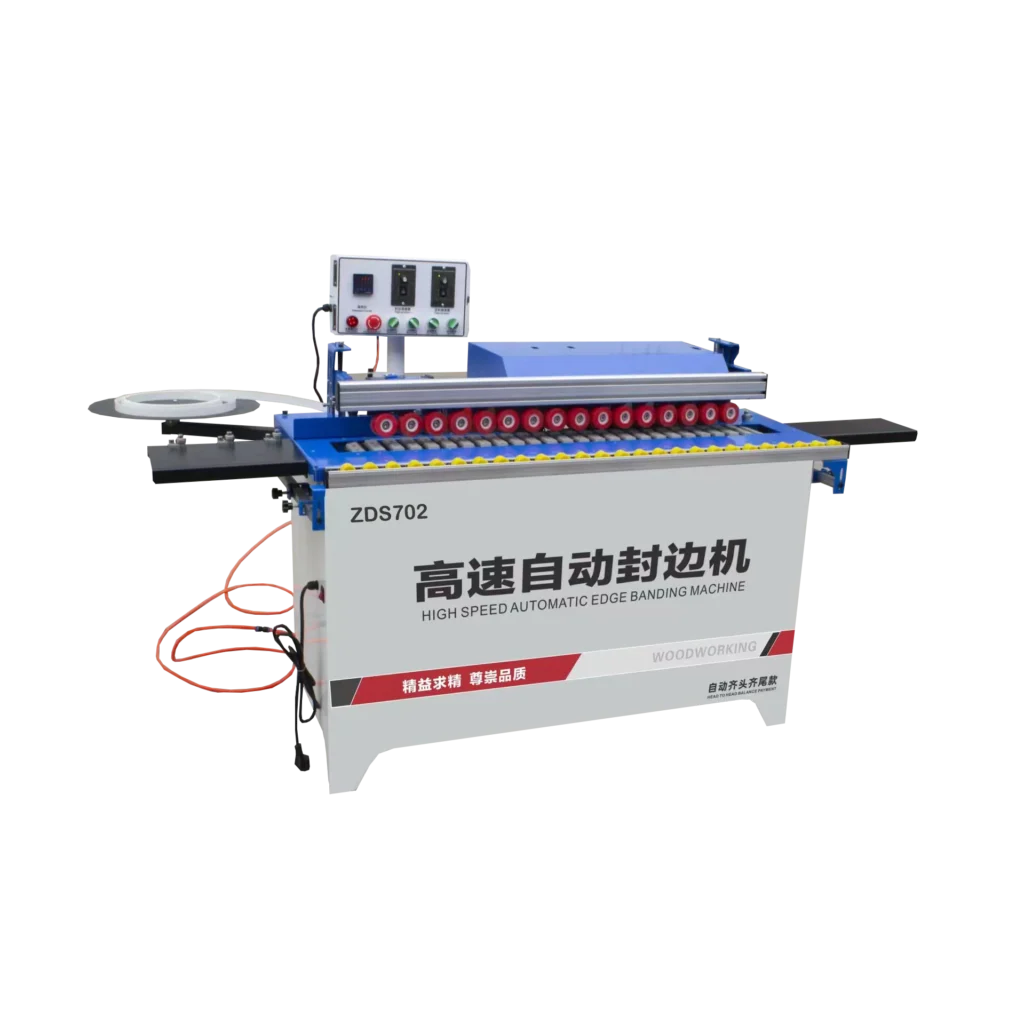
Verified Tolerance Mapping — every ZDS702 parameter is documented against actual panel thickness and feed rate ranges so you can cross-check capability before ordering.
Technical Specifications
| Parameter |
Value |
| Model |
ZDS702 |
| Product Type |
Semi Automatic Edge Banding Machine |
| Edge Type |
Straight line |
| Trimming Height (Panel Thickness Range) |
5-50mm |
| Edge Banding Thickness |
0.3-3mm |
| Feed Speed |
0-10m/min (variable) |
| Rated Voltage |
220V/380V/customization |
| Rated Power |
3.8kW |
| Heating Power |
1000W (5-10min heat-up) |
| Glue Pot Capacity |
1000ml |
| Rated Air Pressure |
0.4-0.6MPa |
| Pressure System |
Integrated pressure beam, double rows of pressure wheels, silicone material conveyor belt |
| Pressure Adjustment |
Hand crank wheel with precision scale |
| Overall Dimensions (L×W×H) |
120×55×120cm |
| Machine Weight |
105kg |
| Function Stages |
Automatic plate feeding, end cutting, upper and lower polishing, automatic head and tail trimming, built-in dust collector |
| Warranty |
One year |
Application Suitability
| Application |
Material or Output |
| Custom cabinet door edge finishing |
MDF and particleboard panels 5-18mm with PVC edge banding |
| Workshop-scale plywood furniture production |
Plywood panels up to 50mm with veneer edge banding 0.3-3mm |
| Small-batch solid wood worktop trimming |
Solid wood panels within 5-50mm thickness range |
| Panel processing plant straight-line runs |
MDF, particleboard, plywood with straight edge profiles |
Why Voltage Confirmation Must Happen Before Production Starts
The ZDS702 semi automatic edge banding machine specifications include configurable voltage, but the exact configuration must be locked in before the machine enters assembly.
I once spent a month coordinating across time zones after a semi automatic edge bander arrived in South America with a motor wound for the wrong frequency. The workshop sat idle waiting for a step-down transformer that never should have been necessary. When technical buyers compare semi automatic edge banding machine specifications across suppliers, voltage and frequency alignment is the parameter most often left vague until after the deposit is paid. The ZDS702 is built to 220V/380V standards with customization available, but that range only matters if your local grid parameters are confirmed on the electrical schematic before production begins [NEED_CITE: voltage and frequency standards by export market].
Mapping Feed Speed to Substrate Fragility
The 0-10m/min variable feed speed on the ZDS702 is not just a throughput number — it directly governs how the edge banding adhesive bonds to different substrates. Running thin veneer on particleboard at maximum feed speed can cause the banding to skid before the glue sets, while slowing the feed for MDF allows full adhesive penetration. Semi automatic edge banding machine specifications rarely spell out this relationship, yet it determines whether your finished panels pass visual inspection or return from the assembly bench with lifting edges.
Pressure Beam Configuration and Glue Line Uniformity
The integrated pressure beam with double rows of pressure wheels and a silicone conveyor belt addresses the most common complaint in small-workshop edge banding: inconsistent glue lines across the panel width. Single-row pressure systems tend to concentrate force at the center, leaving edges under-pressed and prone to delamination. The silicone belt material resists glue buildup that would otherwise transfer onto subsequent panels. Hand crank adjustment with a precision scale lets operators set beam height to the exact panel thickness, removing guesswork from changeovers [NEED_CITE: edge banding adhesion standards for wood panel assembly].
Reading the Numbers That Affect Downstream Assembly
Panel thickness range of 5-50mm means the ZDS702 covers the full span from thin cabinet shelf stock to thick solid wood countertop slabs, but the practical implication is how trimming accuracy at each thickness affects your dowel and confirmat screw alignment downstream. A machine that leaves a 0.5mm lip on a 18mm panel forces the assembly team to compensate manually at every joint. The glue pot capacity of 1000ml with 1000W heating element reaching operating temperature in 5-10 minutes suits batch-style production where the machine runs for focused periods rather than continuous all-day operation. The rated air pressure of 0.4-0.6MPa must be available at the machine inlet — not just at the compressor — accounting for line loss across your workshop piping. Built-in dust collection reduces airborne particulate at the trimming station, which directly affects operator visibility and edge inspection quality during production runs.

What Happens When Specifications Are Assumed Rather Than Confirmed
Buyers who select an edge bander based on a single headline number — usually feed speed or price — discover the gaps only after the machine is bolted to the floor. Panels that exceed the stated trimming height jam at the pressure beam, forcing operators to bypass safety interlocks. Insufficient air pressure at the inlet causes the end-cutting cylinder to retract mid-cycle, leaving rough edge band stubs that fail the next quality check. These failures are not machine defects; they are specification mismatches that a thorough review of semi automatic edge banding machine specifications would have prevented [NEED_CITE: common edge bander commissioning failures in export markets].
Why Technical Buyers Source This Model Here
In-house manufacturing with proprietary cutting mechanisms means the ZDS702 tolerance claims are traceable to the machining process, not just the final inspection tag. The full product family from entry-level to full-function pre-milling models means you can evaluate the ZDS702 against higher-tier units on the same specification sheet, comparing like-for-like parameters rather than mixing data from different brands. Voltage, language, and specification customization are treated as standard configuration steps rather than special requests that add weeks to delivery. A four-stage QC process with pre-shipment verification generates a factory test record specific to your panel material before the crate is sealed. Engineer-led configuration recommendations with a formal quotation within 24 hours mean your technical questions get answered by someone who reads electrical schematics, not a sales chatbot.
Documentation & Verification
- Machine specification sheet with confirmed ZDS702 values for your exact voltage and frequency
- Electrical schematic showing wiring configuration matched to your local grid before assembly
- Factory test record documenting feed speed, trimming result, and glue temperature on your panel material
- Operation and maintenance manual written in your agreed language with illustrated adjustment procedures
- Spare parts list with part numbers cross-referenced to the pressure wheels, silicone belt, and heating element
- Packing photographs taken at pre-shipment verification stage for your records before container loading
Installation, Commissioning & Support
- Requires level concrete floor with 120×55cm footprint clearance plus operator access on three sides
- Dedicated 3.8kW circuit at confirmed voltage with isolator switch within reach of the control panel
- Arrives partially assembled; pressure beam and dust collector duct require on-site fitting
- First-run calibration of hand crank pressure scale and feed speed dial against your actual panel stock
- Operator training covers glue pot refill procedure, 5-10 minute heat-up cycle, and banding thickness changeover
- Silicone conveyor belt and pressure wheels listed as consumable spares with replacement intervals documented
Preparing Your Specification Inquiry
To confirm the ZDS702 is the correct configuration for your workshop, provide your standard panel thickness range, the edge banding materials you run most frequently, and your local voltage and frequency. Include your daily panel count so the engineer can verify the 1000ml glue pot capacity matches your batch cycle. If you operate upstream panel saws or downstream boring machines, share their feed heights so the ZDS702 integration is checked before the order is finalized.
Frequently Asked Questions
Q: How can I verify trimming accuracy on my specific panel material before placing the order?
A: Submit your panel samples or specify the exact substrate and edge banding material so a processing test can be run at the factory. The test record documents actual trimming results, glue line quality, and feed speed used. Factory visits are also available if you prefer to witness the run in person and measure output directly against your assembly tolerances.
Q: What voltage and frequency options are available, and when is this confirmed?
A: The ZDS702 supports 220V and 380V with customization for other grid standards. Your local voltage and frequency are confirmed on the electrical schematic before production begins. This document is shared for your approval so the motor winding and control components match your workshop supply — eliminating transformer delays after delivery.
Q: How does the ZDS702 compare to the 802 variant on key parameters?
A: The 802 variant carries a higher rated power at 4kW, a larger 4000ml glue pot, and greater overall dimensions and weight. The ZDS702 at 3.8kW and 1000ml glue pot suits batch-style production with shorter run cycles. Request a side-by-side specification sheet listing both models to match parameters against your panel volume and floor space constraints.
Q: Which panel thickness and edge banding combinations fall within the rated operating range?
A: The machine handles panel thickness from 5mm to 50mm with edge banding from 0.3mm to 3mm. This covers standard MDF and particleboard cabinet panels with PVC banding, as well as thicker plywood and solid wood stock with veneer banding. Combinations outside these ranges require evaluation — submit your material schedule for an engineer-led suitability check.
Q: How do I match the ZDS702 feed speed to my upstream and downstream stations?
A: The 0-10m/min variable feed speed lets you balance the edge bander against your panel saw output and boring machine intake rate. Share your line layout and target daily volume so the engineer can map throughput across stations and confirm the ZDS702 will not become a bottleneck or force upstream machines to idle between batches.