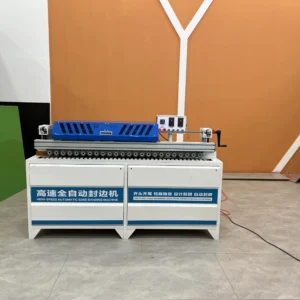
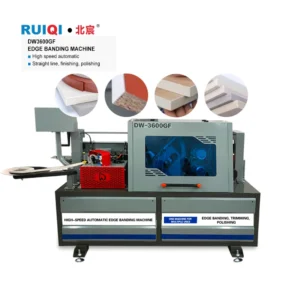
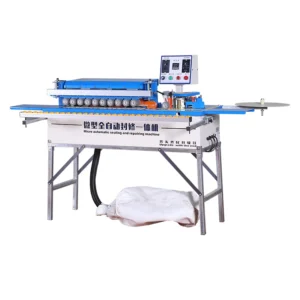
Verified Tolerance — Model 802 specifications are documented with measurable trimming and polishing results on your actual substrate before shipment, so technical buyers can validate feed speed, motor power, and glue capacity against real production requirements.
Technical Specifications
| Parameter |
Value |
| Model |
802 |
| Product Type |
High Speed MDF Edge Strip Banding Machine |
| Function |
Automatic plate feeding, end cutting, upper and lower polishing, automatic head and tail trimming, with dust collector |
| Edge Type |
Straight line |
| Rated Voltage |
220V |
| Strip Thickness Range |
0.5–2.5 mm |
| Sheet Thickness Range |
10–50 mm |
| Trimming Power |
800W × 2 |
| Polishing Power |
180W × 2 |
| Suction Power |
1200W |
| Rated Power |
4 kW |
| Rated Air Pressure |
0.4–0.6 MPa |
| Feed Speed |
0–10 m/min |
| Conveyor Belt Speed |
0–10 m/min |
| Glue Pot Capacity |
4000 ml |
| Heating Power |
1000W (heat-up 5–10 min) |
| Overall Dimensions |
130 × 65 × 75 cm |
| Machine Weight |
150 kg |
| Control System |
Digital display with independent switches |
| Conveyor Belt Material |
Silicone |
| Pressure Beam |
One-piece, double rows of pressure wheels |
| Assembly State |
Partially assembled (some assembly required per user manual) |
| Warranty |
1 year |
Application Suitability
| Application |
Material or Output |
| Custom cabinet door edge sealing |
MDF panels 10–50 mm thick with 0.5–2.5 mm PVC or veneer strips |
| Small furniture workshop production |
Particleboard shelving and carcass panels, straight-line edges only |
| Plywood component finishing |
Plywood sheets for interior joinery and built-in furniture |
| Workshop upgrading from manual banding |
Hot melt glue edge banding on wood-based panel substrates |
Why Voltage Must Be Settled Before You Compare high speed edge banding machine specifications
A machine rated at 220V on paper can arrive at a workshop wired for 440V three-phase and sit idle for weeks.
I have seen this happen more times than I care to count. A buyer in Southeast Asia once ordered a bander based on a competitor's catalog without confirming local supply frequency. The motor overheated within the first shift because the cooling fan was designed for 60 Hz operation on a 50 Hz grid [NEED_CITE: voltage and frequency standards by export market]. The lesson is always the same: verify the electrical specification against your facility before comparing throughput numbers. The Model 802 ships with a formal electrical schematic and voltage confirmation document so there is no guesswork at the dock.

Feed Speed and Panel Thickness — Reading the Numbers Correctly
The 0–10 m/min feed speed range on the Model 802 is adjustable, which matters when you are switching between thin MDF shelves and thicker particleboard carcass panels. Running a 50 mm board at maximum feed speed can overwhelm the dual 800W trimming motors, leaving chatter marks on the edge. Dialing back the conveyor belt speed for heavier stock gives the cutters time to engage cleanly. This is where high speed edge banding machine specifications require interpretation rather than simple comparison.
Glue Pot Capacity and Continuous Run Length
A 4000 ml glue pot capacity means fewer refill interruptions when you are running a batch of cabinet doors back to back. The 1000W heating element brings the hot melt adhesive to working temperature in 5–10 minutes, and maintaining that temperature through a long run depends on your ambient workshop conditions. In cold or poorly insulated spaces, the glue can thicken at the nozzle, affecting adhesion on later panels in the queue [NEED_CITE: hot melt adhesive viscosity and ambient temperature in woodworking].
Trimming, Polishing, and the Tolerance Chain
The dual 800W trimming motors handle upper and lower head-and-tail trimming in a single pass, followed by 180W × 2 polishing units that clean residual adhesive from the panel face. The one-piece pressure beam with double rows of pressure wheels holds the strip against the board edge during each station. When all stages perform within tolerance, the finished edge sits flush and the panel moves directly to assembly without manual touch-up. That is the measurable outcome technical buyers should request in a factory test record.
What Happens When You Skip the Substrate Test
A workshop I worked with once specified a bander purely on motor power and feed speed, ignoring the behavior of their local particleboard. The board had higher resin content than the test samples, which caused the hot melt glue to bond unevenly. Panels that passed visual inspection failed when the assembler applied clamping pressure. The trimming motors were never the problem — the substrate-glue compatibility was [NEED_CITE: adhesive bonding variability across particleboard grades]. Always run your actual board stock through the machine before finalizing an order.
Why Technical Buyers Choose This Configuration
The Model 802 covers the full straight-line workflow in a 130 × 65 × 75 cm footprint, which fits workshops where floor space limits line layout options. Voltage is confirmed and documented before production starts, eliminating on-site electrical surprises. The digital display with independent switches lets operators adjust each station without navigating nested menus, reducing setup errors during shift changes. Factory test records on your specific panel thickness and strip material ship with every unit. Multilingual operation manuals are available so your team can commission the machine without waiting for a translated guide.
Documentation & Verification
- Machine specification sheet listing every motor rating, glue pot capacity, and tolerance value
- Electrical schematic and voltage confirmation document matched to your local supply
- Factory test record on your actual panel thickness and edge strip material
- Operation and maintenance manual in the agreed language for operator-level clarity
- CE declaration of conformity and ISO 9001 certificate for import compliance
- Packing photographs and customs documentation support for smooth clearance
Installation, Commissioning & Support
- Allow floor space for the 130 × 65 × 75 cm footprint plus operator clearance on three sides
- Confirm dedicated 220V circuit capacity for the 4 kW rated power before delivery
- Complete partial assembly per the user manual, including pressure beam and dust collector attachment
- Set feed speed, trimming depth, and polishing pressure during first-run commissioning on your stock
- Train operators on the digital display with independent switches for station-level adjustments
- Stock silicone conveyor belt segments and polishing pads as first-order spare parts
What to Include in Your Inquiry
To give you an accurate configuration recommendation, share your primary panel material, typical board thickness range, and the edge strip material you intend to run. Confirm your facility voltage and frequency so the electrical package matches your supply. If you are replacing an existing bander, note the feed speed you currently operate at and any edge quality issues you want resolved. Sample panels sent to the factory allow a processing test on your exact substrate before the order is finalized.
Frequently Asked Questions
Q: How does the Model 802 feed speed map to my daily panel volume?
A: The 0–10 m/min adjustable feed speed lets you match throughput to board thickness. Thinner MDF runs faster while heavier particleboard requires slower feed for clean trimming. Daily volume depends on your panel size, loading time between boards, and the trimming quality your downstream assembly demands. A processing test on your stock gives a realistic cycle time.
Q: What voltage options are available and how is supply confirmed before shipment?
A: Voltage is confirmed against your local grid during the quotation stage. The Model 802 is listed at 220V, and a formal electrical schematic and voltage confirmation document are produced before the machine enters production. This prevents the common problem of equipment arriving incompatible with the workshop supply [NEED_CITE: CE machinery directive requirements for industrial equipment].
Q: What panel and strip thickness ranges does the 802 handle?
A: The machine accepts sheet thickness from 10 to 50 mm and edge strip thickness from 0.5 to 2.5 mm on straight edges. Tolerance depends on the interaction between your substrate density, strip material, and feed speed. Request a factory test record on your actual board and strip combination to verify edge flush and adhesion quality before committing.
Q: What documentation ships with the machine?
A: Every unit ships with a machine specification sheet, electrical schematic with voltage confirmation, factory test record, operation and maintenance manual in your agreed language, spare parts list, and packing photographs. CE declaration of conformity and ISO 9001 certificate are included for customs clearance. All documents reference the specific configuration you ordered.