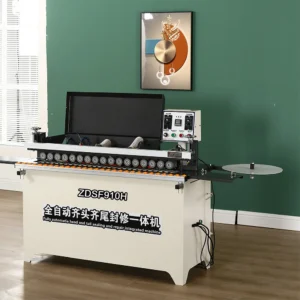
Precision-ground single-track guidance — verified on high-density substrates before dispatch, ensuring the JT650 PRO holds cutting accuracy where manual saws drift under load.
Technical Specifications
| Parameter |
Value |
| Product Type |
Radial Saw Table / Woodworking Sliding Table Saw with Edge Banding Machine |
| Model |
JT650 PRO |
| Total System Power |
6200W (saw unit) + 1000W (banding unit) |
| Main Saw Motor |
3000W, 3800 r/min |
| Scoring Sub-Saw Motor |
2000W, 13000 r/min |
| Vacuum Cleaner Power |
1200W |
| Voltage Configuration |
220V / 380V / customizable per facility supply |
| Maximum Plank Cutting Length |
2.44 m |
| Maximum Plank Cutting Thickness |
4 cm |
| Sliding Table Track |
32 cm width × 120 cm length, single track |
| Main Saw Blade Diameter |
20 cm |
| Edge Banding Height Range |
0–50 mm |
| Edge Banding Thickness Range |
0.3–3 mm |
| Minimum Sheet Dimensions for Banding |
25 cm length × 5 cm width |
| Glue Pot Capacity |
1000 ml |
| Air Source Pressure Requirement |
0.5–0.8 MPa |
| Edge Banding Function |
Curved and straight profiles, manual push plate |
| Control Panel Language |
Chinese and English (additional languages available) |
| Plug Options |
EU, USA, AU, UK |
| Standards |
CE, ISO 9001 |
Application Suitability
| Application |
Material or Output |
| Custom cabinet panel cutting and edge finishing |
MDF, particleboard, plywood up to 2.44 m with PVC or ABS edging |
| Small workshop furniture production |
Wood-based panels with melamine or veneer surfaces requiring chip-free cuts |
| Decorative panel processing |
ABS panels, PVC panels, organic glass plates with straight and curved banding |
| Solid wood joinery prep |
Solid wood panels up to 4 cm thickness with subsequent edge protection |
| Mixed-material prototyping |
Substrates of similar hardness requiring combined cutting and banding in a single station |
Why Voltage Confirmation Must Precede the Sliding Table Saw with Edge Bander How to Choose Decision
Specifying voltage after the order is placed is the most frequent reason machines arrive non-functional at their destination.
When a workshop invests in a combined radial saw table specifications package, the electrical supply at the installation site must be confirmed in writing before production begins. Facilities in different export markets operate on varying frequency standards — 50 Hz versus 60 Hz — and these differences affect motor speed, thermal load, and ultimately cut accuracy. I once helped troubleshoot a sliding table saw installation where the motor ran hot within the first week because the frequency mismatch was caught only at commissioning. The machine was not defective; the specification step had simply been skipped. [NEED_CITE: voltage and frequency standards by export market]

Evaluating the Dual-Saw Configuration Against Your Panel Substrate
The main saw at 3000W and 3800 r/min handles primary cuts through panels up to 4 cm thick, while the scoring sub-saw runs at 13000 r/min to pre-score the bottom face of laminated sheets. This arrangement matters most when cutting melamine-faced particleboard or veneered MDF, where the scoring blade eliminates tear-out on the exit side. For workshops processing a mix of raw and surfaced boards, the dual-saw setup means you do not need to swap blades between jobs — a detail that affects daily throughput more than any single speed rating suggests. Understanding radial saw table specifications at this level prevents ordering a single-saw unit into an application that demands finished edges on both faces.
Matching the Edge Banding Module to Your Cutting Rhythm
The integrated banding unit handles 0.3–3 mm thickness across a 0–50 mm height range with a 1000 ml glue pot, operating on both straight and curved profiles. When you run standard 18 mm particleboard shelving, the banding cycle on each piece will typically take longer than the cut itself — meaning the edge bander, not the saw, sets the pace of the workstation. This is not a flaw; it is a characteristic of any combined cutting-and-banding station. The question for a production manager is whether your batch sizes and panel dimensions align with manual push-plate feeding at this scale. [NEED_CITE: workflow considerations for combined saw and edge bander stations]
What the Track Dimensions and Motor Power Mean for Daily Operation
The 32 cm × 120 cm single-track sliding table supports panels up to 2.44 m in length, which covers standard 8-foot sheet goods. The duralumin construction with a precision-ground steel guide rail is designed to resist deflection under heavy panels — but the real test is how the track holds alignment after months of loading and unloading dense boards. Total saw unit power at 6200W provides adequate headroom for high-density particleboard and MDF, materials that demand more torque than soft plywood or OSB. When selecting based on radial saw table specifications, verify that the maximum cutting thickness of 4 cm covers your thickest scheduled material, including any solid wood stock that occasionally enters the workflow.
The Cost of Discovering Tolerance Failure at Assembly
A sliding table saw that cuts 0.5 mm out of square may not reveal the error until cabinet carcases refuse to close during assembly. By that point, the panels have already been edged, drilled, and possibly laminated — compounding the rework cost well beyond the cut itself. This is why requesting a pre-shipment test record on your actual substrate is not optional paperwork; it is the only way to verify that the machine's guide rail and fence system hold the accuracy your downstream joinery requires. [NEED_CITE: tolerance requirements for panel furniture assembly]
Why Procurement Through This Channel Reduces Configuration Risk
The JT650 PRO is available with voltage configurations matched to your facility supply — confirmed in writing before production, not assumed at dispatch. Custom control panel languages ensure your operators can read settings during commissioning without relying on translated manuals after the fact. The four-stage quality control process covers incoming material inspection through pre-shipment verification, meaning the machine you receive has been tested against documented parameters. Engineer-led configuration recommendations address the specific gap between what a catalog page promises and what your actual material demands. Factory test records on your specified panel thickness range accompany every shipment, providing a baseline for future accuracy checks.
Documentation & Verification
- CE declaration of conformity applicable to the JT650 PRO dual-saw and banding configuration
- Electrical schematic confirming your facility voltage and frequency before production begins
- Factory test record with sample cut photographs on your specified panel material
- Operation and maintenance manual delivered in your operator's confirmed language
- Spare parts list matching the exact components installed on your unit
Installation, Commissioning & Support
- 220V or 380V supply must be confirmed with a dedicated circuit matching the 6200W saw plus 1000W banding total draw
- Air compressor delivering 0.5–0.8 MPa required at the workstation for the edge banding module
- Machine arrives with J2 wooden box packaging; allow adequate floor space for uncrating the combined unit
- Sliding table track alignment verification should be the first commissioning step before any production cuts
- Glue pot initial fill at 1000 ml capacity with adhesive type matched to your banding material specification
- Daily cleaning of the 32 cm × 120 cm track surface prevents dust buildup that degrades sliding accuracy
How to Structure Your Technical Inquiry
When requesting a quotation for the JT650 PRO, include your primary panel material type and thickness range, the maximum sheet dimensions you process, and your facility voltage and frequency. Specify the edge banding materials you use — PVC, ABS, veneer, or melamine — along with typical banding thickness. If your operators require a control panel language beyond Chinese or English, state this explicitly so it is confirmed before build.
Frequently Asked Questions
Q: How do I verify cutting tolerance on the JT650 PRO against my panel assembly requirements?
A: Request a pre-shipment test record showing sample cuts on your specific substrate material. The record should document dimensional accuracy on panels matching your maximum length and thickness. This provides a verifiable baseline you can reference during installation and compare against during routine quality checks on the production floor.
Q: What voltage and frequency configurations are available, and how is this confirmed before shipment?
A: The JT650 PRO is configurable for 220V or 380V supply with frequency matched to your market. Written confirmation of voltage and frequency is obtained during the specification phase before production begins. An electrical schematic reflecting your confirmed configuration is included in the documentation package shipped with the machine.
Q: Can the control panel language be customized for my operators?
A: Chinese and English are standard, with additional languages available upon request. The language requirement should be specified during the quotation phase so the correct interface is installed before dispatch. This eliminates commissioning delays caused by operators unable to read machine settings at first startup.
Q: How does the integrated edge banding throughput match the saw cutting cycle?
A: The manual push-plate banding module typically requires more time per piece than the cutting operation, making the banding station the pace-setting step. This is normal for combined workstations. Assess whether your batch sizes and panel dimensions align with manual feeding before specifying this configuration for higher-volume production runs.
Q: What is the procedure for requesting a sample processing test on my substrate before ordering?
A: Submit your panel material type, thickness, and edge banding specification during the inquiry stage. A sample processing test can be arranged at the factory, producing cut and banded pieces on your exact material. Test results and photographs are documented and shared for your evaluation before any order commitment is made.