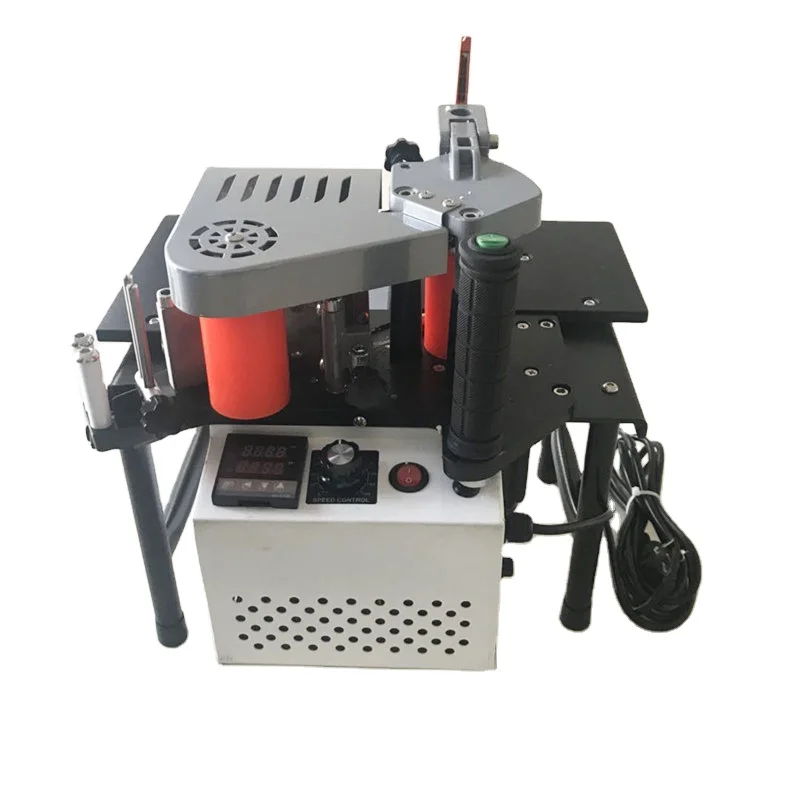
Voltage-confirmed specification matching — each Portable Manual Straight Curve Hand Edge Banding Machine ships with an electrical schematic verifying 220V compatibility before dispatch, matched to your workshop's plug standard.
Technical Specifications
| Parameter |
Value |
| Product Type |
Portable Edge Banding Machine |
| Voltage |
220V (confirm frequency and regional variant availability) |
| Rated Power |
1000W |
| Plate Shape Compatibility |
Curved & Straight plates |
| Edge Thickness Range |
0.3–3mm |
| Board Thickness Range |
7–60mm |
| Gluing Method |
Double-sided gluing |
| Glue Pot Capacity |
800ml |
| Net Weight |
14kg |
| Assembly State |
Portable / hand-held |
| Plug Options |
EU / AU / UK / USA / CN |
| Logo Customization |
Available |
Application Suitability
| Application |
Material or Output |
| Small workshop edge banding on flat panel stock |
MDF, particleboard and plywood panels 7–60mm thick |
| Curved cabinet door and radiused panel edge finishing |
PVC and veneer edge banding 0.3–3mm thick |
| On-site furniture installation edge touch-up |
Pre-cut boards requiring straight or profiled edge sealing |
| Low-volume custom furniture production runs |
Melamine-faced and laminated board with PVC edge trim |
Why the Voltage Question Must Come Before the Portable Edge Banding Machine Specifications
Ordering without confirming local frequency renders a 220V machine inoperable on arrival.
I have watched a 60Hz workshop receive a 50Hz-optimised glue pot and spend two weeks sourcing a step-down transformer before the unit would hold temperature. Buyers compare portable edge banding machine specifications across suppliers but skip the single line that decides whether the unit runs at all [NEED_CITE: voltage and frequency standards by export market]. Frequency mismatch shifts the heating element cycle and the feed motor RPM, producing cold glue lines on thick PVC stock that look fine until the panel reaches the customer's site.

Mapping Board Thickness to Glue Temperature Stability
A 1000W rated heating element holds temperature across the 7–60mm board thickness range, but thicker stock absorbs heat faster as the edge passes through the glue zone. Double-sided gluing compensates by coating both the panel edge and the banding strip, maintaining bond strength when 50mm particleboard draws heat away from the adhesive layer. Operators running 18mm MDF in continuous shifts will notice the glue pot recover between passes, while 60mm solid panels demand a deliberate feed pace to keep the adhesive within bonding temperature.
Curved Profile Geometry and Feed Control
Straight edges allow the operator to push the panel past the glue roller at a consistent rate, but curved profiles require the portable edge banding machine to follow a changing radius without lifting the banding away from the substrate. The 0.3–3mm edge thickness range means thin veneer conforms readily to tight radii, while 3mm PVC requires the operator to reduce feed speed and increase hand pressure to prevent edge lift at the curve apex [NEED_CITE: PVC edge banding adhesion on curved substrate profiles]. Matching banding thickness to the minimum curve radius in your product range prevents delamination claims after installation.
What the Specification Numbers Mean on the Workshop Floor
Board thickness range defines which panel stock the machine accepts without modification, and 7–60mm covers the full span from thin drawer sides to thick workbench tops in a single setup. Edge thickness range governs which banding inventory you can run, and 0.3–3mm spans melamine paper through to impact-resistant PVC without changing the glue roller or pressure shoe. The 800ml glue pot capacity determines how many linear metres you edge before refilling, and double-sided gluing roughly halves that interval compared to single-side application because adhesive is dispensed onto both surfaces simultaneously. Net weight of 14kg keeps the unit stable on a bench during straight runs but allows one operator to reposition it for curved work without a second set of hands.
The Real Cost of Skipping Specification Verification
Buyers who select a portable edge banding machine by price alone often discover after delivery that their local 60Hz supply drives the feed motor faster than the glue can bond, producing edge lines that fail peel tests within days. Others specify a unit rated for 0.4mm veneer and attempt to run 2mm PVC, finding the glue roller cannot maintain contact pressure on thicker stock [NEED_CITE: edge banding delamination causes in small workshop environments]. The rework cost of stripping and re-edging a batch of cabinet doors typically exceeds the price difference between a correctly specified unit and the cheapest alternative.
Why This Source Supports Specification-Led Procurement
In-house manufacturing with patented cutting mechanisms means tolerance claims are verifiable against your actual panel stock, not quoted from a catalogue. The full product family from entry-level to full-function allows a workshop to scale throughput without switching supplier or retraining operators on a different control interface. Voltage, plug and language configuration is confirmed at quotation stage, not discovered at unpacking. Four-stage quality control with pre-shipment verification includes a factory test record run on the buyer's specified board thickness and banding material. Engineer-led configuration recommendation responds within 24 hours with a formal quotation tied to your production volume and panel mix.
Documentation & Verification
- CE declaration of conformity covering portable hand-held woodworking equipment
- Electrical schematic confirming 220V and plug type before shipment
- Machine specification sheet with edge and board thickness values verified
- Operation manual translated to the operator's working language
- Factory test record on buyer-supplied panel and banding samples
Installation, Commissioning & Support
- 1000W draw requires a dedicated circuit to prevent voltage drop during glue heat-up
- 14kg portable assembly needs a stable bench at operator waist height for straight runs
- First commissioning includes glue temperature calibration for your specific banding thickness
- Spare glue roller and pressure shoe included for initial consumable replacement cycle
- Daily glue pot cleaning procedure documented to prevent cured adhesive blockage
Request a Configuration Proposal
Provide your primary board material, thickness range and the edge banding type you run most frequently. Confirm your workshop supply voltage and frequency, along with the plug standard in use. State whether curved profiles are a regular part of your output or an occasional requirement, and we will return an engineer-led specification match within 24 hours.
Frequently Asked Questions
Q: How do I confirm voltage and frequency compatibility before ordering a portable edge banding machine?
A: Supply your workshop's voltage, frequency and plug type at enquiry stage. The quotation includes an electrical schematic confirming the unit matches your supply. Frequency affects both glue pot heating cycle and feed motor speed, so a 50Hz machine behaves differently on a 60Hz network and must be specified accordingly before production begins.
Q: What board and edge thickness combinations work within the 0.3–3mm and 7–60mm ranges?
A: Thin veneer at 0.3mm suits curved profiles on 18mm MDF, while 3mm PVC is suited to straight edges on boards up to 60mm thick. The combination you select affects glue temperature demand and feed pace. Thicker banding on tight curves risks edge lift, so match banding thickness to the minimum radius in your product range.
Q: Does double-sided gluing affect consumable usage and bond quality?
A: Double-sided gluing coats both panel edge and banding strip, consuming adhesive faster than single-side application but producing a stronger bond on thick and porous substrates. The 800ml glue pot capacity supports a defined number of linear metres before refill, and the interval shortens when double-sided mode is active continuously.
Q: What documentation ships with the portable edge banding machine?
A: Each unit ships with a CE declaration of conformity, electrical schematic, machine specification sheet, factory test record and an operation manual in the agreed language. A spare parts list covers consumables such as glue rollers and pressure shoes. All documents reference the specific unit serial number for traceability.