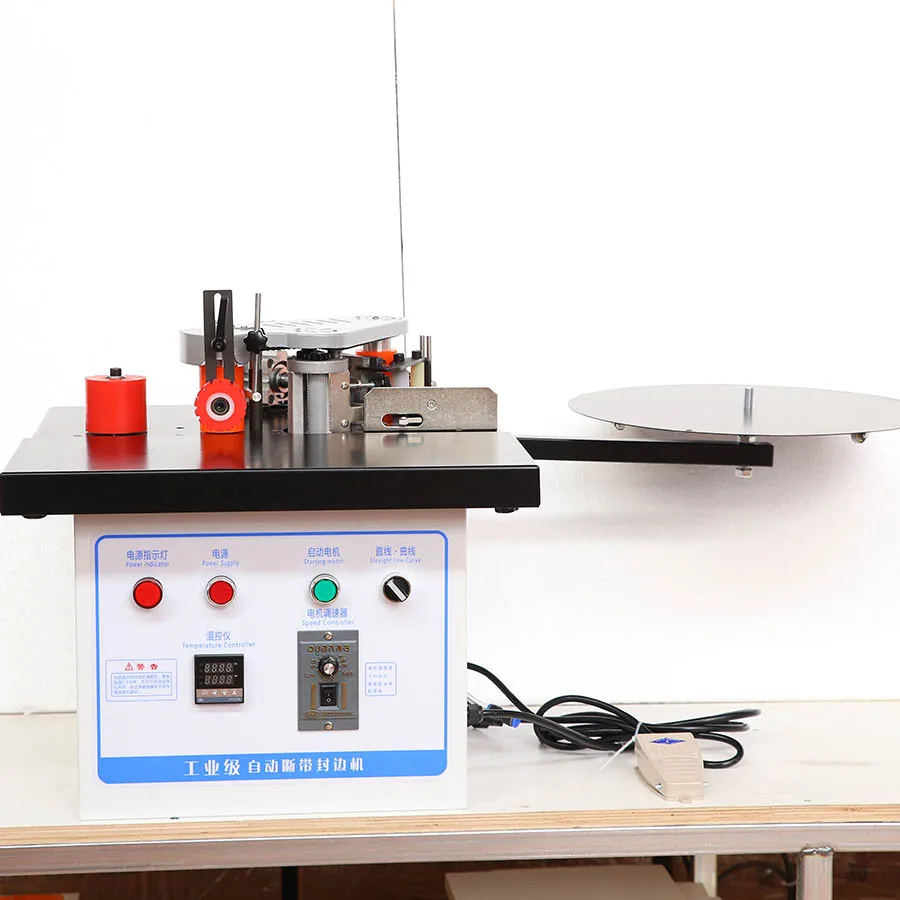
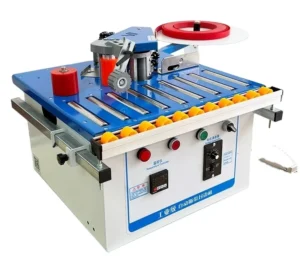
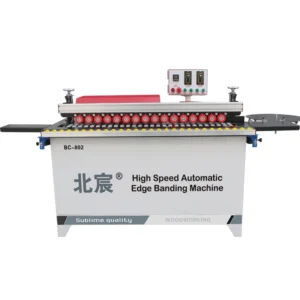
Voltage Verification Before Purchase — ZDSF-60 portable mini edge banding machine specifications confirmed at 220V single-phase with electrical schematic provided before order confirmation.
Technical Specifications
| Parameter |
Value |
| Model |
ZDSF-60 |
| Product Type |
Portable Mini PVC Edge Banding Machine |
| Function |
Straight, curved, and shaped edge banding with automatic tape breaking |
| Edge Banding Speed |
0–6 m/min (variable feed) |
| Max Sheet Thickness |
50 mm |
| Strip Thickness Range |
0.5–2 mm |
| Rated Voltage |
220V single-phase |
| Heating Power |
800W with 4 heating tubes |
| Heat-Up Time |
5–8 minutes (basis to be confirmed) |
| Glue Pot Capacity |
1000 ml |
| Glue Application Method |
Double-sided glue-coated rollers |
| Rated Air Pressure |
0.4–0.6 MPa |
| Belt Breaking System |
Pneumatic with foot switch and travel switch |
| Pressure Rollers |
Adjustable, rubber material |
| Strip Transport |
Adjustable bayonet for strip height |
| Overall Dimensions |
54×54×56 cm |
| Machine Weight |
26 kg |
Application Suitability
| Application |
Material or Output |
| Small workshop panel processing |
MDF, particleboard, plywood edge finishing |
| On-site custom furniture installation |
Solid wood panels requiring curved edge banding |
| Low-volume cabinet production |
PVC edge banding 0.5–2 mm on flat and shaped profiles |
| Joinery workshop scaling operations |
Veneer and PVC strips on straight and curved substrates |
Why 220V Confirmation Must Happen Before You Compare Portable Mini Edge Banding Machine Specifications
Request the electrical schematic and voltage confirmation document before placing any order.
I spent three weeks waiting for a workshop in Chile to rewire their facility because I quoted a 440V machine without checking their actual supply. The electrician arrived on commissioning day, opened the panel, and told us they only had 220V single-phase available. That portable mini edge banding machine sat idle while the facility upgraded. [NEED_CITE: voltage and frequency standards by export market]
Now I ask every buyer to photograph their distribution board before I send a formal quotation. The ZDSF-60 runs on 220V single-phase with 800W heating demand, which suits most small workshop circuits — but only if you verify local frequency compatibility and available amperage first.
Double-Sided Gluing and Substrate Bond Quality
The ZDSF-60 applies adhesive to both the edge strip and the panel surface through paired rollers before the pressure stage. This double-sided glue-coated roller configuration produces stronger adhesion on porous substrates like particleboard compared to single-sided application systems. The 1000 ml glue pot with four heating tubes reaches operating temperature within minutes, maintaining consistent viscosity throughout a production run.
Pneumatic Tape Breaking and Operator Workflow
The pneumatic belt breaking system activates through either a foot switch for curved profiles or a travel switch for automatic straight-line breaking. This configuration lets operators keep both hands guiding the workpiece through curves without stopping to manually cut the strip. The travel switch triggers automatically when the panel edge passes the sensor point, maintaining consistent break positioning across repetitive straight runs.
Feed Speed, Panel Thickness, and Production Volume Matching
The 0–6 m/min variable feed speed range accommodates different panel thicknesses from thin MDF sheets up to 50 mm solid stock. Thicker panels require slower feed rates to allow adequate glue transfer and pressure roller contact time. The adjustable pressure rollers and strip transport bayonet let you dial in settings for each material combination without tooling changes.

What Happens When Voltage and Application Mismatch Occurs
Machines arrive at the dock inoperative because the local grid delivers different voltage or frequency than the unit requires. Three-phase equipment plugged into single-phase supply burns the motor windings within hours. Control boards designed for 50Hz operation malfunction on 60Hz grids, causing erratic heating cycles and inconsistent glue temperature. [NEED_CITE: CE machinery directive requirements for industrial equipment]
Small workshops buy entry-level machines rated for occasional use, then run them eight hours daily processing production volumes they were never designed to handle. The glue pot cycling and roller wear accelerate beyond maintenance intervals, causing bond failures that only surface during furniture assembly.
Manufacturing Depth and Specification Verification
The facility produces edge banding equipment across the full range from portable mini units to complete production lines, so configuration recommendations come from engineers who build every model. Pre-shipment testing runs your specified substrate and strip material through the ZDSF-60 before packing, generating a factory test record that documents actual edge quality on your materials. The four-stage quality control process covers incoming component inspection through final verification, ensuring the 220V electrical system and pneumatic components meet specification before dispatch.
Documentation & Verification
- Electrical schematic and voltage confirmation sheet matching your local grid requirements
- Factory test record showing edge banding quality on your specified panel thickness and strip material
- Operation and maintenance manual in your operator's language with control panel labeling translation
- Spare parts list identifying consumable wear items and recommended replacement intervals
Installation, Commissioning & Support
- 220V single-phase dedicated circuit with adequate amperage for 800W heating load plus motor draw
- Compressed air supply at 0.4–0.6 MPa with moisture filtration for pneumatic tape breaking system
- Compact 54×54×56 cm footprint requires minimal floor space with access clearance for strip loading
- Initial heat-up verification and glue temperature calibration for your specific PVC or veneer strip material
- Operator training on foot switch and travel switch operation for curved versus straight edge profiles
- Consumable spare parts inventory including glue rollers and heating tubes for ongoing maintenance
Requesting Your Configuration Proposal
Send photographs of your workshop distribution board showing available voltage and phase configuration. Specify the panel materials you process most frequently along with typical thickness ranges and the PVC or veneer strip thickness you use. Note whether your production involves primarily straight edges, curved profiles, or a mix requiring both straight-line and manual break operation.
Frequently Asked Questions
Q: How does the 0–6 m/min banding speed compare to full-size edge banders, and what production volume is this machine realistically designed for?
A: The ZDSF-60 portable mini edge banding machine operates at lower throughput than stationary production lines with multiple processing stations. This unit suits small-batch, high-mix environments where you process varied panel sizes and edge profiles rather than running identical components for hours. The variable speed lets you slow down for thick stock or curved sections while maintaining reasonable pace on straightforward straight-edge work.
Q: Can the 220V / 800W electrical specification be confirmed for my country's voltage and frequency standard?
A: The standard configuration delivers 220V single-phase operation, but frequency compatibility depends on your local grid specifications. Request the electrical schematic before ordering so your electrician can verify amperage availability and confirm whether 50Hz or 60Hz operation applies to your region. Voltage customization is available for markets requiring different supply standards.
Q: What substrates and edge banding materials have been tested, and how does double-sided gluing perform on MDF versus particleboard?
A: The double-sided glue application produces strong bonds on porous substrates including MDF, particleboard, and plywood when using PVC or veneer strips within the 0.5–2 mm thickness range. Particleboard's open structure absorbs adhesive readily, while MDF's denser surface requires consistent roller pressure. Request a factory test using your specific material combination before shipment to verify bond quality.
Q: How do I verify actual edge banding tolerance before shipment — can a sample processing test be arranged with my material?
A: Send representative samples of your panel stock and preferred edge strip material to the factory for pre-shipment testing. The facility runs your materials through the ZDSF-60, documents edge quality and bond strength, and includes this factory test record with your shipment documentation. This verification happens before packing so you can approve results or request adjustments before the machine leaves.