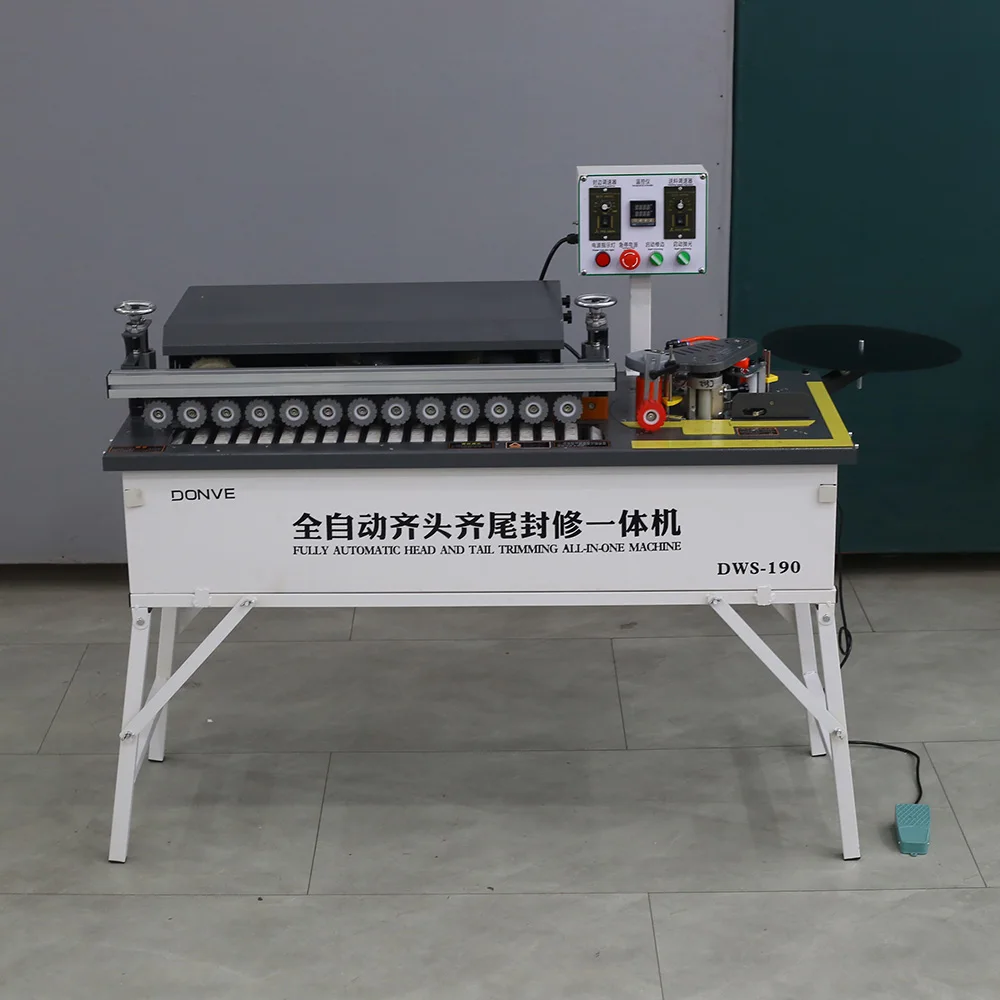
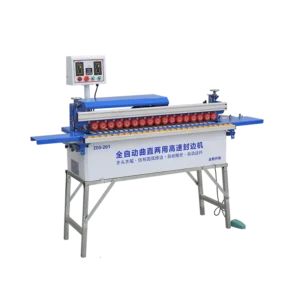
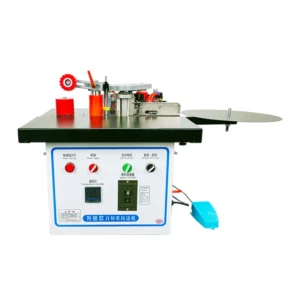
Verified Tolerance Commitment — Edge banding precision of ±0.02mm is not just a brochure claim; every portable automatic edge banding machine ships with a factory test record proving trim accuracy on your specified panel material and strip thickness before it leaves the Shandong facility.
Technical Specifications
| Parameter |
Value |
| Product Type |
Portable Automatic Edge Banding Machine |
| Function |
Automatic feeding, gluing, trimming, polishing, cleaning, vacuuming |
| Edge Type |
Both curved and straight lines |
| Voltage |
110V/220V (source value — verify against manufacturer catalog) |
| Rated Power |
4 kW |
| Rated Air Pressure |
0.4–0.6 MPa |
| Suction Power |
1200 W |
| Belt Power |
25 W |
| Transmission Power |
120 W |
| Heating Power |
800 W |
| Polishing Power |
180 W × 2 |
| Trimming Power |
800 W × 2 |
| Panel Thickness Range |
10–50 mm |
| Strip Thickness Range |
0.5–2.5 mm |
| Glue Pot Capacity |
2000 ml |
| Overall Dimensions |
1900 × 560 × 1300 mm |
| Trimming Mechanism |
4-edge alloy arc cutter head |
| Polishing Device |
Cross polishing up and down |
| Dust Extraction Effect |
98% (source value — verify against manufacturer catalog) |
| Feed System |
Crawler transmission, steel rod slide |
Application Suitability
| Application |
Material or Output |
| Custom furniture panel edge banding |
MDF, particleboard, plywood with PVC strips 0.5–2.5 mm |
| Curved contour edging for cabinet doors |
Solid wood panels with PVC edge banding |
| Small workshop joinery production |
Straight and curved edges on board substrates |
| On-site compact-footprint edging |
MDF and plywood panels 10–50 mm thick |
| Low-to-medium volume batch processing |
Particleboard and veneer-core panels with PVC banding |
Why the Voltage Question Must Come Before the Edge Banding Machine Specifications
A portable unit arriving with mismatched voltage sits idle until the workshop electrical system is reconfigured — a delay no spec sheet warns you about.
I worked the assembly floor before moving into technical sales here in Shandong, and I still remember a South American buyer who received a fully automatic edge bander wired for 440V/60Hz when their shop only had 220V available. The machine sat on the floor for three weeks while they arranged a transformer retrofit. With a 4 kW portable unit rated for 110V/220V, confirming your local frequency and amperage capacity before production starts eliminates that kind of costly surprise. Electrical mismatches on imported woodworking equipment remain a leading cause of commissioning delays across export markets [NEED_CITE: voltage and frequency standards by export market]. The edge banding machine specifications on paper mean nothing if the machine cannot be powered on the day it arrives.

Matching Panel Thickness Range to Your Substrate Mix
A portable edge bander must handle the full spectrum of board thicknesses your workshop processes. This unit covers 10–50 mm panel thickness with a 0.5–2.5 mm strip thickness envelope, which accommodates most standard MDF, particleboard, and plywood stock used in custom furniture. When your production mix includes both thin cabinet shelving at 16 mm and thicker worktop panels at 38 mm, verifying that the feed system's crawler transmission and steel rod slide can track both extremes without manual recalibration saves considerable setup time between batches. Reviewing the edge banding machine specifications against your actual material list prevents the frustration of discovering a gap in coverage after the machine is already on the floor.
Trim Station Configuration and Finished Edge Quality
The number and type of trimming and polishing stations directly determine the edge finish your operators deliver to the next production stage. This machine carries dual 800 W trimming stations paired with a 4-edge alloy arc cutter head, enabling both curved contour trimming and straight-line cuts within a single pass. Downstream, dual 180 W cross-polishing units working in an up-and-down configuration remove residual adhesive marks and smooth the PVC strip edge. For a small workshop producing visible cabinet facades and furniture panels, this station arrangement reduces the need for secondary hand-finishing. Production managers comparing portable edge banders should weigh trim station count against their required finish grade before shortlisting models [NEED_CITE: CE machinery directive requirements for industrial equipment].
How Core Parameters Translate to Workshop Performance
Several specifications on this portable unit interact to define real-world output behavior. The 2000 ml glue pot capacity, heated by an 800 W element, sets a practical ceiling on continuous run length — once the adhesive reservoir depletes, the operator must pause for a refill and reheating cycle, which interrupts batch flow. The crawler transmission feed system provides consistent panel advancement across the 10–50 mm thickness range, but feed speed is inherently lower than a stationary full-size edge bander, making this unit suited to low-to-medium volume operations rather than high-throughput line production. The 1200 W suction system working alongside the 0.4–0.6 MPa pneumatic requirement means your compressor and dust extraction infrastructure must be sized correctly; an undersized compressor causes trimming and polishing stations to lose pressure mid-cycle, degrading edge quality. The 4 kW total rated power draw is modest enough for most single-phase workshop circuits, yet it still demands a dedicated breaker to avoid tripping when other equipment cycles on simultaneously.
The Hidden Cost of Overlooking Air Supply Sizing
A portable edge bander that requires 0.4–0.6 MPa air pressure will underperform silently if the workshop compressor cannot sustain that range under continuous draw. I have seen trim stations on machines of this class produce ragged PVC edges that operators blamed on dull cutters, when the actual cause was pressure dropping below 0.4 MPa during extended runs. The pneumatic cylinders controlling feed clamping, trim head engagement, and polishing contact all depend on stable air supply. When a small workshop adds a portable unit to an existing compressor already serving a sliding table saw and a boring machine, the combined demand often exceeds what was budgeted for. Sizing your compressor with headroom for simultaneous equipment operation avoids intermittent quality defects that are difficult to trace back to their root cause [NEED_CITE: compressed air system sizing for woodworking workshops].
Why Source This Portable Edge Bander Through Our Manufacturing Channel
Our in-house production in Ningjin, Shandong means every portable automatic edge banding machine is assembled, tested, and verified under one roof — not relabeled from a third-party workshop. The patented cutting mechanisms achieving ±0.02 mm tolerance are manufactured and ground on-site, with multi-stage inspection covering incoming components through to pre-shipment verification. Voltage and control panel language customization is treated as standard configuration rather than a special request, so a buyer in Brazil receives a unit wired and labeled for their specific market. An engineer reviews your production requirement and returns a formal configuration proposal, typically within 24 hours, matching glue pot capacity and trim station setup to your actual panel mix. Factory visits are welcomed at any stage, giving you direct access to the assembly floor where your machine is being built.
Documentation & Verification
- Machine specification sheet confirming voltage, frequency, and total power draw for your local grid
- Electrical schematic detailing individual motor ratings for trimming, polishing, suction, and feed systems
- Factory test record verifying ±0.02 mm trim tolerance on your specified panel material and strip thickness
- Operation and maintenance manual produced in the agreed language with illustrated spare parts list
- Packing photographs documenting machine condition and crate configuration before dispatch
Installation, Commissioning & Support
- Allocate floor space for the 1900 × 560 × 1300 mm footprint with clearance for curved-panel feed access
- Provide a dedicated circuit matching the confirmed voltage and the 4 kW total rated power requirement
- Connect compressed air supply rated for sustained 0.4–0.6 MPa delivery to the machine inlet
- Verify glue pot heating element operation and temperature stability before loading PVC edge banding stock
- Calibrate crawler transmission feed speed and trim head alignment using sample panels from your production mix
- Stock replacement 4-edge alloy arc cutter heads and polishing pads based on the included spare parts list
Preparing Your Technical Inquiry
To receive an accurate configuration proposal for this portable automatic edge banding machine, share the panel substrates you process along with their typical thickness range, the PVC strip thicknesses you use most frequently, and your local voltage and frequency standard. Let us know whether your workshop runs primarily straight edges, curved contours, or a combination of both, and provide the available compressed air capacity so we can verify pneumatic compatibility. If you need a sample processing test on your own material before committing to an order, send a panel and strip sample to our Ningjin facility for a documented trial run.
Frequently Asked Questions
Q: How do I verify trimming tolerance on my specific panel substrate before the machine ships?
A: We run a factory test using your exact panel material and PVC strip thickness, then provide a documented test record showing measured trim accuracy. This pre-shipment verification confirms the ±0.02 mm tolerance holds on your substrate rather than on a generic reference board, giving you confidence before the machine leaves our facility.
Q: What happens if the voltage and frequency do not match my workshop supply?
A: We confirm your local voltage and frequency before production begins and configure the motor windings, heating element, and control transformer accordingly. The electrical schematic in your documentation package lists each component's rating so your electrician can verify the installation on arrival, preventing the costly transformer retrofits I have seen delay commissioning.
Q: Does the panel thickness range cover both thin shelving and thick worktop panels?
A: The 10–50 mm panel thickness range and 0.5–2.5 mm strip thickness range accommodate most standard furniture substrates, from 16 mm MDF shelving to 38 mm particleboard worktops. Reviewing your full material list against these limits before ordering ensures no production gap exists for the boards your workshop processes regularly.
Q: When should I consider stepping up from a portable unit to a full-size edge bander?
A: The 2000 ml glue pot and portable feed system suit low-to-medium volume runs with periodic refill pauses. When your daily output demands uninterrupted continuous edging across long production shifts, a full-size edge bander with a larger glue reservoir and higher feed rate becomes the appropriate investment for sustained throughput.
Q: How do I size my compressor to meet the air pressure requirement?
A: This machine requires 0.4–0.6 MPa sustained air pressure for trim, polish, and feed cylinders. Calculate your compressor's delivery capacity against all pneumatic equipment running simultaneously in your workshop, and add headroom so pressure does not drop below 0.4 MPa during peak demand, which would degrade edge finish quality.