Verified tolerance on every sheet — Our edge banding machines ship with a factory test record tied to your specified panel thickness and edge material, not a generic pass certificate.
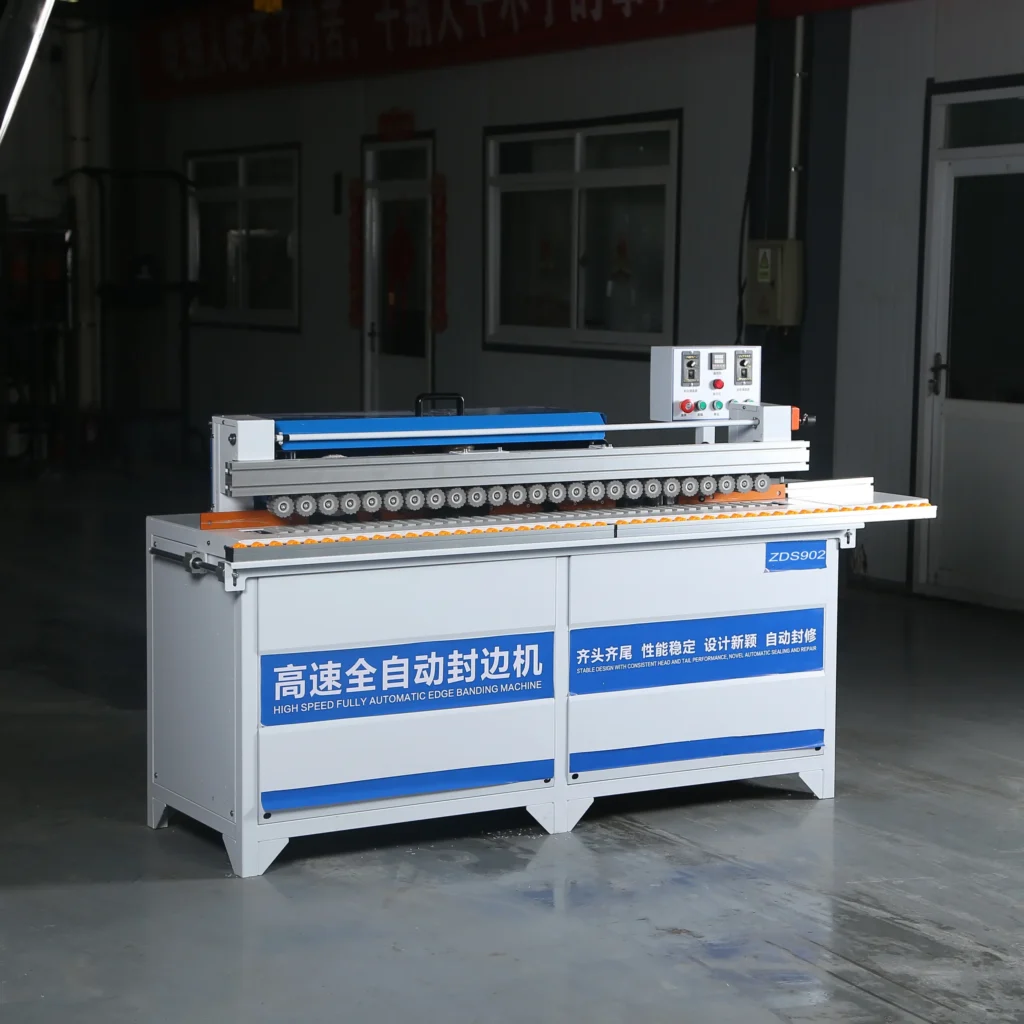
Technical Specifications
| Parameter |
Value |
| Product Type |
Automatic Edge Banding Machine |
| Voltage |
220V (frequency to be confirmed) |
| Total Power |
4200W |
| Equipment Size |
207 × 60 × 122 cm |
| Net Weight |
245 kg |
| Edge Banding Type |
Linear Edge Banding Machine |
| Edge Band Height Range |
0–35 mm |
| Edge Band Thickness Range |
0.5–2.5 mm |
| Glue Pot Capacity |
4000 ml |
| Trimming Configuration |
Double high-speed trimming motors (up and down) |
| Polishing Configuration |
Up and down two polishing motors |
| Conveyor Belt Material |
Silicone |
| Pressure Beam |
Integrated, double rows of pressure wheels, handle-adjustable |
| Edge Strip Cutting |
Pneumatically controlled |
| Control Feature |
Intelligent temperature control |
Application Suitability
| Application |
Material or Output |
| Custom cabinet door production |
MDF and particleboard with PVC edge banding |
| Wardrobe and shelving panel finishing |
Plywood substrates with 0.5–2.5 mm PVC strips |
| Small-batch joinery components |
Solid wood panels with veneer edge banding |
| Furniture factory panel edge sealing |
Melamine-faced boards requiring double-sided gluing |
Why Automatic Edge Banding Machine Specifications Determine Assembly Success Downstream
Tolerance that cannot be measured on arrival is not tolerance — it is a promise.
I have watched workshops receive a machine that ran beautifully on the supplier's test panels, only to discover weeks later that edge thickness variance was throwing off their cabinet assembly jigs. The door panels would not sit flush, the hinge boring offsets drifted, and the entire batch had to be reworked. When buyers compare Automatic Edge Banding Machine specifications across quotes, the edge band thickness range and trimming station configuration tell you more about final assembly fit than any marketing claim [NEED_CITE: woodworking assembly tolerance standards for panel furniture].

Mapping Feed Speed and Glue Temperature to Your Daily Panel Volume
A machine rated for light workshop duty will struggle when pushed into a full production shift. The 4000 ml glue pot on this Automatic Edge Banding Machine reduces the frequency of mid-run refills, which matters when you are edging several hundred panels in a single morning. Intelligent temperature control keeps the adhesive within the working window required by different banding materials — PVC behaves differently from veneer, and the glue viscosity must stay consistent from the first panel to the last.
Trimming and Polishing Station Layout Explained
The double high-speed trimming motors operating in both up and down directions remove excess edge material cleanly from both faces of the panel in a single pass. This is followed by two polishing motors that buff the trimmed edge to a smooth finish. For a production manager evaluating edge quality output, the number and orientation of these stations directly affect whether the finished panel goes straight to the drilling line or needs manual touch-up first [NEED_CITE: edge banding station configuration and surface finish correlation].
Reading the Numbers That Actually Affect Your Panels
The 0.5–2.5 mm edge band thickness range covers the majority of PVC and thin veneer applications found in custom furniture manufacturing. Running material outside this range risks incomplete trimming or excessive pressure on the feed mechanism. The 0–35 mm edge band height range defines the maximum strip width the machine can handle, which corresponds to common panel thicknesses used in cabinet and shelving production. The integrated pressure beam with double rows of adjustable pressure wheels ensures the banding is pressed firmly against the panel edge regardless of substrate density — MDF, particleboard, and plywood all compress differently under the same pressure setting. The pneumatically controlled edge strip cutting device delivers a consistent end-trim on each panel, which matters when you are running a batch where every piece must match.
The Hidden Cost of Buying a Machine That Almost Fits
A workshop that purchases an edge bander without confirming the edge band thickness range against their actual material inventory will spend weeks trying to make the wrong setup work. Glue squeeze-out on thin veneer, incomplete trimming on thicker PVC, and pressure wheel marks on soft MDF are all symptoms of a specification mismatch rather than operator error. The cost shows up as wasted edge material, rejected panels, and delayed shipments to furniture buyers who are waiting on finished components [NEED_CITE: common causes of edge banding defects in panel processing].
What Manufacturing Depth Means for Your Specification Sheet
In-house production of the cutting and trimming mechanisms means the tolerance claimed on the quotation is the tolerance you can verify on your own panels. The machine range spans from entry-level configurations to full-function pre-milling models within one product family, so a growing workshop can add capability without switching suppliers. Voltage and control panel language are confirmed before production starts, not discovered when the crate arrives. Every unit passes through incoming material inspection, in-process assembly checks, finished product testing, and pre-shipment verification. Configuration recommendations come from engineers who review your panel types and production volume, not from a catalogue checkbox.
Documentation & Verification
- CE declaration of conformity covering this edge banding machine model and configuration
- ISO 9001 certificate for the manufacturing facility producing your unit
- Electrical schematic with voltage and frequency confirmed for your local grid
- Factory test record on your specified edge band material and panel substrate
- Operation and maintenance manual in your chosen language with illustrated spare parts list
Installation, Commissioning & Support
- Requires a dedicated 220V circuit capable of supporting the 4200W total power draw
- Equipment footprint of 207 × 60 × 122 cm requires clear access on the infeed and outfeed sides
- Silicone conveyor belt inspected for tension and alignment before first panel run
- Intelligent temperature control calibrated to your specific glue type and edge banding material during commissioning
- Pneumatic edge strip cutting device tested and adjusted for consistent end-trim length
- Double high-speed trimming motors aligned to your panel thickness setting before production handover
Before You Request a Quotation
Send us the panel materials you process most often — MDF, particleboard, plywood, or a mix — along with the edge banding type and thickness you use daily. Confirm your workshop voltage and frequency so the electrical system is built correctly from the start. Let us know your typical daily panel count and whether you are edging cabinet doors, shelving, or a combination, so the configuration matches your actual throughput requirement.
Frequently Asked Questions
Q: How is edge banding tolerance verified before the machine ships?
A: Each unit runs test panels using the edge band material and substrate specified in your order. The trimming output is measured and recorded in a factory test report that ships with the machine. This gives you a baseline to check against when the machine is installed and running in your own workshop.
Q: What happens if my local voltage does not match the machine specification?
A: Voltage and frequency are confirmed during the quotation stage. The electrical system is then configured to match your local supply before assembly begins. An electrical schematic and voltage confirmation document are included in the shipping documentation for your electrician to reference during installation.
Q: How does the trimming station configuration affect edge quality?
A: The double high-speed trimming motors operate on both the top and bottom of the panel edge simultaneously, removing excess material cleanly in one pass. The two polishing motors then smooth the trimmed surface. This station layout is suited to PVC and veneer edge banding where a clean, burr-free finish is required for downstream assembly.
Q: Can the control panel be supplied in our local language?
A: Multilingual control panel options are confirmed at the quotation stage. The operation and maintenance manual is also produced in your agreed language, so your operators can reference settings and troubleshooting steps without translation delays during commissioning.
Q: What glue pot capacity is needed for continuous production runs?
A: The 4000 ml glue pot on this model reduces refill interruptions during extended runs. Intelligent temperature control maintains consistent adhesive viscosity across the run, which is particularly important when switching between PVC and veneer banding materials that require different working temperatures.