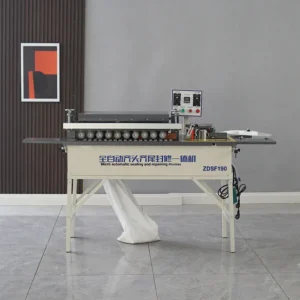
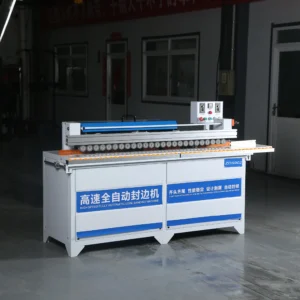
Precision-ground scoring assembly — Verified ±0.02 mm cutting tolerance on coated panels through four-stage inspection before dispatch.
Technical Specifications
| Parameter |
Value |
| Product Type |
Sliding Table Saw with Scoring Blade |
| Total Power |
6.2 kW |
| Main Saw Motor |
3 kW, 3800 r/min |
| Main Saw Blade Diameter |
200 mm |
| Scoring Saw Motor |
2 kW, 13000 r/min |
| Integrated Dust Extractor Power |
1.2 kW |
| Maximum Cutting Length |
2440 mm |
| Maximum Cutting Thickness |
40 mm |
| Plug Options |
EU, USA, AU, UK |
| Control Panel Language |
Chinese and English standard; other languages available on request |
| Certification |
CE, ISO 9001 |
Application Suitability
| Application |
Material or Output |
| Custom cabinet panel sizing |
MDF and melamine-faced particleboard up to 40 mm |
| Plywood component cutting for joinery |
Birch and poplar plywood sheets to 2440 mm length |
| Solid wood rip and crosscut |
Hardwood and softwood boards within 40 mm thickness envelope |
| Small-batch furniture workshop production |
Laminated substrates requiring scoring blade for chip-free bottom edge |
Why Sliding Table Saw Specifications Matter More Than the Brochure Claims
A published tolerance means nothing unless you can verify it on your actual panel material before the machine ships.
I have seen technical buyers compare machines on motor power alone, only to discover during commissioning that the scoring blade speed was insufficient for their melamine stock. The bottom edge chips, the panels fail edge banding adhesion, and the assembly line stalls waiting for rework. Sliding table saw specifications should always be cross-checked against the substrate you actually run, not the generic sample the factory tested [NEED_CITE: material-specific cutting tolerance verification in woodworking machinery procurement].

Reading the Power Distribution Across Both Saw Units
The 3 kW main saw motor at 3800 r/min is paired with a separate 2 kW scoring motor running at 13000 r/min. This split matters when you choose a sliding table saw for laminated board processing. The scoring blade must spin fast enough to score through melamine or veneer without tearing the decorative layer, while the main blade handles the bulk cut. If the scoring motor is undersized for your production volume, the blade bogs down mid-cut and leaves visible tear-out on the panel underside.
Dust Extraction as a Compliance Consideration
The integrated 1.2 kW dust extractor handles immediate chip removal at the blade guard. For a small workshop operating one or two machines, this module may satisfy local air quality requirements. Larger operations running multiple saws typically need a central collection system with ducting sized to total CFM demand [NEED_CITE: industrial dust collection standards for woodworking facilities]. The onboard unit supplements rather than replaces that infrastructure, and buyers should confirm extraction capacity against their regional compliance framework before specifying the machine.
How Blade Diameter and Speed Define Your Consumable Inventory
A 200 mm main saw blade at 3800 r/min sets the cutting envelope and determines which replacement blades fit your inventory. Standard carbide-tipped blades for this diameter are widely available across most markets, reducing consumable lead times. The scoring blade runs at a substantially higher speed, which demands precision-balanced blades rated for 13000 r/min operation. Specifying both blade types at the order stage ensures you receive compatible tooling and avoid sourcing delays during commissioning.
What Happens When Voltage Confirmation Gets Skipped
One cabinet shop I worked with ordered a panel saw based on throughput claims without confirming their facility ran 220V single-phase while the machine was configured for 380V three-phase. The unit arrived, the electrician opened the panel, and the project stalled for weeks waiting on a transformer and rewired motor. Electrical schematic confirmation at the quotation stage prevents this entire failure mode. Always match sliding table saw specifications against your facility voltage and frequency before the order is released to production.
Why You Source From This Configuration
In-house manufacturing with patented cutting mechanisms means the tolerance claim is backed by proprietary tooling, not generic assemblies. The full product family ranges from entry-level to full-function pre-milling models, so a workshop can scale capacity within one supplier relationship. Voltage and control panel language customization is standard at order stage, not an afterthought. Four-stage quality control covers incoming material through pre-shipment verification, with factory test records generated on your specified panel thickness. Engineer-led configuration proposals arrive within 24 hours of inquiry, reducing the quotation-to-order cycle.
Documentation & Verification
- CE declaration of conformity covering this sliding table saw configuration
- Electrical schematic confirming voltage and frequency for your facility
- Factory test record run on your specified panel material and thickness
- Operation and maintenance manual in your requested control panel language
- Spare parts list with scoring blade and main blade specifications
Installation, Commissioning & Support
- Confirm 6.2 kW total power demand against your facility's dedicated circuit capacity
- Verify floor space against machine footprint and operator clearance on all sides
- Request pre-dispatch test video showing cut quality on your panel material
- Schedule remote or on-site commissioning guidance for first-day parameter setup
- Stock replacement scoring blades rated for 13000 r/min in local inventory
- Establish routine blade inspection intervals based on your daily cutting volume
What to Share When You Request a Quotation
Provide your primary panel material types, standard sheet dimensions, and maximum thickness you will process. Specify your facility voltage, phase configuration, and frequency. Confirm the control panel language your operators will need, and indicate whether you require a sample processing test on your actual stock before release for shipment.
Frequently Asked Questions
Q: How do I verify the cutting tolerance on my specific panel material?
A: Request a factory test record generated on your actual panel type and thickness. The ±0.02 mm tolerance is achieved through proprietary cutting mechanisms and verified during pre-shipment inspection. Provide sample material or specify the exact substrate so the test reflects your production conditions rather than a generic reference panel.
Q: Does the integrated dust extractor replace my central collection system?
A: The 1.2 kW onboard module handles chip capture at the blade guard for single-machine workshops. Facilities running multiple machines or operating under strict air quality regulations typically require a central dust collection system sized to total airflow demand. Confirm your local compliance requirements before relying solely on the integrated unit.
Q: What voltage and plug configuration should I specify at order stage?
A: Provide your facility voltage, phase, and frequency so the electrical schematic matches your supply. Plug options include EU, USA, AU, and UK standards. Confirming these details before production prevents costly rewiring or transformer requirements after the machine arrives at your facility.
Q: Can the control panel be configured in a language other than English or Chinese?
A: Additional languages are available on request at the order stage. Specify the operator language during the quotation process so the control panel firmware and documentation are prepared before dispatch, avoiding commissioning delays caused by unreadable interface labels.