Verified Tolerance in Compact Format — a dual-purpose edge bander designed for workshops that need measurable accuracy without scaling to full-production floor equipment.
Technical Specifications
| Parameter |
Value |
| Model |
ZDSF190 |
| Product Type |
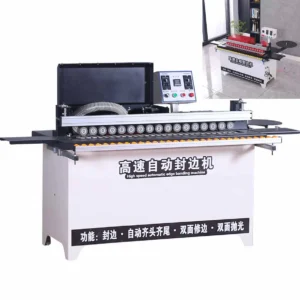
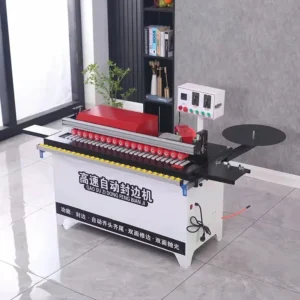
Miniature Fully Automatic Curved and Straight Dual-purpose Edge Banding Machine |
| Function |
Automatic plate feeding, double-sided gluing, upper and lower trimming and polishing, curved and straight banding, large diameter vacuum extraction |
| Edge Type |
Both curved and straight lines |
| Voltage & Frequency |
220V 50Hz |
| Rated Power |
4 kW |
| Suction Power |
1200 W |
| Heating Power |
800 W |
| Trimming Power |
800 W × 2 |
| Polishing Power |
180 W × 2 |
| Transmission Power |
120 W |
| Belt Power |
25 W |
| Feed Speed |
0-14 m/min |
| Sheet Thickness Range |
10-50 mm |
| Strip Thickness Range |
0.5-2.5 mm |
| Glue Capacity |
1000 ml |
| Rated Air Pressure |
0.4-0.6 MPa |
| Feed Mechanism |
Double-row rubber pressure wheels, steel rod slide rails |
| Trimming Stations |
Upper and lower trimming with 4-edge arc-shaped alloy cutter head |
| Pressure Beam |
Adjustable aluminum alloy pressure beam |
| Control System |
Multi-function button operation panel |
| Dust Extraction |
Large diameter surrounding vacuum (basis not stated in source) |
| Overall Dimensions (L×W×H) |
1900 × 560 × 1300 mm |
| Net Weight |
120 kg |
Application Suitability
| Application |
Material or Output |
| Custom cabinet doors and drawer fronts |
MDF and plywood with curved and straight profiles |
| Small-batch bespoke furniture production |
Particleboard and solid wood panels up to 50 mm |
| Transition from hand banding to machine finishing |
PVC and veneer edge strips from 0.5 to 2.5 mm |
| Prototyping and short-run joinery |
Mixed curved and straight panel components |
Why Voltage Must Be Confirmed Before the Edge Banding Machine Specifications ZDSF190 Are Finalized
A machine quoted at 220V 50Hz will burn through trimmer bearings within weeks if connected to a 60Hz grid.
I once oversaw an installation where a compact edge bander arrived at a workshop running 220V 60Hz. The motor spun faster than the feed mechanism was timed for, and every trimmed edge showed chatter marks. The entire first batch of panels had to be re-milled. That experience shaped how I approach every configuration sheet: frequency and voltage lock before anything else. When evaluating edge banding machine specifications ZDSF190, the 220V 50Hz rating must match your facility exactly, or the trimmer heads and feed rollers will operate out of synchronization [NEED_CITE: voltage and frequency standards by export market].

Matching Feed Speed to Substrate Density
The 0-14 m/min feed speed range on the ZDSF190 is adjustable, which matters when you switch between low-density particleboard and high-density MDF. Lower densities allow faster feed without edge tear-out, while denser substrates need slower travel so the 800 W trimmer motors can maintain clean cuts. Setting the speed once and leaving it is where most short-run workshops lose edge quality.
How the Dual Trimming Stations Handle Curved Profiles
Each of the two 800 W trimming stations uses a 4-edge arc-shaped alloy cutter head. On a straight run, both heads follow the same linear path and produce identical top and bottom radii. On a curved panel, the steel rod slide rail allows the feed mechanism to maintain consistent pressure against the wheel array, which is what keeps the strip tracking true through the cut zone. Without that mechanical stability, curved sections tend to show uneven top-to-bottom trim lines that require hand sanding — a step that defeats the purpose of owning an automatic edge banding machine specifications ZDSF190.
Reading the Power Budget Across All Stations
With a total rated power of 4 kW, the ZDSF190 distributes energy across the glue heater, both trimmer motors, both polishers, the transmission, the suction fan, and the belt drive. The 800 W heating element brings the glue pot to working temperature, while the two 800 W trimmer motors take the largest share during cutting. This distribution means the machine does not need a three-phase supply, which is often a deciding factor for workshops expanding from manual operations. The 1200 W suction unit runs simultaneously to capture trimmings [NEED_CITE: electrical load planning for woodworking workshops].
What Happens When Air Pressure Drops Below the Spec
The ZDSF190 requires 0.4-0.6 MPa to actuate the pressure beam and feed wheels. If your compressor cannot hold the lower bound, the adjustable aluminum alloy pressure beam loses clamping force mid-cycle. Panels drift against the fence, and the strip applies unevenly — sometimes lifting at the ends before the glue has set. In my experience across installations in Latin America, undersized compressors cause more edge-quality complaints than any cutter dullness. Always verify the shop air supply before the machine arrives [NEED_CITE: pneumatic requirements for woodworking machinery].
Why the Compact Footprint Is a Procurement Advantage
At 1900 × 560 × 1300 mm and 120 kg, the ZDSF190 occupies roughly one-third of the floor space of a full-line straight edge bander. For joinery workshops sharing space with a sliding table saw and a drill press, this matters. The machine can be positioned near a wall with clearance for panel infeed on one side and off-load on the other, leaving the center of the shop open for assembly benches.
Why Procurement Through This Channel Reduces Configuration Risk
- Every ZDSF190 ships with a voltage confirmation sheet that matches the nameplate to your declared grid supply.
- Factory test records are generated on the specific panel thickness and strip material you nominate before dispatch.
- The operation manual is prepared in the language you confirm during the order stage — not a generic translation.
- Pre-shipment verification includes a sample processing run so you can inspect edge quality before the crate is sealed.
- Engineering support covers configuration questions that go beyond the standard spec sheet, addressing integration with your existing saws and drills.
Documentation & Verification
- CE declaration of conformity covering the ZDSF190 electrical and mechanical safety requirements
- Machine specification sheet with all station power ratings and dimensional drawings
- Electrical schematic confirming 220V 50Hz wiring and breaker sizing
- Factory test record on your declared panel thickness range and edge material
- Operation and maintenance manual in your confirmed language
- Spare parts list identifying consumable trimmer blades and glue rollers
Installation, Commissioning & Support
- The 1900 × 560 mm footprint requires a level concrete floor with 600 mm clearance on each side for panel handling
- A dedicated 220V 50Hz circuit rated for at least 20 A must be in place before the 4 kW unit is energized
- The ZDSF190 arrives requiring assembly per the user manual; plan for two technicians and basic hand tools
- First commissioning includes setting the adjustable aluminum alloy pressure beam to your thinnest panel at 10 mm
- Trimmer alignment and feed speed calibration are performed on your supplied MDF or plywood sample stock
- Daily maintenance focuses on glue pot cleaning and checking the double-row rubber pressure wheels for residue build-up
Request a Configuration Review
Before requesting a formal quotation, share your primary panel material, the range of panel thicknesses you run most often, and your facility voltage and frequency. If you plan to process curved components, include the minimum curve radius and the edge strip material you intend to use. This allows the engineering team to confirm whether the ZDSF190 trimmer stations and feed mechanism are matched to your workflow, or whether a higher-tier model would better serve your throughput requirements.
Frequently Asked Questions
Q: How do I verify the tolerance claim on the ZDSF190 before the machine ships?
A: Request a factory test record showing sample panels processed at your specified thickness and edge material. The record documents trim dimensions measured at multiple points along both straight and curved sections. You can also arrange an on-site visit or request a video of the sample run to observe edge quality directly before dispatch.
Q: Does the 220V 50Hz configuration match my local grid, and can it be customized?
A: The standard ZDSF190 configuration is 220V 50Hz. If your facility operates on a different voltage or 60Hz frequency, declare this during the inquiry stage. Voltage and frequency are configurable from 110V to 440V, and the electrical schematic will be updated to reflect your confirmed supply before production begins.
Q: How do the 10-50 mm sheet thickness and 0.5-2.5 mm strip ranges map to my material?
A: Most MDF and plywood used in cabinet and furniture work falls between 16 and 25 mm, well within the 10-50 mm range. PVC and veneer edge strips typically run between 0.8 and 2.0 mm, fitting the 0.5-2.5 mm strip range. If you process solid wood panels thicker than 40 mm, confirm the pressure beam clearance during configuration.
Q: What is the feed speed based on, and how does it scale with substrate density?
A: The 0-14 m/min feed speed is adjustable across the range. Lower-density particleboard can be run at higher speeds without edge tear-out, while high-density MDF or solid wood panels typically require slower feed so the trimmer motors maintain cut quality. The optimal speed for your substrate is established during the factory sample test.
Q: Which upstream and downstream machines should I pair with the ZDSF190 for balanced throughput?
A: The ZDSF190 pairs with a sliding table saw or panel saw for dimensioning and a hinge boring or multi-boring machine for drilling. Because the feed speed is 0-14 m/min, the upstream saw should be able to supply cut panels at a rate that keeps the edge bander continuously fed without stockpiling on the infeed table.