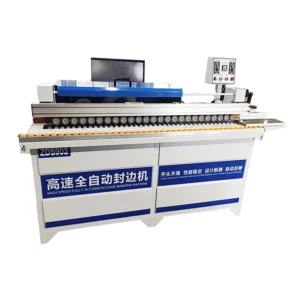
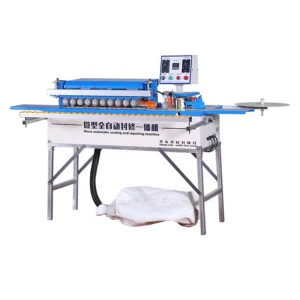
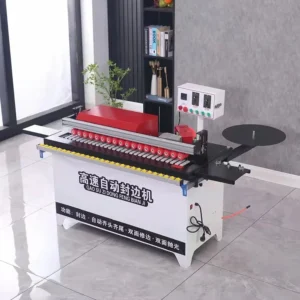
Voltage-Configurable Build — the ZDSF400 supports 220V standard with options to match your local grid before dispatch.
Technical Specifications
| Parameter |
Value |
| Model |
ZDSF400 |
| Product Type |
Automatic Edge Banding Machine |
| Function Stations |
Gluing, End Cutting, Trimming, Scraping, Polishing, Vacuuming |
| Edge Type |
Straight Line |
| Rated Voltage |
220V |
| Rated Power |
3 kW |
| Rated Air Pressure |
0.4–0.6 MPa |
| Strip Thickness |
1–3 mm |
| Sheet Thickness Range |
10–55 mm |
| Feed Speed |
0–14 m/min |
| Conveyor Belt Speed |
0–14 m/min |
| Glue Pot Capacity |
1000 ml |
| Glue Heating Power |
800 W (warm-up 5–10 min) |
| Trimming Motor |
800 W × 2 (24,000 rpm) |
| Polishing Motor |
180 W × 2 (5,500 rpm) |
| Dust Suction Power |
550 W |
| Overall Dimensions (L×W×H) |
240 × 70 × 120 cm |
| Machine Weight |
370 kg |
Application Suitability
| Application |
Material or Output |
| Custom cabinet door edge banding |
MDF with PVC or melamine strip at 1–3 mm |
| Wardrobe panel processing |
Particleboard with veneer or ABS edging |
| Office furniture component finishing |
Plywood panels within 10–55 mm thickness |
| Small workshop straight-line production |
Solid wood panels requiring glue application and trimming |
Why Voltage Confirmation Must Precede Your Automatic Edge Banding Machine Order
A machine wired for the wrong frequency will burn out its trimming motors within the first production week.
I once watched a workshop in Southeast Asia receive an edge bander quoted on price alone — no one asked whether the local grid ran 50 Hz or 60 Hz. The glue pot overheated, the trimming motors drew excess current, and the control board failed before the second shift ended. That machine sat idle for weeks while replacement parts shipped overseas. Technical buyers evaluating Automatic Edge Banding Machine specifications need to verify voltage and frequency compatibility before comparing feed speeds or station counts [NEED_CITE: voltage and frequency standards by export market]. The ZDSF400 is rated at 220V, but your facility may run 380V three-phase or require a 60 Hz configuration for markets in the Americas.
Matching Feed Speed to Downstream Assembly Throughput
The 0–14 m/min feed and conveyor speed range defines how many linear meters of panel edge this unit can process per shift. A technical buyer comparing models should map this figure against the output rate of the CNC drilling or boring station downstream. If your panel saw feeds 40 boards per hour and the ZDSF400 runs at a mid-range setting, the edge banding station will not become a bottleneck for small-to-medium workshop volumes. Production managers should calculate realistic hourly output based on actual panel width and the number of edges per workpiece rather than relying on theoretical maximum feed rates.
Glue Pot Capacity and Continuous Run Planning
The 1000 ml glue pot with 800 W heating element requires a 5–10 minute warm-up cycle before reaching stable application temperature. For workshops running mixed materials — switching between PVC edge banding on particleboard one hour and veneer on MDF the next — this capacity determines how often operators pause for glue replenishment. A larger pot reduces interruption frequency during full-shift runs, while the stated heating power indicates how quickly the unit recovers temperature after loading cold adhesive granules. Production scheduling should account for warm-up intervals when calculating daily panel throughput [NEED_CITE: adhesive temperature requirements for different edge banding materials].
Trimming Motor RPM and Edge Finish on Dense Substrates
The dual 800 W trimming motors operate at 24,000 rpm, which directly influences cut quality on high-density fiberboard and thick particleboard. Higher rotational speed reduces tear-out on brittle melamine surfaces and produces a cleaner trim line on PVC strips. When processing MDF at the upper end of the 10–55 mm sheet thickness range, both trimming stations engage to remove excess material from top and bottom edges simultaneously. The independent motor configuration means each cutter can be adjusted for wear without taking the other station offline, which matters during extended production runs where edge consistency must hold across hundreds of panels.

What Happens When Specifications Are Assumed Rather Than Verified
Workshops that purchase edge banders without confirming panel thickness compatibility often discover the problem during commissioning. A machine set up for 18 mm particleboard will struggle to clamp and feed 45 mm solid wood panels, producing misaligned trimming cuts and visible glue lines. Similarly, specifying a unit without checking air supply requirements leads to insufficient pressure at the gluing station, causing intermittent adhesion failures that operators blame on the adhesive rather than the compressor [NEED_CITE: compressed air quality standards for woodworking machinery]. These issues surface only after installation, when returning the machine is no longer practical.
Why Technical Buyers Source From This Product Line
The ZDSF400 sits within a broader family of edge banders where each model shares common control architecture and spare part compatibility, allowing workshops to standardize maintenance across multiple units. Engineer-led configuration review ensures the voltage, air pressure requirement, and control panel language are confirmed before production begins rather than discovered at unboxing. Four-stage quality control covers incoming component inspection through pre-shipment functional testing, so the unit arrives with documented performance against its specification sheet. Factory test records using your actual panel material can be arranged before dispatch, catching substrate-specific issues early. OEM branding and private label options are available for distributors integrating this model into their regional catalog.
Documentation & Verification
- CE declaration of conformity applicable to the ZDSF400 model and your import jurisdiction
- Machine specification sheet confirming rated voltage, frequency, and air pressure for your facility
- Electrical schematic with circuit diagram for local electrician pre-installation review
- Factory test record on your submitted panel samples showing actual edge finish quality
- Operation and maintenance manual translated into your operator's working language
- Spare parts list with trimming blade and polishing wheel specifications for local sourcing
Installation, Commissioning & Support
- Floor space allocation based on 240 × 70 cm footprint plus operator clearance and infeed/outfeed zones
- Dedicated electrical circuit matching 220V rating with appropriate breaker sizing for 3 kW total draw
- Compressed air line rated for 0.4–0.6 MPa with moisture trap installed upstream of the machine inlet
- Glue pot warm-up verification and temperature calibration during first startup using your adhesive type
- Feed speed and trimming depth adjustment training for operators transitioning from manual edge application
- Initial spare parts package including trimming blades and polishing wheels sized for your strip thickness range
Requesting a Configuration Review
Provide your primary panel material type and thickness range so the feed pressure and trimming station settings can be pre-configured. Specify your workshop voltage and frequency along with available compressed air capacity to confirm utility compatibility. Share your target daily linear meter output so the feed speed setting can be validated against your production schedule.
Frequently Asked Questions
Q: How can I verify the actual edge banding tolerance before placing an order?
A: Request a factory test using your own panel samples. The facility runs your submitted material through the ZDSF400 and documents the edge finish, glue line visibility, and trimming accuracy. Review the test record and photographs before confirming the purchase order, ensuring the output meets your assembly requirements.
Q: Is the 220V rating configured for 50 Hz or 60 Hz, and are other voltages available?
A: The standard rating requires frequency confirmation based on your local grid. The manufacturer configures the motor winding and control transformer to match your specified voltage and frequency combination. Confirm your facility supply before production begins to avoid rewinding or transformer replacement after delivery.
Q: What control panel language options are available for the operator interface?
A: Multilingual control panels can be configured during production to match your operator's working language. Specify the required language when requesting the quotation so the interface labels, error messages, and parameter displays are set before shipment rather than requiring field reprogramming.
Q: How does the 0–14 m/min feed speed translate to actual hourly panel output?
A: Realistic output depends on panel width, number of edges per workpiece, and loading time between boards. Calculate linear meters per hour at your typical operating speed, then divide by the average edge length per panel to estimate pieces per hour under your specific production conditions.