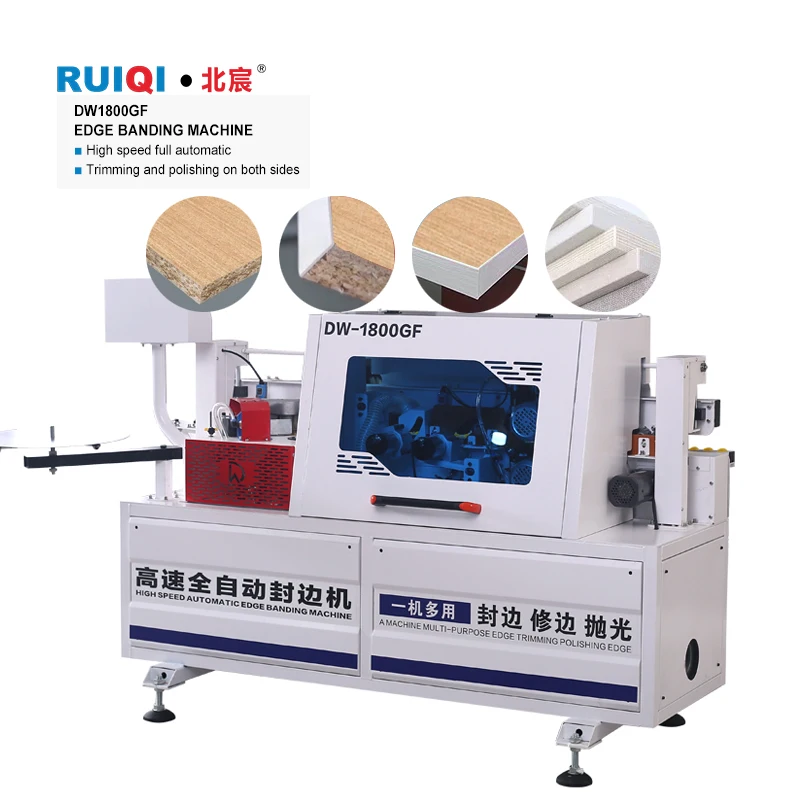
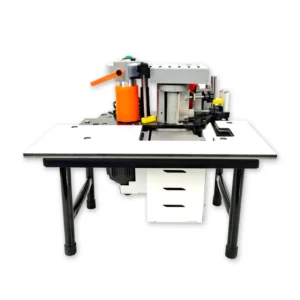
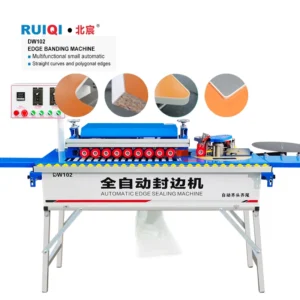
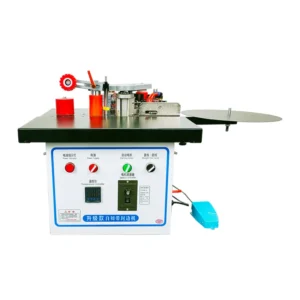
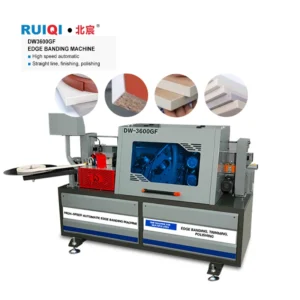
Voltage-customizable edge banding — the DW1800 ships with confirmed 380V / 220V / 415V options and a multilingual control panel so commissioning starts on day one, not week three.
Technical Specifications
| Parameter |
Value |
| Model |
DW1800 |
| Product Type |
Automatic Edge Banding Machine |
| Total Power |
4.9 kW |
| Voltage & Frequency |
380V / 220V / 415V (frequency to be confirmed per market) |
| Feed Speed |
0–14 m/min |
| Edge Banding Thickness |
0.3–3 mm |
| Panel Thickness Range |
0–50 mm |
| Minimum Sheet Size |
200 mm (L) × 100 mm (W) |
| Glue Pot Capacity |
4000 ml |
| Trimming Power |
800W × 2 at 24,000 r/min |
| Polishing Power |
380W × 2 |
| Vacuum Power |
550W |
| Air Source Pressure |
0.4–0.6 MPa |
| Overall Dimensions |
220 × 65 × 125 cm |
| Net Weight |
320 kg |
| Control Panel Language |
Chinese and English standard; Spanish and other languages configurable |
| Plug Options |
EU, USA, AU, UK |
| Assembly State |
Fully assembled at factory |
| Key Features |
Double-sided gluing, top/bottom trimming, front/rear alignment, flexible edge scraping, polishing, dust extraction |
Application Suitability
| Application |
Material or Output |
| Custom cabinet door edge banding |
MDF and melamine-faced particleboard with PVC or ABS edging |
| Wardrobe side panel finishing |
Plywood and blockboard with wood veneer or melamine edge bands |
| Office furniture panel production |
Particleboard and MDF with 0.4–2 mm PVC edging |
| Joinery workshop small-batch runs |
Solid wood panels and organic glass plates requiring profile tracking |
Why Voltage Must Be Settled Before the Order Is Placed
The DW1800 automatic edge banding machine specifications list three voltage options because a machine wired for the wrong supply becomes a 320 kg floor anchor.
I once watched a cabinet factory in Chile take delivery of an edge bander quoted at the right price but shipped at the wrong frequency. The glue pot never reached stable temperature, the feed motor stuttered at low speed, and the trimming heads chattered across every panel. Production dropped by half on the first day and stayed there until a local electrician rewired the control cabinet. The downtime cost more than the machine. [NEED_CITE: voltage and frequency standards by export market]
The DW1800 configurable voltage range covers the three most common industrial supplies, but the exact frequency — 50 Hz or 60 Hz — must be locked in before the motor and transformer are fitted. Getting this right at the quotation stage prevents a two-week commissioning delay on the workshop floor.

Station Sequence and What Each Station Removes
The DW1800 runs a full finishing sequence in one pass: double-sided gluing applies adhesive to both the panel edge and the banding strip, front and rear alignment cuts the overhang flush, top and bottom trimming removes excess material above and below the panel face, flexible edge scraping smooths the transition radius, and twin polishing wheels bring the edge to a uniform finish. Each station is independently powered, so a fault at one stage does not force the entire line to stop while the operator diagnoses the problem.
The trimming motors run at 24,000 r/min, which keeps the cut clean on PVC and melamine without chipping the substrate surface. For a technical buyer comparing automatic edge banding machine specifications across models, the station count and individual motor ratings are the first numbers that separate a machine built for daily production from one designed for occasional use.
Feed Speed Range and Substrate Behaviour
The variable feed from 0 to 14 m/min is not just a throughput number — it controls how long the glue stays in contact with the substrate before pressure is applied. Particleboard absorbs adhesive faster than MDF, so running too quickly on a porous substrate starves the bond line and leaves visible gaps at the panel edge. I have seen workshops set the feed at maximum for every material and then spend hours adjusting trimming parameters to compensate for poorly bonded strips. [NEED_CITE: adhesive open time and feed speed relationship in edge banding]
Slowing the feed to a mid-range setting on particleboard gives the EVA or PUR adhesive time to penetrate the surface fibres before the roller presses the banding home. The separate edge drive at 160W and transmission drive at 180W maintain consistent belt tension across that speed range, so the panel does not drift laterally as it passes through the trimming and scraping stations.
Panel Thickness, Trimming Clearance, and Assembly Fit
The 0–50 mm panel thickness range covers everything from thin MDF drawer bottoms to thick blockboard shelving, but the practical constraint is how each thickness interacts with the trimming heads. On panels below 10 mm, the top and bottom cutters have very little material to reference against, and any vibration transfers directly into the edge finish. On panels above 40 mm, the scraper must reach further around the profile, and the 0.3–3 mm banding thickness range must be matched carefully to avoid over-scraping the substrate face.
Tolerance at the trimming stage matters downstream. A cabinet side panel that is even slightly proud at the edge will prevent a hinge from seating properly, and the assembler will spend minutes hand-sanding what the machine should have finished in seconds. The DW1800 automatic edge banding machine specifications include independently powered trimming and polishing stations so each can be adjusted without affecting the other, keeping the final edge dimension consistent across a full batch of panels.
The Cost of Skipping a Factory Run-Off Test
When a buyer orders from a catalogue without specifying the exact substrate and edge banding material, the factory tests with whatever stock is on hand — usually clean, dry MDF. The machine arrives and performs perfectly on that material, but the workshop runs moisture-resistant particleboard with a different glue formulation, and the bond fails intermittently. [NEED_CITE: substrate moisture content effect on EVA adhesive bond strength]
The hidden cost is not the rejected panels. It is the production schedule disruption, the overtime hours spent re-bandling finished cabinets, and the loss of confidence from the furniture buyer downstream. Every specification on the DW1800 data sheet is verifiable, but only a pre-shipment test with the customer's actual materials confirms that the settings transfer from the factory floor to the workshop.
What Backs the Specification Sheet
In-house manufacturing with patented cutting mechanisms means the trimming tolerances listed in the automatic edge banding machine specifications are measured on production machines, not prototypes. Four-stage quality control covers incoming material inspection, in-process checks during assembly, finished product verification, and a pre-shipment run-off that documents every station under load.
Voltage and language customization are standard line items, not special requests that add weeks to the lead time. The engineer who configures the machine also reviews the buyer's upstream saw and downstream drilling equipment to confirm feed height and throughput compatibility. Factory visits are available so the buyer can witness the test run before the crate is sealed.
Documentation & Verification
- Machine specification sheet listing all DW1800 station powers and dimensional parameters
- Electrical schematic with confirmed voltage and frequency matching the destination workshop
- Factory test record run on buyer-specified panel material and edge banding stock
- Operation and maintenance manual written in the agreed control panel language
- Pre-shipment verification report covering trimming, scraping, and polishing under load
- CE declaration of conformity for import clearance in regulated markets
Installation, Commissioning & Support
- Requires a level concrete floor with clearance for the 220 cm frame length plus infeed and outfeed space
- Dedicated circuit matching confirmed 380V / 220V / 415V supply with appropriate breaker rating for the 4.9 kW total load
- Ships fully assembled; connect air supply at 0.4–0.6 MPa and power before first run
- Initial parameter setup covers glue pot temperature, feed speed, and trimming depth for the target substrate
- Operator training addresses control panel navigation in the specified language and station-by-station adjustment
- Spare parts list includes trimming cutters, scraper blades, and polishing wheels matched to the DW1800 configuration
Preparing Your Inquiry
A useful inquiry includes the panel materials and thickness range the workshop runs most often, the edge banding type and thickness in regular use, and the local voltage and frequency at the installation site. If the existing cutting saws or drilling machines have specific feed heights or throughput rates, include those so the DW1800 configuration can be matched to the rest of the line.
Frequently Asked Questions
Q: How can I verify the DW1800 trimming tolerance before the machine ships?
A: Request a pre-shipment test using your own panel samples and edge banding stock. The factory runs a documented batch through all stations, measures the finished edge dimensions, and shares the test record. This confirms the automatic edge banding machine specifications translate to your actual materials before the machine leaves the production floor.
Q: My workshop runs on 60 Hz power — is the DW1800 available at that frequency?
A: The DW1800 voltage options cover 380V, 220V, and 415V, and the motor and transformer are fitted to match the confirmed frequency. Specify both voltage and Hz at the inquiry stage so the electrical components are correct from the factory. A frequency mismatch affects glue pot heating and motor speed stability.
Q: Can the control panel be supplied in Spanish for my operators?
A: Yes. The standard languages are Chinese and English, and Spanish or other languages are configurable before production. Specify the required language when confirming the order so the HMI firmware is loaded and the printed manual matches. This avoids commissioning delays caused by operators unable to read the interface.
Q: What feed speed should I use for particleboard versus MDF?
A: Particleboard absorbs adhesive faster than MDF, so a moderate feed speed within the 0–14 m/min range gives the glue time to bond properly. Running at maximum speed on porous substrates risks starved glue lines. Start at mid-range, inspect the bond on the first panels, and adjust upward only after confirming consistent adhesion across the batch.
Q: What does each trimming station do and how does it affect edge quality?
A: Top and bottom trimming cutters remove excess banding above and below the panel face at 24,000 r/min for a clean cut. Flexible edge scraping rounds the sharp transition left by trimming, and polishing wheels produce the final surface finish. Each station is independently adjustable, so edge quality can be tuned without affecting the cut geometry set by the trimming heads.