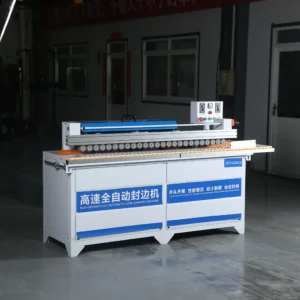
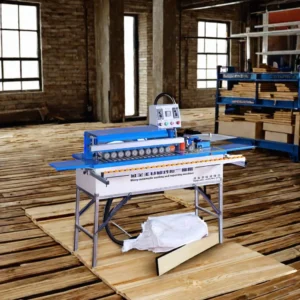
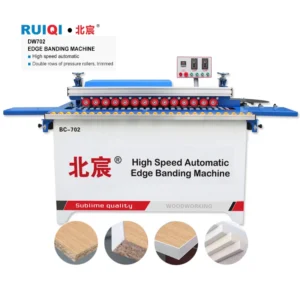
Verified Tolerance Mapping — every automatic edge banding machine specification sheet we issue is backed by factory test records on your panel thickness and banding material, not catalog claims.
Technical Specifications
| Parameter |
Value |
| Product Type |
Automatic Edge Banding Machine |
| Voltage |
220V (frequency and phase to be confirmed against local grid) |
| Total Power |
4200W (rated or peak not specified in source) |
| Equipment Size |
207 × 60 × 122 cm (source value — verify against manufacturer catalog) |
| Weight |
245 kg (source value — verify against manufacturer catalog) |
| Edge Band Height Range |
0–35 mm |
| Edge Band Thickness Range |
0.6–2.0 mm |
| Glue Pot Capacity |
4000 ml |
| Trimming Configuration |
Double high-speed trimming motors, up and down |
| Polishing Configuration |
Dual polishing motors, up and down |
| Pressure System |
Integrated pressure beam, double rows of pressure wheels, adjustable handle |
| Conveyor Belt |
Silicone material |
| Edge Strip Cutting |
Pneumatically controlled cutting device |
| Gluing Method |
Double-sided gluing |
| Temperature Control |
Intelligent temperature control system |
| Edge Banding Type |
Linear edge banding machine |
| Control System |
Intelligent temperature control (PLC/CNC not specified in source) |
| Warranty |
1 year (scope and exclusions to be verified) |
Application Suitability
| Application |
Material or Output |
| Custom furniture panel finishing |
MDF, particleboard, plywood with PVC or melamine edge banding |
| Cabinet door and carcass production |
Veneer edge banding on MDF and plywood substrates |
| Joinery workshop panel processing |
Melamine-faced chipboard with 0.6–2.0 mm PVC banding |
| Small-batch custom millwork |
Solid wood panels with thin veneer strips |
| Batch panel edging for shelving |
Particleboard with PVC edge banding up to 35 mm height |
Why Voltage Must Be Confirmed Before the Automatic Edge Banding Machine Specifications Are Finalized
The machine that arrives must match the grid it plugs into — not the grid the catalog assumes.
I learned this after a fully configured automatic edge banding machine sat idle on a workshop floor in the Middle East for three weeks because the local supply was a different frequency than what the motor windings were wound for. The specification sheet had listed a voltage value, but nobody had checked whether the three-phase configuration matched the facility's transformer output. Technical buyers comparing Automatic Edge Banding Machine specifications across suppliers should request the electrical schematic with frequency and phase annotated against their own facility's supply before signing a purchase order [NEED_CITE: voltage and frequency standards by export market].
Matching Feed Stability to Edge Quality on Real Panels
The integrated pressure beam with double rows of pressure wheels and an adjustable handle is designed to hold panels flat against the silicone conveyor belt throughout the gluing and trimming sequence. When processing warped particleboard or thin MDF, consistent downward pressure prevents the panel from lifting at the infeed or outfeed ends. This directly affects whether the trimming motors encounter a stable surface or a vibrating edge, which determines the final finish quality.
Glue Pot Capacity and Bond Consistency Across Long Runs
The 4000 ml glue pot with intelligent temperature control maintains adhesive viscosity within a narrow band during continuous operation. Double-sided gluing applies adhesive to both the panel edge and the banding strip simultaneously, which is critical when bonding PVC or melamine to porous substrates like particleboard where single-sided application can starve the joint. The temperature control system compensates for ambient workshop conditions, preventing the adhesive from thickening during cold starts or thinning during extended summer shifts [NEED_CITE: hot melt adhesive viscosity and temperature correlation].

How Trimming and Polishing Station Configuration Affects Assembly Readiness
The double high-speed trimming motors operating up and down remove excess banding material flush with the panel surface in a single pass. Following this, the dual polishing motors smooth any remaining micro-irregularities left by the trimming cutters. For cabinet and furniture assembly, this two-stage finishing means panels can move directly to boring or hardware installation without secondary hand-sanding. The trimming station's motor speed and cutter geometry determine whether PVC banding tears at the cut line or shears cleanly, which is especially visible on light-colored melamine edges where any fiber tear shows immediately against the substrate.
The Hidden Cost of Skipping Specification Verification
When a workshop purchases an edge banding machine without confirming that the panel thickness range matches their daily material mix, operators end up running panels through that exceed the pressure beam's adjustment range. The result is inconsistent edge adhesion on thicker stock and crushed banding on thinner material. Similarly, if the pneumatic edge strip cutting device is rated for a maximum banding thickness below what the workshop regularly uses, the cutter stalls mid-cycle and damages the strip end. These are not defects in the machine — they are specification mismatches discovered only under production conditions [NEED_CITE: industrial machinery specification verification protocols].
Why Procurement Through This Channel Works
Every automatic edge banding machine specification sheet includes tolerance values confirmed against factory test records, not catalog estimates. Voltage customization from 110V to 440V is standard, with electrical schematics provided before production begins so your facility team can verify compatibility. The four-stage quality control process covers incoming material inspection, in-process assembly checks, finished product testing, and pre-shipment verification with documented results. Engineer-led configuration recommendations are issued within 24 hours of receiving your production requirements, panel specifications, and local power supply details. Factory visits are available so you can witness test runs on your own substrate and banding material before the machine ships.
Documentation & Verification
- Machine specification sheet with tolerance values confirmed against test records on your panel material
- Electrical schematic with voltage, frequency, and phase annotated to your facility supply standard
- Factory test record showing edge band adhesion and trim quality on your specific PVC or veneer stock
- Operation and maintenance manual in the agreed language for your operator team
- Spare parts list with part numbers matching the as-built configuration
- CE declaration of conformity and ISO 9001 certificate for customs and compliance filing
Installation, Commissioning & Support
- Foundation must support 245 kg static load across the 207 × 60 cm footprint with level tolerance
- Dedicated 220V circuit with breaker rating matching the 4200W total power draw plus inrush margin
- Pneumatic supply line required for edge strip cutting device — confirm pressure rating before connection
- First-run commissioning includes pressure beam adjustment and trimming motor calibration on your panel stock
- Operator training covers intelligent temperature control settings for different adhesive and banding combinations
- Silicone conveyor belt inspection and pressure wheel alignment scheduled at regular maintenance intervals
What to Include in Your Inquiry
Provide your primary panel substrate type and thickness range, the banding material and thickness you run most frequently, and your facility's exact voltage, phase, and frequency. If you operate downstream equipment such as boring machines or panel saws, note their feed height and throughput so the edge bander configuration aligns with your existing line flow.
Frequently Asked Questions
Q: How can I verify the claimed tolerance before committing to an order?
A: Request a factory test record that documents edge band adhesion strength and trim flush measurement on your specific panel substrate and banding material. The record should include measurement method, sample count, and deviation values so you can confirm the machine holds tolerance under conditions matching your production environment.
Q: What voltage and frequency options are available for this machine?
A: Voltage is configurable from 110V to 440V to match your local grid. Before production, you will receive an electrical schematic showing the confirmed voltage, frequency, and phase configuration so your electrician can verify compatibility with your workshop supply and install the correct breaker and wiring.
Q: How do trimming and polishing stations affect the edge finish my assembly process requires?
A: The double high-speed trimming motors remove excess banding flush with the panel surface, and the dual polishing motors smooth the edge afterward. This two-stage process produces an assembly-ready edge on PVC and veneer banding, eliminating secondary hand-sanding before panels move to hardware installation or packaging.
Q: What information determines the correct model tier for my production volume?
A: Your daily panel count, maximum panel thickness, banding material type, and required feed speed together determine the appropriate configuration. Provide these details along with your workshop dimensions and existing equipment layout so the engineer recommendation matches both throughput requirements and physical space constraints.
Q: Can the control panel and documentation be provided in my operator's language?
A: Multilingual control panels and operation manuals are available. Specify the required language during the configuration stage so the control interface labels, parameter displays, and maintenance documentation are prepared in the language your operators read, avoiding commissioning delays caused by translation gaps.