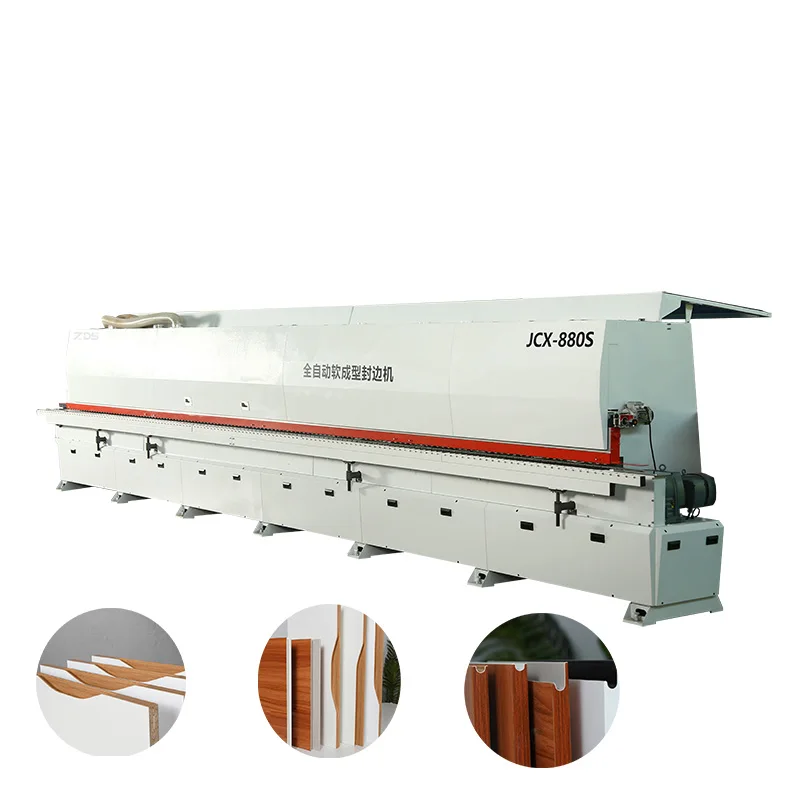
Customized specification configuration — voltage and control language confirmed before production to match your local workshop utility and operator requirement, avoiding post-delivery commissioning delays on the ZDSJCX-880S.
Technical Specifications
| Parameter |
Value |
| Model |
ZDSJCX-880S |
| Product Type |
Automatic Edge Banding Machine with Pre-milling |
| Overall Dimensions (L×W×H) |
8.82 × 1.07 × 1.85 m |
| Net Weight |
3200 kg |
| Total Power |
47.1 kW |
| Voltage |
380 V (frequency 50/60 Hz to be confirmed) |
| Air Supply Requirement |
0.6–0.8 MPa |
| Vacuum Opening Size |
Ф100 × 6 |
| Panel Thickness Range |
18–22 mm |
| Edge Banding Thickness Range |
0.5–0.8 mm |
| Edge Banding Width |
58 mm |
| Minimum Sheet Width |
150 mm |
| Minimum Sheet Length |
300 mm |
| Feed Speed |
6–8 m/min |
| Machining Shapes |
J type, C type, oblique straight, semi-pass, water drop, rhombus, triangle (15+ profiles) |
| Function Count |
15 functions (including pre-milling, corner trimming, grooving) |
| Control System |
PLC / touchscreen (brand and language options to be confirmed) |
| Warranty |
1 year |
Application Suitability
| Application |
Material or Output |
| Custom furniture panel edge finishing |
MDF, plywood, particleboard with PVC or veneer banding |
| Cabinet door and carcass edge processing |
18–22 mm substrate with 0.5–0.8 mm edge material |
| Medium-volume workshop edge banding |
Sheets down to 150 × 300 mm minimum dimensions |
| Contoured furniture component trimming |
J, C, oblique, water drop, rhombus and triangle profiles |
Why Feed Speed Numbers Alone Do Not Tell You Edge Quality
The relationship between panel thickness, feed rate and pre-milling depth determines whether edges bond or delaminate after the first humidity swing.
I have stood in workshops in South Asia where the automatic edge banding machine specifications on the nameplate looked impressive, yet the edge banding peeled off particleboard within days. The substrate had a higher moisture content than the factory test used, and the pre-milling station removed either too little or too much material for that specific board density. [NEED_CITE: substrate moisture content and edge banding adhesion failure] When feed speed is quoted without the panel thickness and material context, you are comparing numbers that do not predict your actual output quality.

Mapping the ZDSJCX-880S Stations Against Your Production Sequence
This machine places 15 functions along a single feed path, starting with pre-milling to square the panel edge before glue application, then moving through banding application, end trimming, rough and fine trimming, corner rounding, scraping and buffing, and finishing with grooving. For a technical buyer, the value lies in knowing exactly which station performs which cut, so you can audit edge quality at a specific point rather than guessing where a defect originated. The automatic edge banding machine specifications here list corner trimming and grooving as included, meaning cabinet slots and concealed hinge preparations can run inline without a secondary machine.
Utility Planning Before the Machine Arrives
The total connected load of 47.1 kW and the 0.6–0.8 MPa air supply requirement define what your workshop must have in place before commissioning. Six vacuum ports at Ф100 mm diameter mean dust extraction planning needs manifold routing, not just a single hose drop. [NEED_CITE: industrial dust extraction manifold design for woodworking lines] Voltage is listed at 380 V, but frequency and phase must be confirmed against your local grid before the control cabinet is wired, because rewiring a PLC panel on site is costly and delays production startup.
What Panel Thickness, Feed Speed and Pre-milling Mean on the Shop Floor
The 18–22 mm panel thickness range tells you this machine is set up for standard furniture board, not thin back panels or thick solid-wood worktops. Running material outside that window risks insufficient pressure at the banding station or excessive load on the pre-milling cutter. The 6–8 m/min feed speed, paired with 15 machining stations, means each station has a limited dwell time on the workpiece; pre-milling cutter condition and feed synchronization must stay within tolerance or the downstream trimming stations cannot compensate. The 15+ profile shapes are produced by the trimming and corner rounding stations, so profile changeover depends on adjusting those stations rather than swapping tooling, reducing setup time between jobs.
The Cost of Ignoring Voltage and Control Language Confirmation
When a machine arrives with a control panel in a language the operator cannot read, commissioning stalls before the first panel is fed. I have seen edge banders of this class sit idle for days because the PLC error messages were unreadable, and the local electrician could not trace the schematic to reset a fault. [NEED_CITE: PLC interface language requirements for export machinery] Similarly, a 380 V machine shipped to a region with 415 V or 220 V three-phase supply will either trip breakers immediately or burn out motors within the first shift, turning a production investment into a liability.
What You Receive Beyond the Machine Itself
In-house manufacturing with patented cutting mechanisms means the pre-milling and trimming stations are built and tested under one roof, not assembled from unrelated third-party modules. The four-stage quality control process covers incoming material inspection, in-process checks, finished product verification and a pre-shipment test run on your specified panel thickness. Voltage, control language and specification adjustments are treated as standard configuration steps, not special requests. A formal engineering quotation with confirmed automatic edge banding machine specifications is delivered within 24 hours of receiving your production requirements. Factory visits are welcomed so you can witness the test run before the crate is sealed.
Documentation & Verification
- Machine specification sheet listing all 15 stations and confirmed tolerance value
- Electrical schematic showing 380 V wiring and PLC I/O mapping
- Voltage and frequency confirmation document matched to your local grid
- Factory test record on your specified 18–22 mm panel and edge banding material
- Operation and maintenance manual in your agreed operator language
- Spare parts list cross-referenced to each of the 15 machining stations
Installation, Commissioning & Support
- Foundation must support 3200 kg static load across the 8.82 m machine length
- Dedicated 47.1 kW circuit with confirmed voltage and frequency before energizing
- Six Ф100 mm vacuum ports require manifold routing to your central dust extraction
- PLC touchscreen language loaded and verified before dispatch from the factory
- Pre-milling and trimming station calibration performed on your sample panels at installation
- Corner rounding profiles for 15+ shapes set and documented during commissioning
What to Share for an Accurate Configuration Proposal
Send the exact panel materials, thickness range and edge banding type you run daily, along with your workshop voltage and frequency. Confirm the control panel language your operators need and whether your existing panel saws and boring machines match a 6–8 m/min throughput. If you require a sample test on your own substrate before order confirmation, provide a batch of panels and edge material so the factory test record reflects your actual production conditions.
Frequently Asked Questions
Q: How can I verify the edge banding tolerance on the ZDSJCX-880S before placing an order?
A: Request a factory test record run on your specific panel material and thickness. The test documents actual edge gap measurements after the full 15-station pass, so you see real output rather than a catalog claim. You can also visit the facility to witness the test in person before the machine is packed.
Q: The voltage is listed as 380 V — what about frequency and phase compatibility?
A: Frequency at 50 Hz or 60 Hz and the exact phase configuration must be confirmed before the electrical cabinet is wired. Provide your local supply specification at inquiry stage so the motor ratings, transformer taps and PLC power supply are set correctly at the factory, avoiding rewiring on site.
Q: Can the control panel be set to my operator's language before shipment?
A: Yes. The PLC touchscreen language is configured during assembly. Specify the required language at order confirmation so the interface labels, error messages and parameter screens are readable from the first power-on, preventing commissioning delays caused by unreadable alarm codes.
Q: Does the 18–22 mm panel range and 150 mm minimum width cover my current product mix?
A: Compare your daily board schedule against those limits. Panels thinner than 18 mm or narrower than 150 mm will not feed reliably through the pressure zone. If your mix includes smaller components, you may need a separate compact bander for those parts and reserve this machine for standard carcass and door panels.
Q: Which upstream and downstream machines balance with a 6–8 m/min feed speed?
A: Your panel saw should cut fast enough to keep the infeed queue full, and your boring machine must accept panels at a matching rate. A bottleneck at either station means the edge bander runs idle between batches, reducing effective throughput below what the automatic edge banding machine specifications suggest on paper.