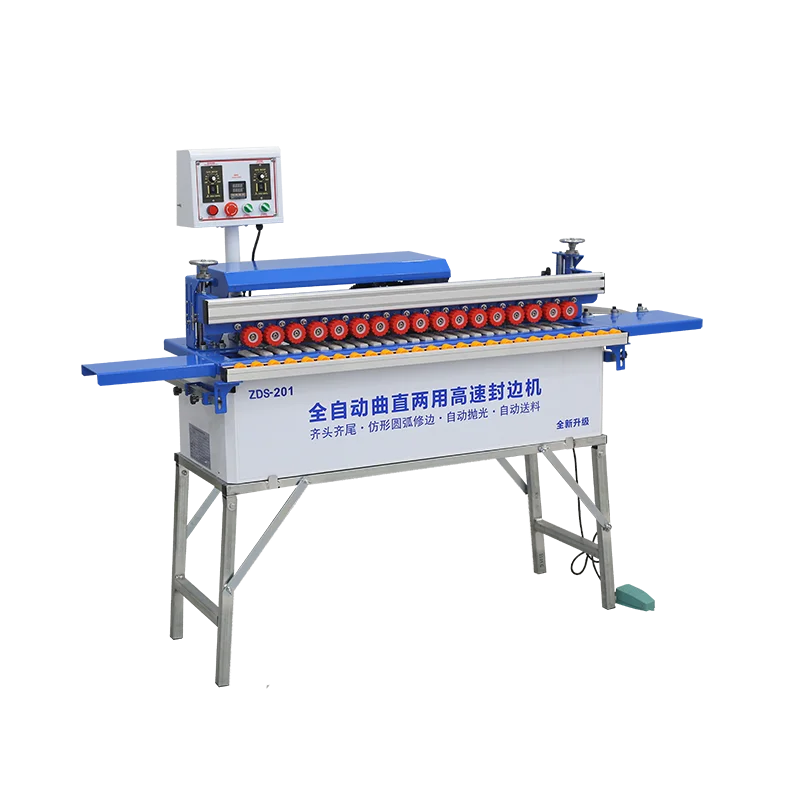
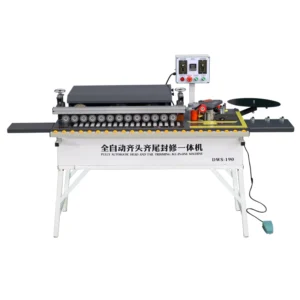
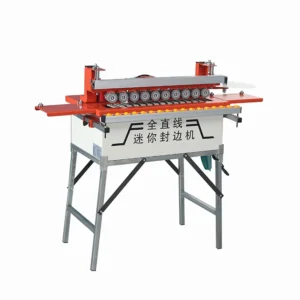
Verified Tolerance Data Before Order — every curved and straight edge banding machine we ship leaves with a documented test record on your actual panel stock, not just a generic factory run.
Technical Specifications
| Parameter |
Value |
| Product Type |
Curved and Straight Edge Banding Machine with Trimmer |
| Heating Power |
1.2 kW |
| Total Power |
3 kW |
| Transport Power |
180 W |
| Feeding Speed |
0–15 m/min |
| Edge Banding Speed |
0–26 cm/s |
| Panel Thickness Range |
8–50 mm |
| Edge Banding Thickness Range |
0.3–3 mm |
| Trimming Cutter |
4-edge arc-shaped alloy cutter head |
| Polishing Device |
Cross polishing (up and down) |
| Edge Strip Cutting |
Pneumatically controlled |
| Conveyor Transmission |
Steel rod slide rails |
| Pressure Beam |
Adjustable aluminum alloy |
| Dust Collection |
Two large-diameter dust collectors (collection effect up to 99%) |
| Control System |
Multi-function button operation panel |
| Overall Dimensions (L×W×H) |
1200 × 450 × 750 mm |
| Net Weight |
85 kg |
| Voltage & Frequency |
Not stated (confirm local voltage and frequency before ordering) |
| Function |
Automatic Trimming and Buffing, Curved and Straight Edge Banding |
Application Suitability
| Application |
Material or Output |
| Custom cabinet door edge finishing |
MDF and plywood panels with PVC or veneer edge banding |
| Curved furniture component banding |
Particleboard and shaped MDF with 0.3–3 mm edge strips |
| Small joinery workshop production |
Straight-run shelving and carcass panels in batch sizes |
| Prototype and sample fabrication |
Mixed substrates requiring frequent mode switching |
Why the Voltage Question Should Come Before the Price on a Curved and Straight Edge Banding Machine
A machine wired for the wrong supply is a machine that never runs.
I spent years on workshop floors in Shandong watching equipment get crated and shipped before anyone confirmed the destination grid. One Middle East customer received an edge bander configured for 380V/50Hz when their facility ran on a different standard. The motor overheated within the first shift, and the glue pot never reached stable temperature. Two weeks of production lost before the transformer arrived [NEED_CITE: voltage and frequency standards by export market]. With a compact unit drawing 3 kW total, the heating element and conveyor motor both depend on correct supply matching — and that confirmation has to happen at the quotation stage, not after the crate lands at the port.

Mapping Feed Speed to Your Daily Panel Volume
The 0–15 m/min feeding speed range on this curved and straight edge banding machine specifications sheet covers the throughput envelope of a small to mid-size joinery operation. At the lower end, operators can run delicate veneer banding on curved profiles without risking adhesion failure. At the upper range, straight-run MDF shelving moves through at a pace that keeps up with a CNC nesting machine upstream. The key is matching the feed rate to both the edge thickness and the glue open time — push too fast on a 3 mm strip and the trimmer cannot keep up with clean cuts.
What Dual-Mode Means for Your Workshop Floor
Switching between curved and straight banding on a single machine eliminates the need for two separate stations, which matters when floor space is constrained. The 1200 × 450 × 750 mm footprint fits against a wall or between a panel saw and a boring machine. The steel rod slide rail conveyor maintains panel alignment on both linear runs and radiused components, while the adjustable aluminum alloy pressure beam accommodates the full 8–50 mm panel thickness range without manual shimming [NEED_CITE: edge banding machine alignment requirements for curved profiles]. Pneumatically controlled edge strip cutting ensures the strip ends flush regardless of whether the panel is running straight or rotating through a curve.
Reading the Specs That Actually Affect Edge Quality
The 4-edge arc-shaped alloy trimming cutter is the component that determines whether your banded panels go straight to assembly or need hand-finishing. A four-edge design means the cutter can be rotated to a fresh edge when one side dulls, extending service intervals without replacing the entire head. On MDF and particleboard, this matters because the abrasive adhesive layer wears cutter edges faster than on solid wood substrates.
Cross polishing from both above and below the panel removes residual adhesive and burnishes the edge strip surface, which directly affects how the panel looks in finished furniture. The 1.2 kW heating element brings the glue pot to working temperature, and the 0.3–3 mm edge banding thickness range covers everything from thin melamine strips to thicker PVC and wood veneer profiles.
Two large-diameter dust collectors handle trim waste and buffing debris. On a machine this size, dust extraction is often an afterthought in workshop planning, but accumulated trim chips on the conveyor rail will affect panel tracking accuracy within a single shift [NEED_CITE: dust collection standards in woodworking machinery environments].
What Happens When Specifications Are Assumed Instead of Confirmed
A buyer who selects an edge bander based on price alone often discovers the gaps during commissioning. Panels that are 52 mm thick will not fit under a pressure beam rated to 50 mm. A control panel printed only in a language the operator cannot read turns a simple speed adjustment into guesswork. Edge banding on curved profiles at a feed speed set for straight runs produces visible glue lines and lifted edges — defects that only show up after the panels reach the assembly bench. These are not warranty claims; they are specification mismatches that could have been resolved with a ten-minute conversation before the order was placed [NEED_CITE: common causes of edge banding defects in panel processing].
Why Technical Buyers Source This Machine Here
In-house manufacturing with a patented cutting mechanism means tolerance claims are verifiable on a test panel, not just printed on a brochure. The full product family spans entry-level to full-function edge banders, so a workshop scaling from manual banding to automated trimming does not need to change supplier when volume grows. Voltage and control panel language are configured per order — the 3 kW electrical system is built to match the destination facility, and the multi-function button panel is labeled in the operator's working language. A four-stage quality control process covers incoming material inspection through pre-shipment verification, with a documented test run on the buyer's specified panel stock. Engineer-led configuration recommendations arrive as a formal quotation within 24 hours of receiving the material list and production requirements.
Documentation & Verification
- CE declaration of conformity matching the shipped unit's configuration
- Machine specification sheet confirming your voltage, frequency, and panel range
- Electrical schematic with circuit diagram for local electrician reference
- Factory test record on your actual panel thickness and edge material before dispatch
- Operation and maintenance manual in the agreed language with spare parts list
- Packing photographs and customs documentation support for import clearance
Installation, Commissioning & Support
- Place the 85 kg unit on a level floor with clearance for the 1200 mm length and curved panel swing radius
- Connect to a dedicated circuit matching the confirmed voltage and frequency rating at 3 kW total draw
- Machine ships assembled; position and level on the adjustable feet before first power-on
- Set glue pot temperature and feed speed on the multi-function button panel during first-run calibration
- Train operators on straight-to-curved mode switching and pneumatic strip cutting controls
- Stock replacement 4-edge arc-shaped alloy cutters and buffing wheels as first-order spare parts
- Clean the two dust collector ports and steel rod slide rails at the end of each production shift
Before You Request a Quote
Send us your actual panel material list including substrate type, thickness range, and the edge banding material you plan to run — PVC, melamine, or wood veneer all require different glue temperatures and feed speeds. Confirm your facility voltage and frequency, and tell us which language your operators need on the control panel. If you are running both curved and straight profiles, share the minimum curve radius and the maximum panel dimensions so we can verify the machine envelope matches your production.
Frequently Asked Questions
Q: How do I verify edge banding tolerance before accepting the machine?
A: Request a pre-shipment test record showing the machine running your specified panel material and edge strip. We run sample panels through the full trimming and buffing cycle and ship them with the documentation package so you can measure edge overhang and surface finish before the crate leaves the factory.
Q: What happens if the voltage and frequency do not match my facility?
A: We confirm your local supply standard at the quotation stage and configure the 3 kW electrical system accordingly. The heating element, conveyor motor, and pneumatic controls are all wired to match. Ordering without this step risks motor overheating and glue pot instability on arrival.
Q: How does switching between straight and curved mode affect throughput?
A: Curved banding requires a slower feed speed to maintain adhesive contact on radiused profiles, while straight runs can use the full 0–15 m/min range. Plan your daily schedule to batch curved components separately so operators are not constantly adjusting speed between panels.
Q: Can this machine handle wood veneer edge banding, or is it only for PVC?
A: The 0.3–3 mm edge banding thickness range covers PVC, melamine, and wood veneer strips. However, veneer requires specific glue pot temperature and feed speed settings. Provide your actual veneer thickness and substrate so we can confirm parameters before building the machine.
Q: What language options are available for the control panel?
A: The multi-function button operation panel is labeled in the language you specify at order confirmation. We also supply the operation manual and spare parts list in that same language so your maintenance team can reference documentation without translation delays.