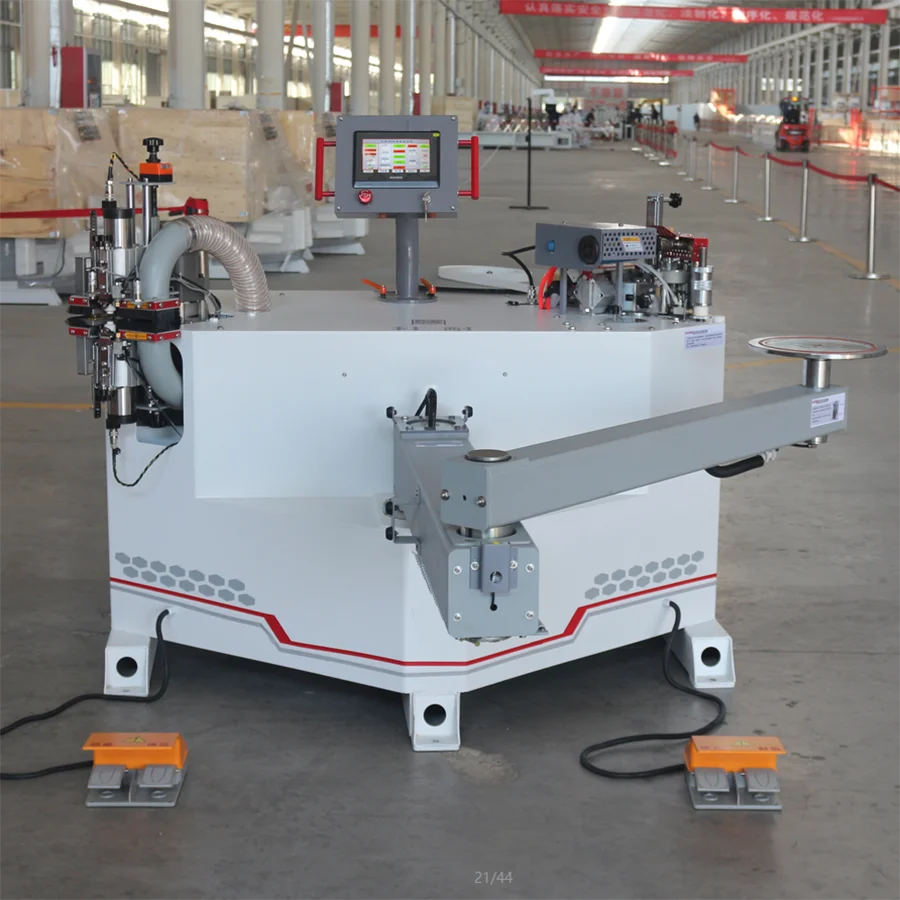
Servo-Driven Precision — The ZDS-700 pairs a 400W servo motor with laser displacement sensing to achieve verifiable ±0.3mm docking accuracy on contoured panel edges.
Technical Specifications
| Parameter |
Value |
| Model |
ZDS-700 |
| Product Type |
Automatic Curved Edge Banding and Trimming Machine |
| Rated Power |
6 kW |
| Voltage & Frequency |
380V / 50Hz (configurable 110V–440V) |
| Control System |
PLC (HIU-XP), Touch Screen (IT7000) |
| Overall Dimensions (L×W×H) |
1550 × 1440 × 1350 mm |
| Net Weight |
451 kg |
| Edge Banding Speed |
0–22 m/min |
| Feeding Speed |
0–30 cm/s |
| Thickness of Strips |
0.5–3 mm |
| Width of Strips |
14–70 mm |
| Length of Stacking Arm |
2270 mm |
| Air Pressure Requirement |
0.6–0.8 MPa |
| Volume of Air Storage Tank |
2 L |
| Glue Pot Volume |
2600 ml |
| Edge Banding Motor |
220V 400W servo motor |
| Trimming Profiling Motor |
220V 60W single-phase motor |
| Trimming High-Speed Motor |
220V 400Hz 24000 rpm |
| Frequency Transformer |
MD200 2.2 kW |
| Laser Displacement Sensor |
1030 series |
| Docking Error |
±0.3 mm |
| Glue Type Compatibility |
PUR and EVA |
| Touch Screen Data Storage |
20 form-data presets |
| Cleaning Devices |
4 stations with automatic spray cleaning liquid |
| Dust Collection |
Enlarged suction port with air pump for periodic cleaning |
| Hot Air Device |
1 heating unit for strip-to-panel pre-heating |
| LCD Screen Adjustment |
Rotatable 50° left and right |
Application Suitability
| Application |
Material or Output |
| Custom furniture curved cabinet doors |
MDF, plywood with PVC or veneer edge banding |
| Shaped shelving and display units |
Particleboard and melamine-faced board with PVC strips |
| Contoured tabletop and headboard profiles |
Solid wood panels with veneer banding up to 70mm width |
| Joinery workshop transition from manual trimming |
Mixed panel substrates requiring programmable form presets |
Why "Automatic Curved Edge Banding Machine Specifications" Matter More Than the Brochure Photo
Every tolerance claim should come with a measurement method, not just a marketing number.
When buyers evaluate automatic curved edge banding machine specifications, the docking tolerance figure often sits alone on a spec sheet with no context. I have watched customers receive machines where the quoted ±0.3mm held on flat MDF panels in the factory but drifted noticeably once the same machine processed tighter radii on particleboard in their own workshop [NEED_CITE: effect of substrate density on edge banding adhesion consistency]. The curve radius, strip width, and glue temperature together determine whether that stated tolerance survives real production conditions. Without a factory test record documenting performance on your actual panel profile and material, the number on the brochure remains an aspiration rather than a guarantee.

Servo Response and Laser Alignment on Non-Linear Profiles
The 400W servo motor driving the edge banding station provides fast positional response, which matters when the feed path changes direction continuously around a curved panel. Unlike stepper-driven alternatives, the servo closes the loop on strip position relative to the panel edge, correcting micro-deviations before they accumulate along the contour.
The 1030-series laser displacement sensor monitors the strip-to-panel gap in real time, feeding correction data back to the servo. This combination is what produces the stated ±0.3mm docking error. For technical buyers reviewing automatic curved edge banding machine specifications, the presence of both a servo motor and a laser sensor in the same system provides a measurable control chain rather than an open-loop assumption.
Glue Pot Behaviour Across PUR and EVA Cycles
The 2600ml glue pot supports both PUR and EVA adhesive types, but the two chemistries demand different thermal management. EVA typically runs between 160°C and 200°C depending on the formulation, while PUR requires lower temperatures and a sealed pot to prevent moisture-triggered curing. The ZDS-700 includes a heat preservation function on the pot, which maintains adhesive temperature during idle intervals without requiring a full cool-down and reheating cycle [NEED_CITE: PUR adhesive moisture sensitivity and pot life management].
This dual compatibility allows a single machine to handle PVC banding on production runs and switch to veneer with PUR for higher-end panels, reducing the need for two dedicated stations.
Reading the Spec Sheet for Downstream Assembly Impact
The trimming high-speed motor runs at 24000 rpm, which directly affects the surface finish left on the trimmed edge. Higher rotational speed reduces chatter marks on the cut face of PVC and veneer strips, meaning less manual cleanup before the panel moves to assembly. At 14–70mm strip width and 0.5–3mm thickness, the trimming head encounters varying cutting forces depending on whether you are processing thin melamine paper or thick PVC on a tight radius.
The 0–22 m/min edge banding speed range and 0–30 cm/s feeding speed together determine throughput. On gentle curves, the upper range is achievable; on tight radii with wider strips, the feed must slow to let the laser sensor and servo maintain alignment. Understanding this relationship between feed rate and curve geometry prevents buyers from projecting linear-machine throughput onto a curved-edge application [NEED_CITE: relationship between edge banding feed speed and minimum curve radius].
The Cost of Overlooking Voltage and Control Language Before Ordering
A machine wired for 380V/50Hz that arrives in a facility running 440V/60Hz will not simply underperform — the servo motor and frequency transformer will experience stress that shortens component life and voids warranty coverage. Similarly, an IT7000 touch screen displaying only Chinese labels forces the local operator to guess at form-data presets, leading to incorrect feed speed and glue temperature settings that surface only after several panels are ruined. These are not rare occurrences; they represent some of the most common commissioning delays I have encountered on curved edge banding equipment shipped without a pre-dispatch configuration check [NEED_CITE: industrial machinery voltage mismatch incidents in export markets]. The cost is measured in days of idle production and expensive remote troubleshooting sessions.
Purchasing With Engineering Depth Behind the Spec Sheet
The ZDS-700 is manufactured in a facility with proprietary cutting mechanism patents and multi-stage precision grinding, meaning the trimming head alignment is set through documented processes rather than operator feel on the assembly floor.
Voltage configuration from 110V to 440V is handled as a standard option, confirmed through an electrical schematic document before production begins, so the machine arrives matched to the buyer's facility.
Control panel language is set per order, with the 20 form-data presets labeled in the operator's language before the machine leaves the factory.
A four-stage QC process covers incoming material, in-process assembly, finished product, and pre-shipment verification, with a factory test record documenting docking tolerance on the buyer's specified panel profile.
Single-unit orders are accommodated alongside larger production runs, meaning a joinery workshop can evaluate one machine before committing to a line.
Documentation & Verification
- CE declaration of conformity specific to the ZDS-700 curved edge banding configuration
- ISO 9001 certificate covering the manufacturing quality management system
- Machine specification sheet detailing all motor ratings and PLC parameters
- Electrical schematic confirming voltage and frequency for the destination facility
- Factory test record measuring ±0.3mm docking tolerance on buyer's panel material
- Operation and maintenance manual in the agreed operator language with spare parts list
Installation, Commissioning & Support
- Requires a level floor area of at least 1550 × 1440 mm plus operator clearance on three sides
- Dedicated 380V/50Hz circuit rated for the 6 kW load, or custom voltage as confirmed on the electrical schematic
- The 451 kg net weight allows positioning with standard workshop lifting equipment
- Air supply at 0.6–0.8 MPa must connect to the 2L storage tank before first startup
- Initial commissioning includes setting the 20 form-data presets for the buyer's specific curve profiles
- Spare parts list covers the servo motor, laser sensor, and trimming blades for regional stock planning
What to Include in Your Inquiry
To receive a configuration recommendation that matches your workshop, provide the panel materials you process most frequently, the typical curve radius range of your components, and your local voltage and frequency standard. Specify the edge banding materials — PVC, veneer, or melamine paper — along with the strip widths and thicknesses you need to run. If you have upstream CNC routers or downstream trimming stations already in place, share their feed rate and throughput so the ZDS-700 can be evaluated for line compatibility.
Frequently Asked Questions
Q: How is the ±0.3mm docking tolerance verified before the machine ships?
A: A factory test record is produced running your specified panel material and curve profile through the ZDS-700, with measured docking values documented at multiple points along the contour. This record accompanies the machine and confirms whether ±0.3mm holds across your specific thickness and radius combination.
Q: Can the ZDS-700 be configured for voltages outside 380V/50Hz?
A: Yes. Voltage is configurable from 110V to 440V, and the final specification is confirmed through an electrical schematic document before production begins. This ensures the servo motor, frequency transformer, and high-speed trimming motor all match your facility's supply.
Q: What languages are available on the IT7000 touch screen?
A: The control panel supports multiple languages, and the 20 form-data presets can be labeled in the operator's preferred language before dispatch. This prevents misconfiguration during commissioning and reduces reliance on translation during daily operation.
Q: How does the 0–22 m/min banding speed integrate with a production line?
A: On gentle curves with standard PVC strips, the upper speed range is achievable. For tight radii or wider veneer banding, feed speed must decrease to maintain laser-guided alignment. Throughput matching with upstream CNC routers and downstream stations should be evaluated on your actual component mix.
Q: What minimum curve radius can the ZDS-700 handle?
A: The minimum radius depends on strip width and panel thickness together. Narrower strips within the 14–70mm range and the 2270mm stacking arm geometry allow tighter curves, while wider strips require larger radii. Provide your component profiles for a specific feasibility assessment.