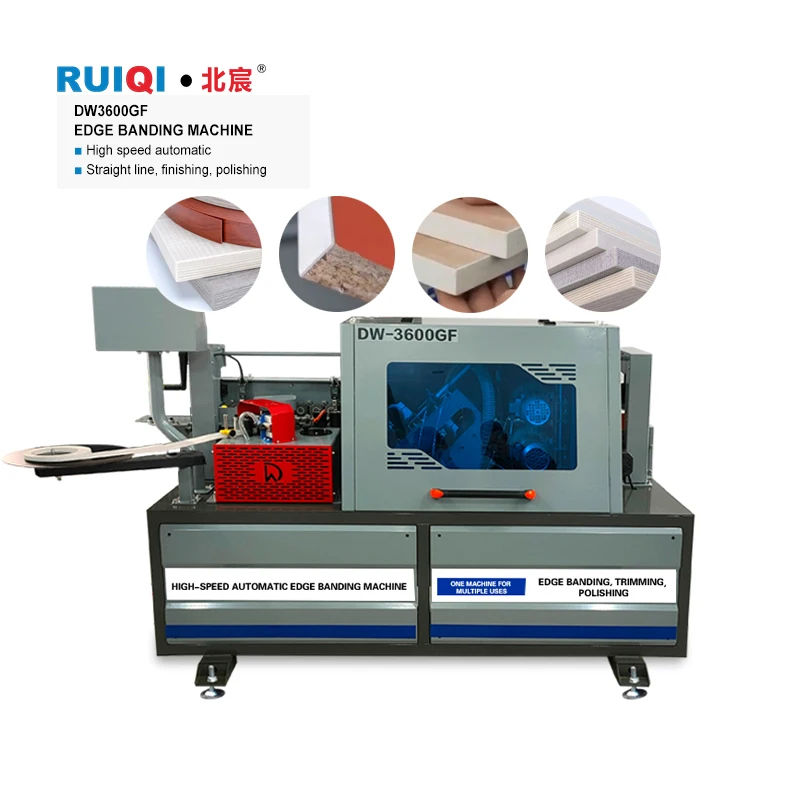
Patented cutting mechanism precision — The DW-3600GF holds edge trimming tolerance verifiable at ±0.02 mm on MDF and plywood substrates before the machine leaves the factory.
Technical Specifications
| Parameter |
Value |
| Model |
DW-3600GF |
| Product Type |
Fully Automatic Edge Banding Machine |
| Standard Functions |
Gluing, Trimming (front and rear), Scraping, Polishing, Vacuuming |
| Voltage & Frequency |
380V, three-phase four-wire (frequency to be confirmed against destination grid) |
| Total Power |
4.9 kW |
| Transmission Power |
180 W |
| Trimming Power / Speed |
800 W × 2, 24,000 r/min |
| Polishing Power |
400 W × 2 |
| Feed Speed |
0–14 m/min |
| Edge Band Thickness Range |
0.3–3 mm |
| Edge Band Height Range |
0–50 mm |
| Minimum Panel Length |
200 mm |
| Edge Banding Type |
Straight edge banding |
| Air Supply Requirement |
0.4–0.6 MPa |
| Overall Dimensions (L×W×H) |
2200 × 650 × 1250 mm |
| Net Weight |
320 kg |
| Language Options |
Chinese and English standard; Spanish and other languages customizable |
| Plug Options |
EU, USA, AU, UK |
| Certification |
CE, ISO 9001 |
Application Suitability
| Application |
Material or Output |
| Custom furniture panel edge finishing |
MDF and particleboard with PVC or melamine banding |
| Cabinet door and carcass production |
Plywood panels with veneer or ABS edge banding |
| Panel processing plant straight-edge runs |
Solid wood panels requiring clean trimming and polishing |
| Small-batch joinery workshop output |
Mixed substrate batches with frequent banding material changes |
Why the Voltage Question Must Come Before the Machine Ships
Local grid frequency determines whether the inverter powers up or locks out on arrival.
I used to do after-sales repair in the Yangtze Delta region, and the worst calls were always the preventable ones. A fully automatic 7-function edge bander arrived at a customer site, the operator hit start, and the variable frequency drive threw a fault code immediately — the local grid frequency did not match what the machine was built for. The entire shop floor stood idle waiting for a replacement drive [NEED_CITE: voltage and frequency standards by export market]. When I specify edge banding machine specifications for a client now, the first thing I do is walk onto the floor with a multimeter and check the actual supply before any order is placed.

Mapping Feed Speed to Your Panel Mix
The feed speed range of 0–14 m/min covers the typical throughput envelope for small to mid-volume furniture production. The dedicated 180 W transmission motor maintains consistent panel advance across materials of varying density. Heavier MDF panels and lighter particleboard respond differently to feed pressure, and having adjustable speed lets operators dial in the rate that prevents chatter on thin substrates while still pushing volume on thicker stock. Matching edge banding machine specifications to your actual panel mix prevents bottlenecks at the trimming station downstream.
Seven Stations, Each with Its Own Motor Rating
The seven-function layout — gluing, front and rear trimming, scraping, polishing, and vacuuming — assigns a dedicated motor to each cutting or finishing action. The dual 800 W trimming spindles run at 24,000 r/min, which is the speed range needed for a clean shear cut on PVC and melamine banding without chipping the substrate edge. The 400 W polishing wheels follow scraping to bring the edge to a smooth finish ready for assembly. Each station operates independently, meaning maintenance on one module does not require shutting down the entire feed chain. [NEED_CITE: CE machinery directive requirements for industrial equipment]
Reading the Numbers That Affect Downstream Assembly
Edge band thickness coverage from 0.3 to 3 mm determines which banding materials you can run without swapping pressure rollers or adjusting the glue roller gap. A 0.4 mm PVC band behaves very differently at the trimming station compared to a 2 mm melamine strip — the dual 800 W motors at 24,000 r/min must shear both cleanly without tear-out. The 0–50 mm height range accommodates standard cabinet panel thicknesses, but panels outside this window require a different machine class. Air supply at 0.4–0.6 MPa drives the pneumatic actuators that control roller pressure and trimming blade engagement; insufficient pressure results in inconsistent glue spread and visible bond lines on finished panels. The 4.9 kW total power draw means the machine fits within the electrical capacity of most small workshops without requiring a dedicated transformer upgrade, though the three-phase four-wire requirement must be confirmed against the local panel board before installation.
The Hidden Cost of Skipping Specification Verification
When edge banding machine specifications are not cross-checked against the workshop's actual utilities, the consequences compound quickly. A machine wired for 50 Hz running on a 60 Hz supply will push trimming spindles beyond their rated speed, accelerating bearing wear and introducing vibration that degrades edge finish quality. Operators confronted with a control panel in an unfamiliar language will bypass safety interlocks to keep production moving [NEED_CITE: industrial machine operator safety and control language requirements]. Panels that leave the bander with inconsistent glue lines or rough trimming force the assembly department to spend extra time on sanding and rework, shifting the bottleneck rather than eliminating it. These problems are entirely preventable if specification confirmation happens before the machine is crated.
Why Procurement Teams Route DW-3600GF Inquiries Through This Channel
In-house manufacturing with patented cutting mechanisms means the trimming tolerance is not a reseller's claim but a verifiable factory output. The full product family from entry-level to full-function allows a workshop to scale capacity later without changing suppliers or retraining operators. Voltage, language, and plug configuration are confirmed as part of the order process rather than left as assumptions. A four-stage quality control process with pre-shipment verification ensures the machine is tested against the buyer's actual panel material before dispatch. Engineer-led configuration recommendations with a formal quotation turnaround within 24 hours keep project timelines moving without extended back-and-forth cycles.
Documentation & Verification
- Machine specification sheet detailing every motor rating and pneumatic requirement for the DW-3600GF
- Electrical schematic confirming 380V three-phase wiring and frequency matched to destination grid
- Factory test record run on buyer-supplied MDF or plywood samples with edge banding material specified
- Operation and maintenance manual provided in the operator's working language before commissioning
- CE declaration of conformity and ISO 9001 certificate included with shipping documentation
Installation, Commissioning & Support
- Verify 380V three-phase four-wire supply and dedicated breaker rated for 4.9 kW total draw
- Confirm air compressor delivers stable 0.4–0.6 MPa to the machine's pneumatic manifold
- Allow 2200 × 650 mm floor footprint plus operator clearance on the feed and discharge sides
- Run first-article test panels at low feed speed to calibrate glue pot temperature and roller pressure
- Stock spare trimming blades and polishing wheels rated for the 24,000 r/min spindle speed
What to Include in Your Specification Inquiry
To build an accurate configuration proposal, share the substrate types and panel thickness range your shop processes most frequently, along with the edge banding materials and thicknesses you plan to run. Confirm the local voltage, phase, and frequency at the installation point — a photo of the main distribution board nameplate is often the fastest way to eliminate mismatches. If your line includes upstream saws or downstream boring machines, note their feed height and throughput so the DW-3600GF can be matched to the existing workflow.
Frequently Asked Questions
Q: How do I verify feed speed and trimming accuracy against my panel material before committing?
A: Request a sample processing test using your own MDF, plywood, or particleboard along with the exact PVC or veneer banding you intend to run. The factory test record will document feed speed, trimming quality, and edge finish on your specific materials, giving you verifiable data rather than catalog claims. This step eliminates surprises when the machine arrives on your floor.
Q: What voltage and frequency does the DW-3600GF support, and how is it confirmed before shipment?
A: The standard configuration is 380V three-phase four-wire, but frequency must be matched to your local grid — 50 Hz and 60 Hz markets require different motor and inverter settings. Voltage and frequency are confirmed during the specification review stage, and the electrical schematic shipped with the machine reflects the agreed configuration. Always verify your actual supply with a multimeter before ordering.
Q: How do I choose between this 7-function setup and a higher- or lower-spec model?
A: The seven functions cover gluing, front and rear trimming, scraping, polishing, and vacuuming — suitable for furniture production where visible edge quality matters for final assembly. If your output is structural panels where appearance is secondary, a simpler configuration may suffice. For high-volume lines running continuous shifts, a higher-spec model with additional pre-milling or corner-rounding stations may be more appropriate.
Q: What panel thickness range does this machine handle, and how does that affect assembly?
A: The edge band height range covers 0–50 mm, which accommodates standard cabinet and furniture panel thicknesses. Panel thickness directly affects trimming accuracy — panels that are too thin may flex under roller pressure, while very thick panels may exceed the trimming cutter engagement depth. Confirm your thickest and thinnest panels against the machine's verified range to ensure clean edges that assemble without gaps.
Q: How can I request a sample processing test using my own board and banding material?
A: Ship a representative sample of your panel material and edge banding to the factory for a live test run on the DW-3600GF. The resulting test record documents edge quality, glue adhesion, and trimming finish on your exact materials. This is standard practice before order confirmation and gives your production team confidence in the output before the machine is crated for shipment.