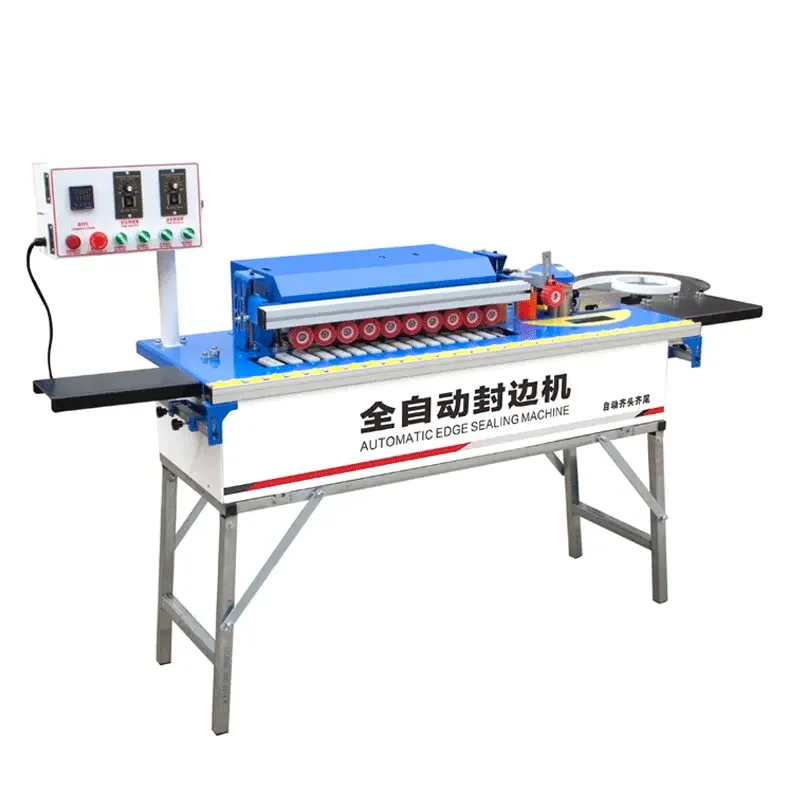
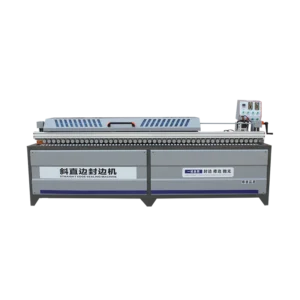
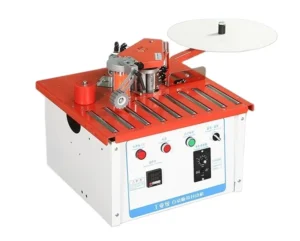
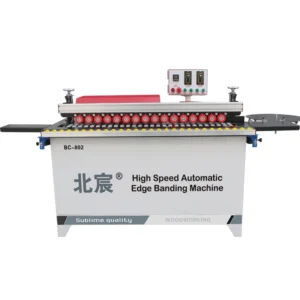
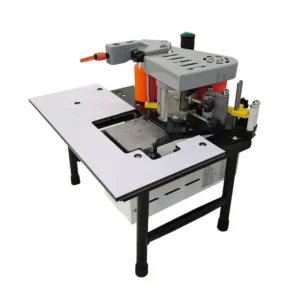
Compact Footprint, Full Function — the DW102 delivers curved and straight edge banding with trimming and polishing in a 128×47×69 cm footprint, configurable to your local voltage before shipment.
Technical Specifications
| Parameter |
Value |
| Model |
DW102 |
| Product Type |
Mini Automatic Edge Banding Machine |
| Total Power |
3800W |
| Voltage |
220V / 380V / customization available |
| Edge Banding Height |
0–50 mm |
| Edge Banding Thickness |
0.3–3 mm |
| Minimum Sheet Length |
250 mm |
| Minimum Sheet Width |
50 mm |
| Glue Pot Capacity |
1000 ml |
| Trimming Power |
650W × 2 |
| Polishing Power |
180W × 2 |
| Vacuum Power |
1200W |
| Edge Power |
20W |
| Transmission Power |
60W |
| Air Source Pressure |
0.5–0.8 MPa |
| Product Size |
128 × 47 × 69 cm |
| Product Weight |
75 kg |
| Assembly State |
Fully assembled |
| Language Options |
Chinese, English (other languages customizable) |
| Plug Options |
EU, USA, AU, UK |
| Key Features |
Curved and straight edge banding, edge trimming, polishing, automatic head and tail cutting, vacuum feed |
Application Suitability
| Application |
Material or Output |
| Cabinet door edge banding |
MDF and plywood with PVC edge banding 0.3–3 mm |
| Small-batch furniture production |
Particleboard panels with straight and curved profiles |
| Custom joinery and shelving |
Blockboard and solid wood panels up to 50 mm edge height |
| Polymer door finishing |
Polymer door blanks requiring curved edge contouring |
| Workshop prototyping runs |
Mixed panel substrates in short production sequences |
Why the Voltage Question Must Come Before Everything Else
Confirming voltage and frequency before production prevents a machine from arriving electrically incompatible with your workshop.
I spent years sourcing woodworking equipment for factories across Southeast Asia, and I have seen edge banders of this class sit idle for weeks because the motor was wound for a frequency that the local grid does not supply. A mini automatic edge banding machine specifications sheet that lists 220V/380V without confirming your actual phase configuration and Hz rating leaves a gap that only shows up when the motor overheats on the first production run [NEED_CITE: voltage and frequency standards by export market]. The DW102 supports voltage customization and ships with plug options for EU, USA, AU, and UK standards, but the configuration must be locked in during the quotation stage, not assumed.

Mapping the DW102 to Your Actual Panel Mix
This machine processes edge heights from 0 to 50 mm and thicknesses from 0.3 to 3 mm, which covers standard PVC and thin veneer banding used on MDF, plywood, and particleboard. When a workshop runs primarily melamine-faced chipboard for cabinet carcasses, the 0.3–1 mm range carries most of the load, and the automatic head and tail cutting keeps corner joints clean without manual trimming. The 1000 ml glue pot handles short production sequences without frequent refills, making the DW102 suitable for shops batching panels in smaller lots rather than running continuous shifts.
Curved Edges Without a Second Station
Most mini edge banders handle only straight runs, forcing operators to hand-trim curved profiles on shaped cabinet doors or radius shelving. The DW102 integrates curved and straight edge banding within one pass, so a joinery workshop can process a curved MDF door front and a straight shelving panel back-to-back without reconfiguring the feed path. The vacuum system holds the edge banding strip against the contour during glue application, which matters when the radius is tight and gravity alone would let the strip drift. Matching feed speed to glue temperature on curved sections requires operator attention — set the glue pot too cool and the bond fails at the curve apex [NEED_CITE: hot melt adhesive open time on curved substrates].
What the Spec Numbers Mean on the Shop Floor
The dual 650W trimming motors work the top and bottom edges simultaneously, which is the minimum configuration for producing a flush edge that needs no secondary sanding before assembly. The 180W × 2 polishing motors follow trimming to remove the micro-burrs that cause visible glue lines on light-colored PVC banding. Air source pressure between 0.5 and 0.8 MPa drives the pneumatic actuators that control head and tail cutting — below 0.5 MPa, the cutters hesitate and leave overhang on the panel ends. The 3800W total power draw means the machine can run on a dedicated single-phase circuit in most small workshops, but you should verify that your existing compressor can sustain the required air pressure simultaneously. The 75 kg weight and fully assembled delivery mean the DW102 rolls into position without rigging equipment, which matters in second-floor workshops or rented units where floor loading is a concern.
The Hidden Cost of Specifying Too Light for Your Volume
When a furniture workshop buys a mini edge bander rated for short batches and then pushes it through eight-hour production days, the glue pot cycles through heat-up and cool-down too many times, degrading the adhesive and leaving streaky bonds on panels processed late in the shift. Operators compensate by slowing the feed, which then creates a bottleneck that backs up the panel saw and the boring machine downstream. The trimming motors, designed for intermittent duty, begin to overheat and produce chatter marks on the edge that require hand sanding — the exact manual step the machine was supposed to eliminate [NEED_CITE: motor duty cycle and thermal limits in continuous woodworking operations]. Matching the DW102 to your actual daily panel count prevents this cascade.
Why Source the DW102 Through This Channel
The DW102 ships with a factory test record run on your specified panel thickness and edge banding material before dispatch, so you can verify edge quality against your assembly tolerances before the crate leaves the facility. Voltage and plug configuration are confirmed during the quotation stage with an electrical schematic, not left to assumption. The control panel language is set to match your operators before shipment — a detail that prevents commissioning delays when the technician on the floor cannot read the interface. CE documentation and an ISO 9001-aligned quality process back the build, and the four-stage inspection covers incoming components through pre-shipment verification. For workshops that may scale later, the DW102 sits within a broader product family, so moving to a higher-throughput model keeps you with the same supplier and spare parts ecosystem.
Documentation & Verification
- CE declaration of conformity specific to the DW102 model configuration
- Machine specification sheet confirming your voltage and plug selection
- Electrical schematic with circuit diagram for your local electrician
- Factory test record on your panel material and edge banding thickness
- Operation and maintenance manual in your selected language
- Spare parts list with part numbers for trimming blades and polishing wheels
Installation, Commissioning & Support
- Requires a dedicated circuit matching the confirmed voltage (220V or 380V) and the 3800W total draw
- Air compressor must sustain 0.5–0.8 MPa continuously to drive pneumatic cutters and feed
- Arrives fully assembled at 75 kg — position on a level floor near the panel saw
- First-run glue temperature calibration against your specific edge banding material and thickness
- Operator training covers curved-edge feed technique and glue pot refill intervals
- Trimming blades and polishing wheels included in spare parts list for routine replacement
Preparing Your Inquiry
To receive an accurate configuration proposal, share the panel materials and thicknesses you process most often, the edge banding type and thickness range, your daily panel volume, and your facility voltage and frequency. If you run curved profiles regularly, include the minimum radius so the feed path can be validated before production.
Frequently Asked Questions
Q: How do I verify the DW102 throughput matches my production volume?
A: Share your daily panel count and average edge length with the engineering team. They will calculate whether the glue pot capacity, feed mechanism duty cycle, and trimming motor rating sustain your volume without thermal degradation. The DW102 suits short-batch and medium-volume workshops; continuous high-volume lines require a different machine class.
Q: What voltage and frequency does my facility need for the DW102?
A: The DW102 supports 220V, 380V, and custom voltage configurations. You must confirm both voltage and frequency (Hz) during the quotation stage so the motor winding and control transformer match your grid. An electrical schematic is provided before production for your electrician to verify the circuit.
Q: Can the control panel be set to my local language?
A: Yes. The DW102 ships standard with Chinese and English interfaces, and additional languages are configurable before dispatch. Specify your required language when requesting the quotation so the control panel is loaded and tested before the machine leaves the factory.
Q: What is the smallest panel this machine can edge-band reliably?
A: The minimum sheet length is 250 mm and the minimum width is 50 mm. Panels below these dimensions cannot be held securely by the feed mechanism and may slip during trimming. For very small offcuts, a manual edge trimmer is the appropriate tool rather than the automatic feed path.
Q: How do I match edge banding thickness to my panel substrate?
A: PVC banding between 0.3 and 3 mm is supported. Thinner banding suits melamine-faced chipboard where the edge is primarily decorative, while thicker banding protects MDF and plywood edges from impact damage. Share your substrate and banding material so the glue temperature and feed pressure can be calibrated during the factory test.