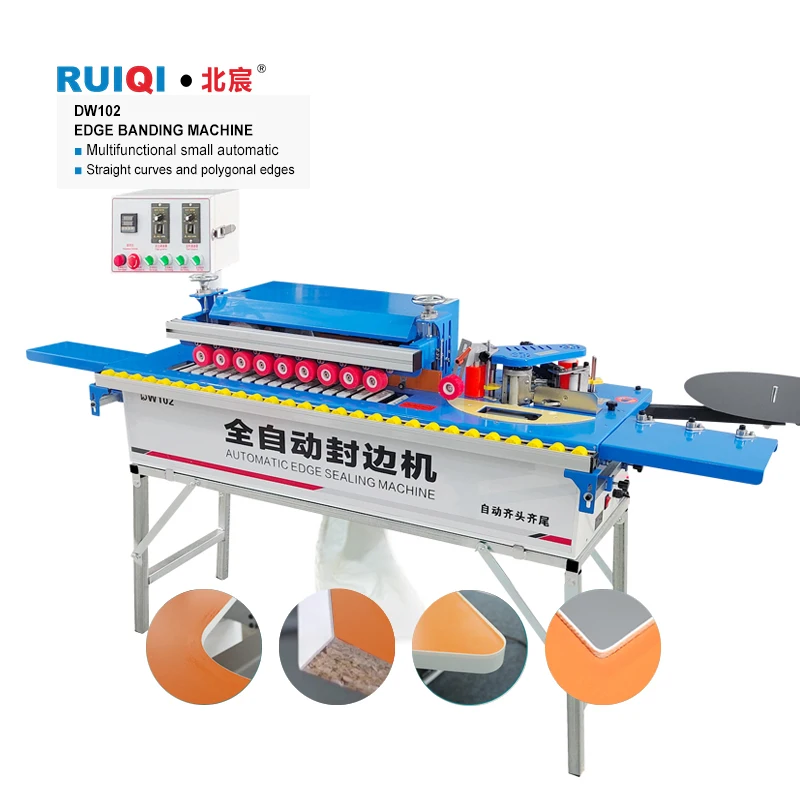
Voltage-flexible configuration — DW102 automatic edge bander available in 220V or 380V with plug options covering four regional standards, verified against your facility's electrical infrastructure before dispatch.
Technical Specifications
| Parameter |
Value |
| Model |
DW102 |
| Product Type |
Automatic Edge Banding Machine |
| Total Power |
3800W |
| Voltage Options |
220V / 380V / customization |
| Trimming Power |
650W × 2 |
| Polishing Power |
180W × 2 |
| Vacuum Power |
1200W |
| Edge Power |
20W |
| Transmission Power |
60W |
| Edge Banding Thickness |
0.3–3MM |
| Edge Banding Height |
0–50MM |
| Minimum Sheet Length |
25CM |
| Minimum Sheet Width |
5CM |
| Glue Pot Capacity |
1000ml |
| Air Source Pressure |
0.5–0.8MPa |
| Product Dimensions |
128 × 47 × 69CM |
| Product Weight |
75KG |
| Language Options |
Chinese, English (customizable) |
| Plug Options |
EU, USA, AU, UK |
| Key Features |
Curved and straight edge banding, edge trimming, polishing, automatic head and tail cutting, vacuum assist |
Application Suitability
| Application |
Material or Output |
| Cabinet door and drawer front edging |
Medium density fiberboard with PVC or melamine banding |
| Small-format panel processing |
Plywood and particleboard offcuts down to 25CM × 5CM |
| Polymer door production |
Polymer door components with curved profile edging |
| Workshop-scale furniture edging |
Blockboard and solid wood panels with veneer banding |
| Custom joinery short runs |
Mixed substrate batches requiring straight and curved trimming |
Why Voltage Must Be Confirmed Before DW102 Edge Banding Machine Specifications Are Finalized
Specifying voltage after the machine ships is the most common cause of commissioning failure for compact edge banders entering export markets.
When I started doing technical sales in Shandong, I watched a container arrive in Southeast Asia with a 380V/50Hz motor and a control transformer that could not step down correctly for the local 220V/60Hz grid. The DW102 edge banding machine specifications list both 220V and 380V as standard options, but frequency — 50Hz or 60Hz — is not stated in the source data and must be confirmed per destination. A motor wound for 50Hz running on a 60Hz supply will overspeed; wound for 60Hz on a 50Hz supply, it will overheat under load. Neither failure appears during factory acceptance testing because the test bench matches the factory's own grid [NEED_CITE: voltage and frequency standards by export market].
The plug option list covers EU, USA, AU, and UK configurations, but plug type alone does not guarantee compatibility. The internal wiring, contactor ratings, and heater element in the 1000ml glue pot all respond differently to frequency shifts. Technical buyers evaluating the DW102 edge banding machine specifications should treat voltage and frequency confirmation as a prerequisite to production, not a shipping detail.

Matching Station Power to Edge Material
The DW102 splits its 3800W total across dedicated stations: 650W × 2 for trimming, 180W × 2 for polishing, and 1200W for vacuum extraction. When comparing DW102 edge banding machine specifications against your edge stock, the trimming power matters most. PVC banding at 2–3MM thickness demands sustained torque from both trimming motors; undersized trimming on hard PVC leaves a chatter mark visible after polishing. The 180W polishing motors are adequate for standard buffing on PVC and melamine, but natural wood veneer may require a lighter touch to avoid burning the edge face.
Small-Format Capability and Its Limits
The minimum sheet dimensions — 25CM length and 5CM width — place the DW102 in a category suited for cabinet component work: drawer sides, narrow filler strips, and offcut reuse from larger panel nesting. Edge banding height of 0–50MM covers most standard panel thicknesses encountered in MDF and particleboard cabinet production. However, the source does not publish feed speed or cycle time, which are critical when calculating daily throughput. Before committing to this model for volume runs, request a timed test on your actual panel dimensions to establish realistic cycle expectations [NEED_CITE: CE machinery directive requirements for industrial equipment].
Interpreting the Glue Pot and Air Supply Specs
The 1000ml glue pot capacity suits short-run and job-shop workflows where the operator loads EVA hot melt for each batch. For facilities running continuous shifts, the pot size means periodic refill interruptions. Air source pressure of 0.5–0.8MPa drives the pneumatic cylinders controlling head-and-tail cutting and the pressure roller track. A compressor delivering pressure at the lower end of that range may cause incomplete snip cuts on thicker banding, while pressure above 0.8MPa risks premature seal wear. Verify your compressor's regulated output and line diameter before connecting the DW102.
Tolerance and Assembly Consequences
The source material for the DW102 does not state a trimming tolerance figure. In cabinet assembly, even a fraction of a millimeter of over-trim or under-trim accumulates across a multi-door run, causing hinge misalignment and visible panel gaps. When evaluating DW102 edge banding machine specifications, request a factory test record showing trimming results on your specific substrate and edge combination. Without verified tolerance data, the only way to assess edge quality is through a physical sample processed on the actual machine destined for your floor [NEED_CITE: edge banding tolerance verification methods in panel processing].
What Happens When Configuration Is Skipped
A compact bander ordered without confirming substrate and glue type arrives unable to handle high-density fiberboard, where EVA adhesion requires higher pot temperatures and longer open time than standard MDF. The operator slows feed manually to compensate, but without a published feed speed baseline, there is no reference point for what the machine should achieve. Panels leave the trimming station with visible glue lines or partially bonded edges. By the time the fault is diagnosed, the production schedule has slipped and the installer has already left the site [NEED_CITE: common commissioning failures in exported woodworking machinery].
Why Procurement Teams Source This Model Here
In-house manufacturing with patented cutting mechanisms means the trimming stations on the DW102 are built and tested under one roof, not assembled from third-party sub-contracts. Voltage, language, and plug customization are handled as standard configuration steps, not special engineering requests, reducing the gap between quotation and dispatch. Four-stage quality control — incoming material, in-process, finished product, and pre-shipment verification — catches wiring and pneumatic faults before the crate is sealed. Engineer-led configuration recommendations ensure the quoted DW102 matches your panel range and edge stock rather than a generic catalog entry. Factory visits are welcomed so buyers can witness a test run on their own material before authorizing shipment.
Documentation & Verification
- CE declaration of conformity covering the DW102 electrical and mechanical safety requirements
- Machine specification sheet with full power breakdown per station and voltage confirmation
- Electrical schematic showing wiring diagram matched to your confirmed voltage and frequency
- Factory test record documenting edge quality on your specified substrate and banding material
- Operation and maintenance manual in the agreed language with illustrated spare parts list
- Pre-shipment photograph set showing packing condition and included accessories
Installation, Commissioning & Support
- Floor space requirement based on the 128 × 47 × 69CM footprint plus operator clearance zone
- Dedicated circuit sized for the 3800W total load with appropriate breaker rating for your confirmed voltage
- Air line connection rated for 0.5–0.8MPa with moisture trap installed upstream of the machine inlet
- First-run parameter setting for glue pot temperature, trimming depth, and polishing pressure on your actual panels
- Operator training on curved versus straight edge mode switching and head-and-tail cut adjustment
- Spare parts list identifying wear items: trimming cutters, polishing wheels, pressure roller covers, and pneumatic seals
Preparing Your Inquiry
To receive a configuration proposal that matches your workshop conditions, include the substrate types and thicknesses you process most often, the edge banding materials and thickness range in your current stock, and your facility's confirmed voltage and frequency. If you run both straight and curved components, note the approximate ratio so the engineer can advise on fixture setup. Specify the control panel language and plug type required at the destination.
Frequently Asked Questions
Q: How can I verify feed speed and cycle time if they are not published for the DW102?
A: Request a timed factory test using panels matching your production dimensions and edge material. The test record should document pieces processed per hour under continuous operation, giving you a baseline for daily planning. This approach provides verified throughput data tied to your actual workload rather than a generic estimate.
Q: What is the difference between edge banding height and panel thickness range on this machine?
A: Edge banding height of 0–50MM refers to the maximum vertical dimension of the banding strip the machine can apply and trim. Panel thickness range is the board dimension that fits between the pressure beam and conveyor. Confirm both values match your stock before ordering to avoid clearance or tracking issues during operation.
Q: How do I ensure the 220V or 380V option matches my local grid including frequency?
A: Provide your facility's exact voltage and frequency (50Hz or 60Hz) at the inquiry stage so the motor winding, transformer, and glue pot heater element are specified accordingly. A machine wound for the wrong frequency will experience speed deviation or thermal overload, neither of which is detectable during standard factory testing on a different grid.
Q: What compressor capacity is needed to maintain 0.5–0.8MPa at the DW102 inlet?
A: The compressor must deliver regulated air within 0.5–0.8MPa at the machine connection point after line losses. Undersized compressors cause pressure drops during pneumatic cylinder actuation, resulting in incomplete snip cuts. Include a moisture trap and adequate line diameter to maintain stable pressure throughout the operating cycle.
Q: When should I consider stepping up from the DW102 to a full-function pre-milling model?
A: If your panels show visible edge defects from the saw cut — chipping, tear-out, or dimensional variation — a pre-milling station removes that damaged zone before edge application. The DW102 handles clean-cut panels effectively, but pre-milling adds a corrective pass that improves final edge appearance on lower-grade substrates or high-volume production environments.