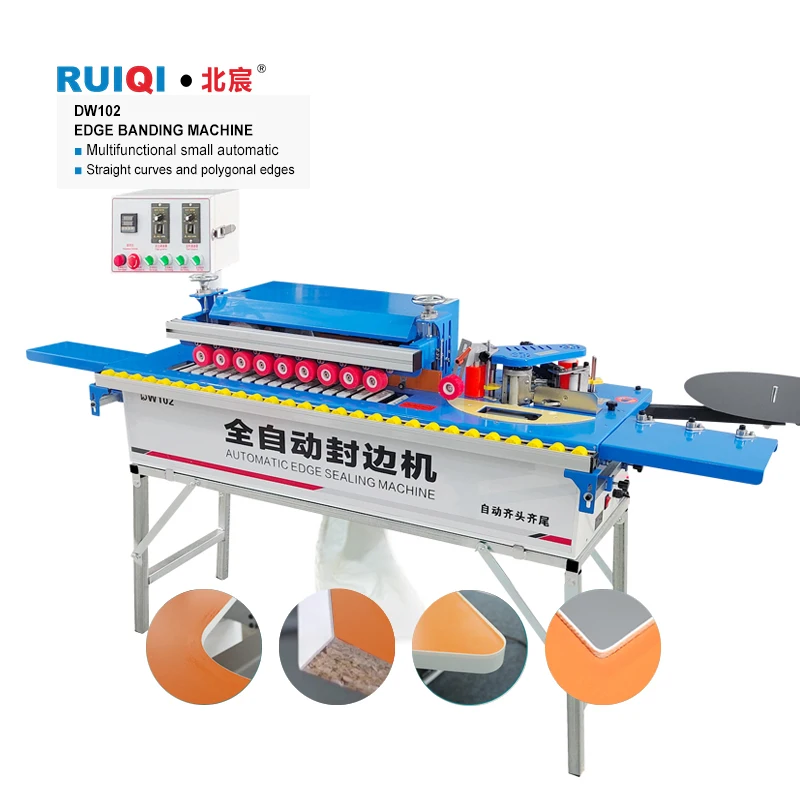
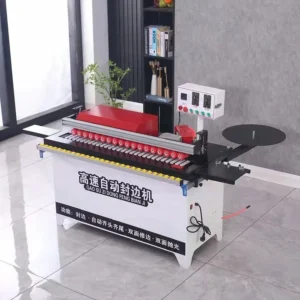
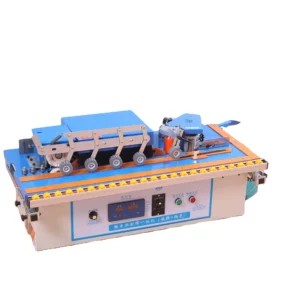
Verified Configuration — The DW102 ships with documented voltage, plug type and control language matched to your workshop grid before assembly begins, eliminating on-site electrical surprises.
Technical Specifications
| Parameter |
Value |
| Model |
DW102 |
| Product Type |
Automatic Edge Banding Machine |
| Total Power |
3800W |
| Voltage |
220V/380V/customization |
| Edge Banding Thickness |
0.3–3 mm |
| Edge Banding Height |
0–50 mm |
| Minimum Sheet Length |
25 cm |
| Minimum Sheet Width |
5 cm |
| Trimming Power |
650W × 2 |
| Polishing Power |
180W × 2 |
| Vacuum Power |
1200W |
| Glue Pot Capacity |
1000 ml |
| Air Source Pressure |
0.5–0.8 MPa |
| Product Size |
128 × 47 × 69 cm |
| Product Weight |
75 kg |
| Key Features |
Curved and straight edge banding, automatic head and tail cutting, edge trimming, polishing, integrated vacuum |
Application Suitability
| Application |
Material or Output |
| Cabinet door and carcass edge finishing |
MDF, particleboard, plywood with PVC or melamine banding |
| Small component and offcut processing |
Wood panels and blockboard down to 25 × 5 cm |
| Curved furniture profile banding |
Polymer doors and shaped MDF components |
| Custom joinery and shelving |
Veneer and solid wood edge banding on plywood substrates |
Why the Voltage Question Should Come Before the Price
A machine quoted without confirmed voltage and frequency becomes dead weight the day it arrives.
I spent years on assembly floors watching crates get opened with excitement, only to have that excitement turn into a three-week delay while everyone waited for a step-down transformer. The DW102 automatic edge banding machine specifications include voltage configurable from 220V to 380V with plug options for EU, USA, AU and UK markets. That flexibility means nothing unless someone actually asks for your配电柜 photo and confirms the local grid frequency before the build order goes in.
Workshops in regions with unstable supply often discover the mismatch only after the control board refuses to power on. [NEED_CITE: voltage and frequency standards by export market]. A spec sheet listing "customization" as an option is not the same as a pre-production electrical confirmation document signed by both parties.

Matching Panel Dimensions to Workshop Reality
The DW102 handles sheet lengths starting at 25 cm and widths down to 5 cm, which matters for workshops cutting nested components from standard boards. Many automatic edge banding machine specifications quote maximum panel sizes but omit the minimum, leaving buyers to discover on day one that their small offcuts and drawer sides cannot feed through the transport chain.
A 0.3–3 mm edge banding thickness range covers standard PVC, thin melamine and real wood veneer stock. This lets a cabinet maker switch between high-gloss PVC for doors and veneer for exposed shelving edges on the same unit, without changing glue or feed parameters between runs.
How Trimming and Polishing Stations Determine Edge Quality
Dual trimming motors rated at 650W each provide consistent end-cut force across MDF and particleboard, where the substrate density can vary board to board. The automatic head and tail cutting sequence trims banding overhang before the panel reaches the polishing stage, reducing the chance of tear-out on brittle melamine edges.
An integrated 1200W vacuum system extracts dust at the trimming and polishing zone rather than relying on a separate shop dust collector to pull debris from a remote port. [NEED_CITE: CE machinery directive requirements for dust extraction on woodworking equipment]. This keeps the polishing cloth clean longer and prevents fine MDF dust from settling back onto freshly glued surfaces.
Reading the Specification Sheet Like a Production Manager
Edge banding height of 0–50 mm defines which stock thicknesses the feed rollers can grip without slipping — critical when running 50 mm solid wood nosing alongside 0.4 mm PVC tape. The 1000 ml glue pot capacity suits batch runs of moderate size; shops running continuous full-shift production should verify whether the pot recovery rate maintains temperature between panels.
Air source pressure of 0.5–0.8 MPa determines the pneumatic cylinder force holding the banding against the panel edge during the pressing stage. Undersizing the compressor causes intermittent pressure drops visible as uneven glue lines. The DW102 automatic edge banding machine specifications list this requirement explicitly so buyers can cross-check their existing compressor capacity before ordering.
Total power draw at 3800W fits within a standard single-phase or small three-phase workshop circuit, but the machine still needs a dedicated breaker to avoid voltage sag when trimming motors engage simultaneously.
What Happens When You Skip the Specification Check
Machines built for 220V/50Hz and shipped to a 60Hz grid run their motors at higher RPM than designed, accelerating bearing wear and altering the glue pot heating curve. Operators then adjust feed speed to compensate, masking a problem that surfaces weeks later as inconsistent trim quality. [NEED_CITE: effects of frequency mismatch on induction motor speed and torque].
Control panels in an unread language stall commissioning until someone translates the menu tree. Shops that assumed English was default have spent days matching button labels to a PDF manual in another language.
Why Configuration Confirmation Matters Here
Voltage, frequency and plug type are confirmed in writing before the DW102 enters production, not discovered at the packing stage. The electrical schematic provided matches the actual wiring, so your local electrician can trace a fault without guessing.
Language options on the control panel extend beyond Chinese and English to Spanish and other languages on request, specified at the order stage. A four-stage quality check covers incoming components through pre-shipment testing, with a factory test record documenting your exact panel material run through every station.
The DW102 sits within a full product family, meaning a workshop that outgrows this compact model can move to a higher-throughput unit from the same supplier without learning a new control interface or renegotiating service terms.
Documentation & Verification
- Electrical schematic and voltage confirmation matching your local grid before dispatch
- Machine specification sheet with every parameter verified against the actual DW102 build
- Operation and maintenance manual in your agreed language covering all stations
- Pre-shipment factory test record with photographs of your panel material processed
- Spare parts list identifying consumables specific to your trimmer and polisher configuration
Installation, Commissioning & Support
- Dedicated 3800W circuit with breaker rated for simultaneous trimming motor startup current
- 128 × 47 × 69 cm footprint fits through standard workshop doors without disassembly
- 75 kg single-unit assembly allows two-person positioning without overhead lifting gear
- Air compressor sized to sustain 0.5–0.8 MPa at the machine inlet during continuous operation
- Glue pot first-heat cycle and temperature calibration performed during commissioning on your stock
- Language-configured control panel verified at startup with operator walk-through of all functions
What to Share With Your Inquiry
Provide your panel material types, the thickest edge banding stock you run, and your workshop voltage and frequency. Include the language your operators need on the control panel and the plug standard for your region. If you are replacing an existing edge bander, note the model and the specific edge quality issue you want to resolve.
Frequently Asked Questions
Q: How do I confirm my panel materials fall within the DW102 edge banding thickness and height range?
A: The machine covers 0.3–3 mm banding thickness and 0–50 mm banding height, handling PVC, melamine, veneer and solid wood stock. Send a sample of your thickest and thinnest banding material for a pre-shipment processing test, and request the factory test record confirming edge quality on your specific substrate before the machine leaves the facility.
Q: How is voltage, frequency and plug configuration confirmed before the DW102 is built?
A: Before production begins, you provide a photo of your local electrical panel and confirm grid frequency. An electrical schematic and voltage confirmation document are issued for your approval, and the machine is wired and tested at that exact configuration before dispatch to avoid on-site transformer delays.
Q: What control panel languages are available and how do I request one not listed?
A: Standard options include Chinese, English and Spanish. Other languages can be configured at the order stage if specified before the control board is programmed. Confirm the required language during the specification review so the panel arrives ready for your operators on day one.
Q: What air compressor capacity does the DW102 require?
A: The machine needs a stable 0.5–0.8 MPa supply at the inlet to operate pneumatic pressing cylinders and the automatic head-and-tail cutter. An undersized compressor causes pressure drops visible as inconsistent glue lines, so confirm your existing compressor output or plan for a dedicated unit rated for continuous workshop use.
Q: What are the minimum and maximum sheet dimensions the DW102 can process?
A: The machine handles sheets down to 25 cm in length and 5 cm in width, enabling small offcut and component edge banding. The edge banding height range of 0–50 mm defines the maximum panel thickness the feed system accommodates. Verify your largest standard panel against these dimensions during the specification review stage.