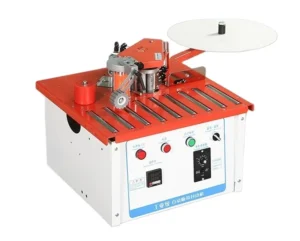
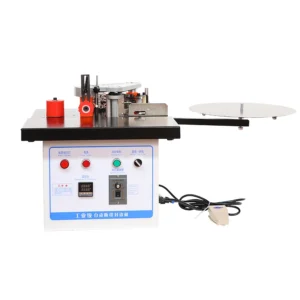
Engineer-Led Configuration — every DW130 order begins with substrate and voltage verification before the quotation is finalized, so the machine you receive matches the panels you actually cut.
Technical Specifications
| Parameter |
Value |
| Model |
DW130 |
| Product Type |
Fully Automatic Multifunctional Edge Banding Machine |
| Standard Dimensions (L×W×H) |
139×52×61 cm |
| Glue Pot Capacity |
2000 ml |
| Voltage |
220V (frequency to be confirmed at order) |
| Heating Time |
5–10 min |
| Edge Profile |
Oblique & Straight Edge |
| Control Panel Language |
Chinese & English (multilingual options available) |
| Plug Standard |
EU / USA / AU / UK selectable |
| Assembly State |
Fully assembled at dispatch |
| Certification |
CE |
Application Suitability
| Application |
Material or Output |
| Small workshop cabinet edge banding |
MDF and particleboard with PVC edging |
| Custom furniture bevel trimming |
Plywood panels with veneer banding |
| Joinery startup production runs |
Solid wood panels up to standard thickness |
| Low-to-medium batch edge finishing |
Straight and oblique profiles on board stock |
Why the Voltage Question Should Come Before the Price on a DW130 Edge Banding Machine
Confirming local voltage and frequency before shipment prevents a machine that simply will not start on arrival.
I have seen workshops wait six weeks for an edge bander only to discover the heating element was wired for 50 Hz while the facility runs on 60 Hz. The glue pot never reaches temperature, the feed motor runs at the wrong speed, and the entire commissioning schedule collapses. The DW130 edge banding machine specifications include 220V as the base rating, but frequency, plug type, and circuit capacity must all be matched to your local grid before production begins [NEED_CITE: voltage and frequency standards by export market]. Skipping this step turns a straightforward installation into weeks of rewiring and transformer sourcing.

Matching Glue Temperature to Your Substrate
The 2000 ml glue pot on this unit reaches working temperature within 5 to 10 minutes, but that number only matters if you know what you are bonding. Standard particleboard absorbs heat differently from high-density MDF, and the feed speed must be adjusted accordingly. When the DW130 edge banding machine is configured for your specific panel material, the operator can set a predictable warm-up routine at shift start rather than guessing at temperature readiness mid-run.
Footprint Planning in a Shared Workshop
At 139×52×61 cm, this machine fits alongside a sliding table saw or a boring station without dominating the floor plan. Workshops moving from manual edge banding to mechanized production often have limited space, and every centimeter of clearance affects material flow. The compact footprint means you can position the infeed and outfeed zones to align with your existing cutting and assembly stations rather than rearranging the entire shop floor [NEED_CITE: workshop layout standards for small furniture operations].
Reading the Specifications That Actually Affect Output Quality
The oblique and straight edge capability in a single unit eliminates the need for a separate bevel machine, which matters when floor space and budget are both constrained. Glue pot capacity of 2000 ml supports continuous runs on standard panel widths without mid-shift refills that break production rhythm. The heating time of 5–10 minutes sets the minimum gap between power-on and first feed, which directly shapes your morning startup procedure. Control panel language customization ensures the operator reads feed speed and temperature settings in their working language, removing a common cause of commissioning delays in export markets [NEED_CITE: multilingual control panel requirements in woodworking machinery exports].
The Hidden Cost of Skipping Configuration Checks
A machine ordered without confirming substrate type often shows up with default settings calibrated for standard particleboard. If your actual production uses high-density MDF or moisture-resistant board, the glue temperature and feed speed will be mismatched from day one. Edge peeling, visible glue lines, and rejected panels follow within the first production run. The cost is not the machine price — it is the material waste, the delayed deliveries to your own customers, and the weeks spent troubleshooting what is fundamentally a configuration problem rather than a mechanical failure [NEED_CITE: common edge banding defects from incorrect parameter settings].
Why Technical Buyers Source This Model Here
The DW130 is built within a product family that scales from entry-level to full-function pre-milling configurations, so your workshop can add capacity later without switching suppliers. Voltage and plug type are confirmed at the quotation stage rather than assumed, eliminating the grid-compatibility failures that strand machines at customs. The four-stage quality check covers incoming material through pre-shipment verification, with factory test records available on your specific panel thickness range. Engineer-led configuration recommendations arrive within 24 hours of inquiry, based on your actual substrate and production volume rather than a generic catalog entry. OEM branding and private label options are available for distributors integrating this model into a regional product line.
Documentation & Verification
- Machine specification sheet with voltage and frequency matched to your facility
- Electrical schematic confirming plug type and circuit breaker requirements
- Factory test record on your specified panel material and edge banding type
- Operation and maintenance manual delivered in your operator's working language
- CE declaration of conformity for customs clearance and regulatory compliance
- Spare parts list with part numbers for consumables and wear components
Installation, Commissioning & Support
- Arrives fully assembled; position on level floor near a dedicated 220V circuit
- Allow 5–10 minutes for initial glue pot heating before first panel feed
- Compact 139 cm length requires clearance on both infeed and outfeed sides
- Control panel language verified against operator preference before dispatch
- First-run parameter adjustment supported by remote engineering guidance
- Wear parts list provided for glue scraper, pressure roller, and trimming blades
What to Include in Your Inquiry
Send your primary panel material, typical board thickness range, and the edge banding type you run most often. Specify your facility voltage and frequency so the electrical system is built to match. If your operators need a specific control panel language, state it at the inquiry stage to avoid commissioning delays.
Frequently Asked Questions
Q: How do I verify the DW130 voltage and frequency match my facility?
A: Provide your local voltage and frequency at the inquiry stage. The engineering team confirms compatibility on the specification sheet before production begins. The electrical schematic is included with shipment documentation so your electrician can verify circuit requirements and plug type before the machine is uncrated.
Q: What panel thickness and edge banding materials does the DW130 support?
A: This unit handles MDF, plywood, particleboard, and solid wood panels with PVC or veneer edge banding. Confirm your typical board thickness and substrate density during configuration so glue temperature and feed speed are set correctly for your production material rather than generic defaults.
Q: Can the control panel be customized to my operator's language?
A: Chinese and English are standard, with additional languages available at order. Specify the required language during the quotation stage so the control panel firmware is loaded before dispatch. This avoids commissioning stalls caused by operators unable to read temperature and speed settings on arrival.
Q: How does throughput compare with higher-tier models in this product family?
A: The DW130 is configured for low-to-medium volume operations where compact footprint and dual edge profile capability are the priority. Higher-tier models offer additional processing stations and faster feed rates for continuous production lines. Your engineer configuration proposal will match the model to your daily panel volume.
Q: What documentation ships with the machine?
A: Every DW130 ships with a specification sheet, electrical schematic, factory test record, operation manual in the agreed language, spare parts list, and packing photographs. CE declaration of conformity is included for import clearance. Request these documents during the quotation stage to verify before dispatch.