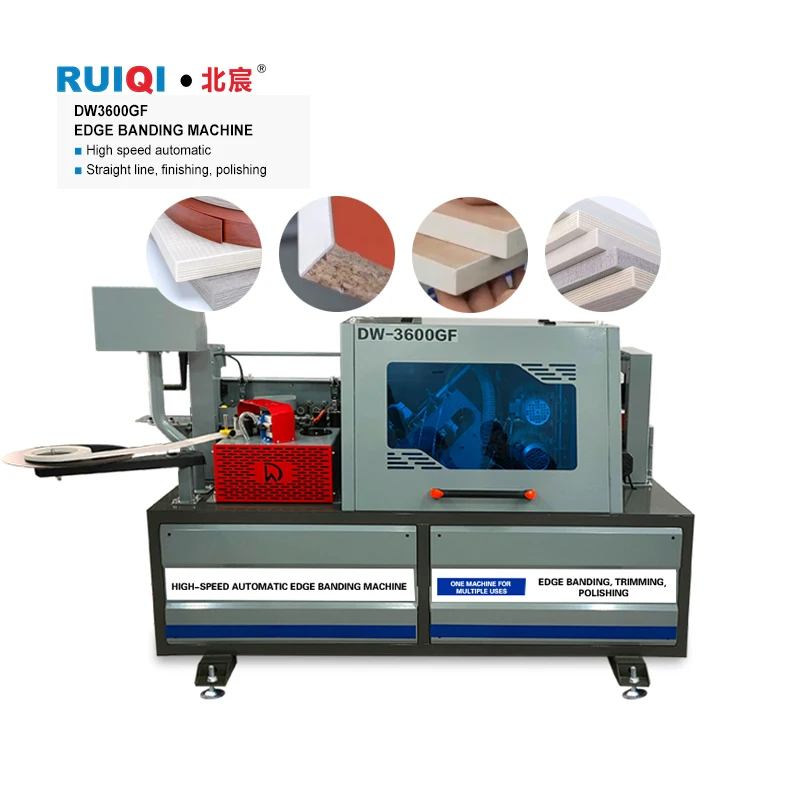
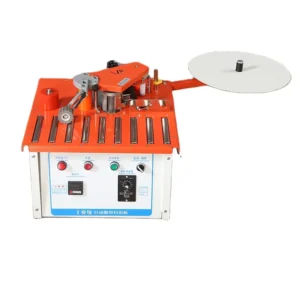
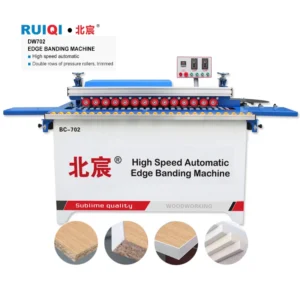
Voltage-locked configuration — every DW-3600GF quotation confirms local voltage and frequency before production starts, eliminating on-site power mismatches.
Technical Specifications
| Parameter |
Value |
| Model |
DW-3600GF |
| Product Type |
Automatic Compact Edge Banding Machine with Pre-Milling |
| Voltage & Frequency |
380V Three-Phase Four-Wire (configurable 110V–440V) |
| Total Power |
4.9 kW |
| Equipment Size (L×W×H) |
2200×650×1250 mm |
| Total Weight |
320 kg |
| Edge Banding Type |
Straight Edge Banding |
| Edge Band Height Range |
0–50 mm |
| Edge Band Thickness Range |
0.3–3 mm |
| Minimum Panel Length |
200 mm |
| Feed Speed |
0–14 m/min |
| Transmission Power |
180 W |
| Trimming Power |
800 W × 2 |
| Trimming Spindle Speed |
24000 r/min |
| Polishing Power |
400 W × 2 |
| Air Pressure Requirement |
0.4–0.6 MPa |
| Standard Functions |
Gluing, Trimming, Front and Rear Trimming, Scraping, Polishing, Vacuuming |
| Control System |
PLC (basis not stated in source — confirm control type at order) |
| Language Options |
Chinese, English; other languages customizable (basis not stated in source — confirm at order) |
| Standards |
CE, ISO 9001 (basis not stated in source — verify against manufacturer catalog) |
Application Suitability
| Application |
Material or Output |
| Custom cabinet door and carcass edge banding |
MDF and particleboard panels with PVC or melamine edge bands |
| Small-batch joinery workshop production |
Plywood and blockboard with wood veneer banding up to 3 mm thickness |
| Straight-edge furniture component finishing |
Pre-cut panels from sliding table saws requiring pre-milling before glue application |
| Prototype and sample-room processing |
Short panel runs down to 200 mm minimum length for one-off cabinet components |
Why Voltage Confirmation Must Precede Every Other Specification
The DW-3600GF automatic compact edge bander specifications only matter if the machine can actually power on at your facility.
I once watched a shipment sit idle for three weeks because the destination grid ran 415V while the machine was wired for 380V. The transformer retrofit cost the buyer more than the shipping itself. When evaluating automatic compact edge bander specifications, voltage and frequency compatibility should be the very first line item you verify — before feed speed, before trimming power, before anything else. A machine that cannot energize is not a production asset; it is floor ballast [NEED_CITE: voltage and frequency standards by export market].

Mapping Feed Speed to Substrate Behavior
The 0–14 m/min feed range on this automatic compact edge bander gives operators room to dial in speed based on the substrate they are running. Particleboard with a fragile core needs a slower feed to prevent chipping at the trimming stations, while denser MDF tolerates higher feed rates without edge degradation. The independent 180 W transmission motor allows speed adjustment without affecting trimming spindle performance, so you can tune throughput without sacrificing cut quality.
Pre-Milling as Standard Insurance Against Saw Marks
Panels cut on a standard sliding table saw rarely leave a perfectly clean edge. Micro-chips and tear-out along the cut line create visible glue lines once the edge band is applied. The pre-milling station on the DW-3600GF removes a thin layer from the panel edge before gluing, producing a fresh surface that allows the adhesive to bond uniformly. This is especially relevant when working with recycled-core particleboard, where internal voids often cause ragged cuts [NEED_CITE: effect of substrate density variation on edge band adhesion quality].
How Trimming and Scraping Stations Define Final Edge Quality
The dual trimming stations each deliver 800 W at 24,000 r/min, which is sufficient to produce a clean flush cut on PVC bands up to 3 mm thick without leaving chatter marks. After trimming, the scraping station removes the microscopic ridge left by the trimming cutter, and the dual 400 W polishing wheels bring the edge to a smooth finish. For workshops running both thin 0.3 mm melamine bands and thicker 3 mm PVC profiles, the ability to adjust each station independently means one machine handles the full material range without manual re-tooling between batches. The compact 2200 mm length keeps the entire glue-to-polish sequence within a small footprint, which matters when floor space constrains line layout.
The Hidden Cost of Skipping Configuration Verification
When a buyer orders an edge bander without confirming the air pressure supply at their facility, the gluing roller fails to maintain consistent contact pressure, leaving uneven adhesive coverage that only shows up after the panel reaches the assembly bench. I have seen workshops blame the machine for poor edge quality when the real issue was a compressor that could not sustain the required 0.4 MPa continuously. Similarly, skipping language confirmation on the control panel means the operator cannot read fault codes, turning a minor sensor trip into a full production halt while someone searches for a translator [NEED_CITE: common causes of commissioning delays in exported woodworking machinery].
Why Sourcing This Machine Through Our Configuration Process
Every DW-3600GF order begins with an engineer-led review of your local power supply, panel mix, and production volume before a formal quotation is issued. Voltage is locked in writing — 380V, 415V, or any value between 110V and 440V — so the machine arrives wired correctly for your grid. A four-stage quality check covers incoming components, in-process assembly, finished-product testing, and a pre-shipment verification run on your specified panel thickness range. The operation manual is produced in the language your operators actually read, not an afterthought translation. Full OEM and private-label capability means distributors can brand the machine for their regional market without managing separate production runs.
Documentation & Verification
- Electrical schematic confirming exact voltage and frequency wired at factory
- Factory test record run on your specified panel thickness and edge band material
- Machine specification sheet with all station power ratings and dimensional drawings
- Operation and maintenance manual in your agreed operator language
- CE declaration of conformity and ISO 9001 certificate for customs clearance
- Packing photographs showing crate condition before container loading
Installation, Commissioning & Support
- Requires a dedicated three-phase circuit matching the confirmed 4.9 kW total power draw
- Floor space of 2200×650 mm with rear clearance for dust extraction hose routing
- Air compressor must sustain 0.4–0.6 MPa continuously at the machine inlet
- First-run commissioning includes feed speed calibration across your panel thickness range
- Trimming spindle alignment checked against your primary edge band thickness
- Spare trimming cutters and scraping blades included for initial production period
What to Include in Your Inquiry
To receive a configuration-accurate quotation, share your primary panel materials and thickness range, the edge band types and thicknesses you run most often, and your local three-phase voltage and frequency. If you are integrating this machine into an existing line, note the upstream saw model and any downstream boring or drilling stations so feed height and throughput can be matched. Confirm the preferred control panel language and whether you require a pre-shipment test on your own sample panels.
Frequently Asked Questions
Q: How can I confirm that the 0–14 m/min feed speed is practical for my panel material?
A: Feed speed suitability depends on substrate density and edge band thickness together. During the pre-shipment test, we run your actual panel and band combination at incremental speeds, documenting edge quality at each step. This gives you a verified operating range rather than a theoretical maximum, so you know exactly where to set the dial on day one of production.
Q: Can the DW-3600GF be configured for a 415V or 220V three-phase supply?
A: Yes. Voltage is configurable from 110V to 440V at the order stage. We confirm the exact voltage and frequency of your destination grid in writing before production begins. The electrical schematic and factory wiring record are included in the shipping documentation so your local electrician can verify compatibility on arrival.
Q: Does pre-milling make a difference if my panels are already cut on a CNC panel saw?
A: CNC panel saws generally produce cleaner edges than sliding table saws, but even CNC-cut panels can develop micro-chips on recycled-core particleboard. Pre-milling removes approximately one millimeter of material, exposing a fresh bonding surface. If your panels are consistently clean-cut virgin MDF, you may choose to bypass the station, but keeping it active adds a margin of quality insurance.
Q: What adjustments are needed when switching between PVC and wood veneer edge bands?
A: PVC bands up to 3 mm require higher trimming spindle engagement and moderate scraping pressure, while wood veneer at 0.3–1 mm needs lighter scraping to avoid cutting through the veneer layer. Polishing wheel pressure is also reduced for veneer to prevent surface burnishing. All adjustments are made at the station level without tools, allowing material changeovers within a single shift.
Q: How do I match this edge bander with upstream and downstream stations in a small line?
A: The 0–14 m/min feed speed and 200 mm minimum panel length define the throughput envelope. Upstream, your panel saw should produce cut panels faster than the bander consumes them. Downstream, boring stations should accept panels at the same feed height. We review your full equipment list during the configuration stage to flag any height or throughput mismatches before machines are shipped.