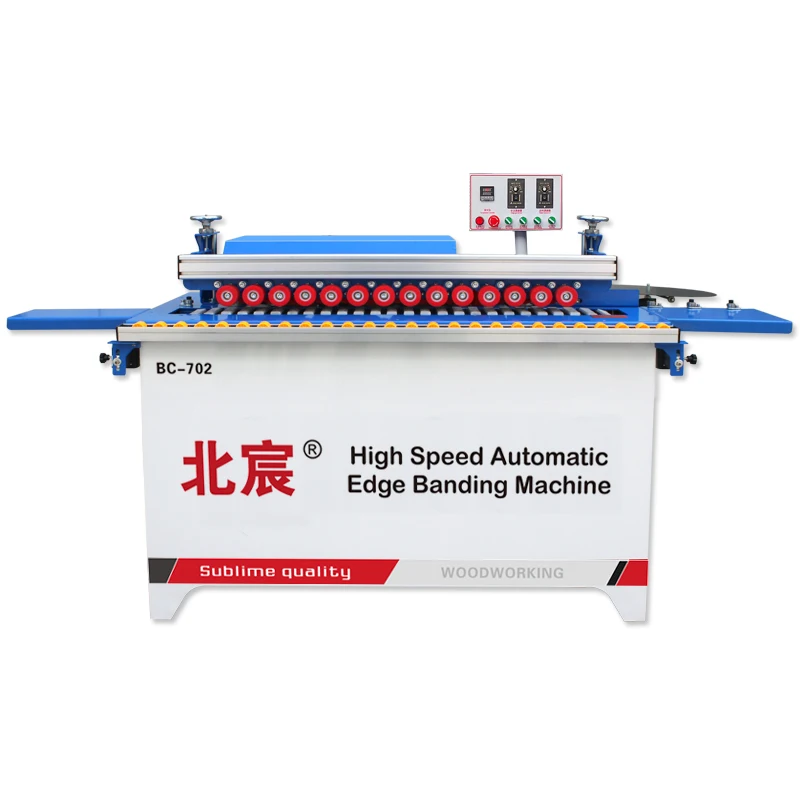
Voltage-First Configuration — Every DW702 quotation is issued only after the destination site's voltage and frequency are confirmed in writing, preventing the costly idle-machine scenarios that plague cross-border equipment purchases.
Technical Specifications
| Parameter |
Value |
| Model |
DW702 |
| Product Type |
Automatic Edge Banding and Trimming Machine |
| Total Power |
3800W |
| Voltage Options |
220V / 380V / customization (frequency to be confirmed) |
| Edge Feed Power |
20W |
| Transmission Power |
140W |
| Trimming Power |
800W × 2 |
| Polishing Power |
180W × 2 |
| Vacuum Feed Power |
1200W |
| Glue Pot Capacity |
1000 ml |
| Edge Banding Height Range |
0–50 mm |
| Edge Banding Thickness Range |
0.3–3 mm |
| Minimum Sheet Length |
25 cm |
| Minimum Sheet Width |
10 cm |
| Air Source Pressure |
0.4–0.8 MPa |
| Overall Dimensions (L×W×H) |
120 × 55 × 110 cm |
| Net Weight |
105 kg |
| Key Features |
Automatic head-and-tail cutting, dual trimming, dual polishing, vacuum feed |
Application Suitability
| Application |
Material or Output |
| Cabinet door edge finishing |
MDF and particleboard with PVC or melamine edge banding |
| Custom furniture panel edging |
Plywood and blockboard with veneer strips up to 3 mm |
| Polymer door production |
Polymer composite panels requiring trimmed and polished edges |
| Small-batch joinery components |
Solid wood panels sized down to 25 × 10 cm |
Why Voltage Confirmation Belongs at the Top of Every Edge Banding Machine Specifications Sheet
A machine wired for the wrong supply sits idle until a transformer arrives — sometimes for weeks.
I learned this after a unit shipped to a furniture factory outside Riyadh arrived configured for 380V while the facility ran 220V three-phase. The edge banding machine specifications looked right on paper, but the electrical mismatch stalled commissioning entirely. The factory manager spent three weeks sourcing a step-up transformer while partially finished panels accumulated on the shop floor [NEED_CITE: voltage and frequency standards by export market]. That single oversight cost more in delayed deliveries than any specification upgrade could have recovered.

Power Distribution Across the DW702 Processing Stations
The 3800W total power draw is distributed across seven distinct functional groups. The two 800W trimming motors account for the largest single load, which is typical when clean edge termination is a priority in edge banding machine specifications. The 1200W vacuum system runs continuously during operation to maintain panel stability through each station. Buyers evaluating their workshop's available circuit capacity should account for the inrush current of all motors starting in sequence, not just the steady-state draw.
Throughput Considerations for Cabinet and Furniture Workshops
Feed speed is not stated in the source documentation, and this is a parameter that must be confirmed before matching the DW702 against a daily board throughput target. The 25 cm minimum sheet length and 10 cm minimum width define the lower boundary of what the vacuum feed system can grip reliably. For workshops running a mix of large cabinet sides and small drawer fronts, verifying that the smallest components in the production schedule exceed these minimums is essential before placing an order [NEED_CITE: typical feed speed ranges for compact edge banders].
How Trimming and Polishing Configuration Affects Edge Quality
The dual 800W trimming motors handle automatic head-and-tail cutting, which removes the leading and trailing overhang of edge banding material without requiring a secondary manual operation. Downstream, the dual 180W polishing stations work the trimmed edge to a finished surface. For PVC and melamine banding in the 0.3–3 mm thickness range, this two-stage trimming plus polishing sequence determines whether the finished edge meets visual inspection standards for exposed cabinet components. The glue pot capacity of 1000 ml supports continuous runs, though pot refill intervals depend on the edge banding height and adhesive consumption rate per linear meter.
The Cost of Skipping Specification Verification
When procurement teams order edge banders on price alone, the missing parameters surface during installation. A machine specified without confirming panel thickness range may accept the board but produce uneven glue coverage on thicker substrates. A control panel delivered in a language the operator cannot read stalls commissioning just as effectively as a voltage mismatch [NEED_CITE: common commissioning delays in imported woodworking machinery]. These are not hypothetical scenarios — they appear repeatedly in post-delivery support requests from buyers who skipped the specification confirmation step.
Why Technical Buyers Source This Machine Here
In-house manufacturing with patented cutting mechanisms means the trimming tolerance is verifiable on the actual unit before it leaves the factory, not just claimed in a brochure. Voltage, plug standard, and control panel language are configurable as standard options, eliminating the transformer and translation problems that delay commissioning. A four-stage QC process with pre-shipment verification ensures the machine that arrives matches the edge banding machine specifications on the order sheet. Engineer-led configuration recommendations are delivered within 24 hours of receiving the factory's processing requirements and electrical supply details. Factory visits are welcomed so buyers can witness test runs on their own panel materials before committing to production.
Documentation & Verification
- CE declaration of conformity matching the DW702 configuration as shipped
- Electrical schematic confirming voltage, frequency, and plug type for destination country
- Factory test record processed on buyer-specified panel material and edge banding thickness
- Operation and maintenance manual delivered in the operator's agreed language
- Spare parts list identifying consumables specific to the dual trimming and polishing stations
Installation, Commissioning & Support
- Requires a dedicated circuit matching the confirmed voltage and the 3800W total draw plus inrush margin
- 120 × 55 × 110 cm footprint needs level flooring with clearance for panel infeed and outfeed
- Air supply must deliver 0.4–0.8 MPa at the machine inlet for pneumatic actuation
- First-run calibration of the dual 800W trimming motors verified against buyer-supplied sample panels
- Glue pot and feed system commissioning includes temperature setting for the specified edge banding material
- Vacuum feed system tested across the full 0–50 mm edge banding height range before handover
Before You Request a Quote
To configure the DW702 correctly, provide your workshop's available voltage and frequency, the panel materials and thicknesses in your production schedule, and the edge banding materials and thicknesses you run most frequently. If you are integrating this machine into an existing line, share the upstream panel saw output rate so the feed speed can be matched accordingly.
Frequently Asked Questions
Q: How is the trimming tolerance of the DW702 verified before shipment?
A: A factory test record is generated on the exact unit being shipped, using panel samples in the buyer's specified material and thickness. The record documents the measured edge termination quality after the dual 800W trimming stations process the test pieces, and this documentation accompanies the machine.
Q: What voltage and frequency options are available, and how is this confirmed?
A: The DW702 is configurable for 220V, 380V, or custom voltage, with frequency to be confirmed at the time of order. An electrical schematic and voltage confirmation document matching the destination country's supply standard is issued before production begins and included in the shipment documentation package.
Q: Can the control panel interface be supplied in the operator's local language?
A: Chinese and English are standard language options for the control panel. Additional languages are available as a customization option and must be specified at the quotation stage so the correct firmware and labeling are installed before the machine leaves the factory.
Q: How does the 0.3–3 mm edge banding thickness range map to different substrate materials?
A: The range covers PVC, veneer, and melamine strip materials. Feed speed settings for each substrate type are not stated in the source documentation and must be confirmed during the configuration phase based on the specific edge banding material and panel combination the workshop will process most frequently.