Voltage-First Specification Lock — every DW702 electrical schematic is reviewed against the buyer's local frequency and phase before production starts, preventing the dead-on-arrival scenarios that stall furniture factory commissioning.
Technical Specifications
| Parameter |
Value |
| Model |
DW702 |
| Product Type |
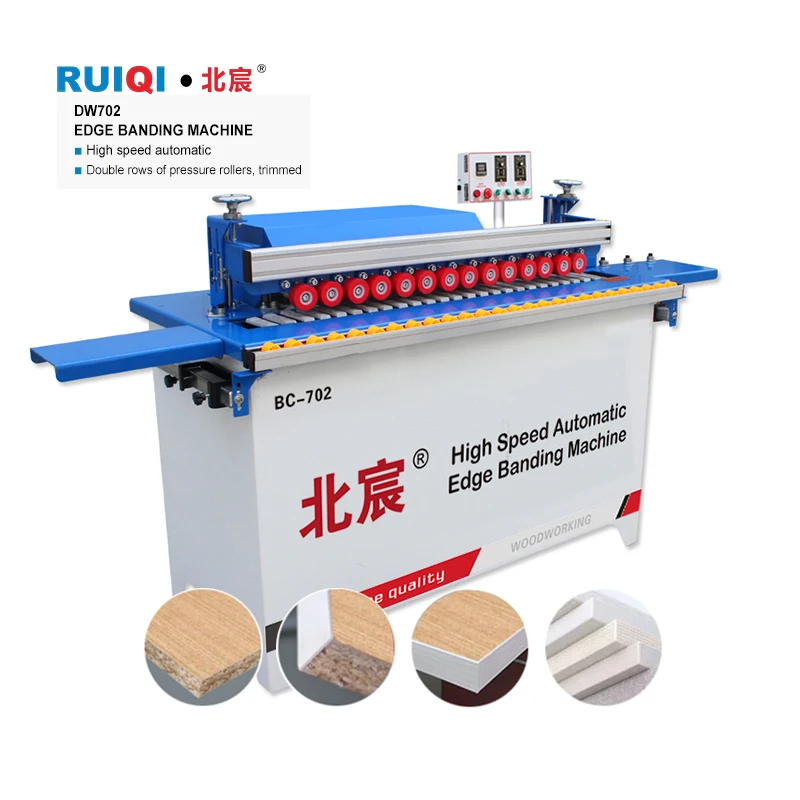
High Speed Automatic Edge Banding Machine |
| Total Power |
3800W |
| Voltage |
220V / 380V / customization |
| Edge Banding Thickness |
0.3–3 mm |
| Edge Banding Height |
0–50 mm |
| Minimum Sheet Length |
250 mm |
| Minimum Sheet Width |
100 mm |
| Trimming Power |
800W × 2 stations |
| Polishing Power |
180W × 2 stations |
| Vacuum Power |
1200W |
| Edge Feed Power |
20W |
| Transmission Power |
140W |
| Glue Pot Capacity |
1000 ml |
| Air Source Pressure |
0.4–0.8 MPa |
| Product Size |
1200 × 550 × 1100 mm |
| Product Weight |
105 kg |
| Control Language |
Chinese / English (Spanish and others available) |
| Plug Options |
EU / USA / AU / UK |
| Key Features |
Automatic head and tail trimming, integrated vacuum, pre-milling not included |
Application Suitability
| Application |
Material or Output |
| Cabinet door and carcass edge banding |
MDF, particleboard, plywood with PVC or melamine edge |
| Custom furniture panel finishing |
Medium density fiberboard, blockboard, solid wood panels |
| Polymer door production |
PVC-foam and composite door blanks with veneer banding |
| Small-batch workshop runs |
Mixed substrates requiring frequent edge material changeover |
Why the Voltage Question Must Come Before the DW702 Edge Banding Machine Specifications
A machine that cannot be energized on arrival is not a specification problem — it is a sourcing process failure.
I spent years assembling edge banders on the shop floor in Shandong, and the most expensive mistake I ever witnessed was not a mechanical fault. It was a 380V machine shipped to a 220V single-phase workshop in South America. The customer waited three weeks for a step-up transformer while production deadlines slipped past. Since then I review every electrical drawing myself before a DW702 edge banding machine specifications package is locked. Frequency, phase, and plug type are confirmed line-by-line against the destination country's grid standard [NEED_CITE: voltage and frequency standards by export market].
Matching Trim Stations to Substrate Mix
The DW702 carries dual trimming stations rated at 800W each, followed by dual polishing stations at 180W each. For MDF and particleboard — the two most common substrates in cabinet manufacturing — this arrangement removes the bulk of excess edge material in the first trim pass and refines the profile in the second. When running 3 mm PVC edge on dense particleboard, the two-stage trim reduces chatter marks that a single-pass unit tends to leave. Polish wheels then smooth the transition between edge and face, which matters when laminated panels move directly to assembly without secondary sanding.
Glue Pot Sizing and Batch Workflow
A 1000 ml glue pot means the operator refills periodically during long runs. For workshops batching 50 to 80 cabinet sides before switching edge color, the capacity holds enough adhesive for a typical run without interruption. If your production involves short runs with frequent material changes — say, alternating between 0.4 mm melamine and 2 mm PVC — the smaller pot actually helps: less glue sits idle and degrades between cycles [NEED_CITE: hot-melt adhesive pot life at idle temperature]. Confirm your dominant edge material and typical batch length so the glue temperature profile can be preset before the machine ships.
Tolerance Verification Against Assembly Requirements
DW702 edge banding machine specifications list an edge height range of 0–50 mm and thickness of 0.3–3 mm. Within that envelope, the trimming and polishing sequence is designed to hold edge-to-face flush within tight limits. When panels move to dowel or confirmat assembly, even a slight lip on the trimmed edge causes misalignment visible in the final carcass. Always request a factory test record run on your actual substrate thickness and edge material, not a generic MDF sample, before accepting shipment.

Reading the Numbers That Actually Affect Output
Feed speed on a 105 kg bench-class edge bander is governed by the 140W transmission motor and the friction characteristics of the panel surface. Heavier boards with textured melamine faces grip the feed chain differently than raw MDF, so the practical feed rate varies with material. The 1200W vacuum system holds smaller workpieces against the fence, which is critical given the minimum sheet size of 250 mm × 100 mm. Without adequate vacuum, narrow drawer sides tend to drift during the trimming pass and produce a beveled rather than square edge. Air pressure at 0.4–0.8 MPa drives the pneumatic cylinders that control edge snipping and pressure roller engagement — inconsistent shop air supply directly degrades the head-and-tail cut quality.
The Hidden Cost of Skipping Specification Confirmation
Machines quoted without confirming local voltage and frequency arrive unusable. Control panels written in a language the operator cannot read stall commissioning for days while manuals are translated informally. Single machines bought piecemeal are later found incompatible in feed height or throughput with the rest of the line [NEED_CITE: CE machinery directive requirements for industrial equipment]. Every one of these failures is preventable at the specification stage, not after the crate is opened.
Why Technical Buyers Source DW702 Here
In-house manufacturing means the patented cutting mechanisms and precision-ground components are built under one roof, not assembled from third-party sub-contracts. The four-stage quality control sequence — incoming material, in-process, finished product, and pre-shipment verification — catches tolerance drift before the machine leaves the factory. Voltage, plug type, and control language are treated as standard customization rather than special requests, so a DW702 destined for a 220V/60Hz market ships configured, not adapted. Engineer-led configuration recommendations are provided within 24 hours of inquiry, and factory visits are welcomed so buyers can witness test runs on their own substrates.
Documentation & Verification
- CE declaration of conformity covering mechanical and electrical safety
- ISO 9001 certificate for the manufacturing quality system
- Machine specification sheet with verified trim tolerance data
- Electrical schematic confirming voltage, phase, and plug type for destination
- Factory test record run on buyer-specified substrate and edge material
- Operation and maintenance manual in agreed language with spare parts list
Installation, Commissioning & Support
- Allocate a floor area exceeding 1200 × 550 mm with clearance on both feed and exit sides
- Provide a dedicated circuit matching the confirmed 220V or 380V supply and 3800W total draw
- Machine ships as a single 105 kg unit; position with pallet jack and level on all four feet
- First power-on includes pneumatic pressure adjustment to 0.4–0.8 MPa and glue pot temperature calibration
- Operator training covers edge loading, trim station adjustment, and vacuum activation for small panels
- Spare polishing wheels and trim blades included; reorder schedule based on weekly running hours
Preparing Your Inquiry for Accurate Configuration
Share your dominant panel material, typical edge thickness range, and the smallest workpiece dimension you run. Confirm your facility voltage, phase, and frequency so the electrical package is built correctly from the start. Specify the control language your operators need — English and Chinese are standard, with Spanish and other languages available on request.
Frequently Asked Questions
Q: How can I verify edge banding tolerance before the machine ships?
A: Request a factory test record that documents actual trim flush and edge-to-face measurements run on your specific substrate and edge material. Generic test samples on standard MDF do not reflect how the machine performs on melamine-faced particleboard or plywood. Pre-shipment verification is part of the standard quality process.
Q: What voltage and frequency options are available for my country?
A: The machine supports 220V and 380V configurations with further customization available. Provide your local supply frequency and phase type during inquiry so the motor windings, control transformer, and plug are matched before production. Electrical schematics are reviewed and confirmed prior to build.
Q: Can the control panel display my operator's language?
A: Chinese and English are standard options. Spanish and additional languages can be configured when specified at order. Confirming the language requirement early prevents commissioning delays caused by operators unable to navigate the menu or understand alarm messages.
Q: What substrate and edge combinations has this model been tested on?
A: Testing covers MDF, particleboard, plywood, blockboard, and polymer door blanks with PVC, melamine, and veneer edge materials ranging from 0.3 mm to 3 mm. If your application uses an uncommon substrate or edge type, a sample processing test can be arranged before order confirmation.
Q: How does this model compare to higher-tier units in the product family?
A: The DW702 is a bench-class machine suited to workshops processing small to medium panels. Higher-tier models add pre-milling, additional trimming stations, and higher feed rates for continuous production. An engineer configuration review determines which tier matches your throughput and panel size requirements.

![【目标站角色】:ruiqiwoodmachine.com → SPECIFICATION AND SELECTION → 技术选型类角色 【修饰词池】:Specifications / Technical Guide / Model Selection 【记录ID数字之和】:1+4+1+8+9 = 23 【句式结构】:23 % 6 = 5 → [站点修饰词] [品类词] – [规格或产能限定] 【修饰词选取】:23 % 3 = 2 → Model Selection JT160 Sliding Table Saw with Edge Banding – Model Selection](https://ruiqiwoodmachine.com/wp-content/uploads/2026/05/H4aa4463034de438483fbbf76b1e49b3aF-1-300x300.webp)

![FX-20 Portable Mini Automatic Edge Banding Machine | Technical Guide 记录 ID 数字和:1+0+3+3+7=14 14 mod 6 = 2 → 句式:[品类词] [机型号或规格] | [站点修饰词] 14 mod 3 = 2 → 修饰词:Model Selection (技术选型池第 3 个) 字符数:67 (含空格)](https://ruiqiwoodmachine.com/wp-content/uploads/2026/05/Hbccc1a81daf24c7bb35fb4f2b45d1a10n-1-300x300.webp)