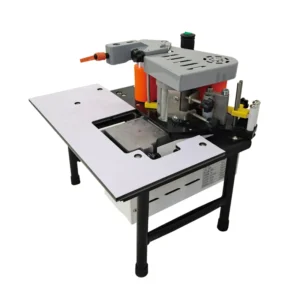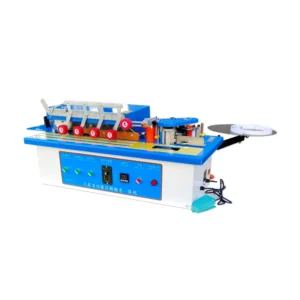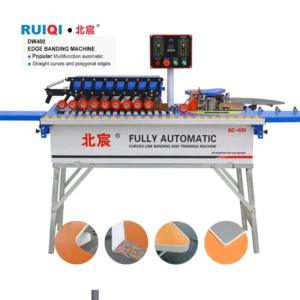
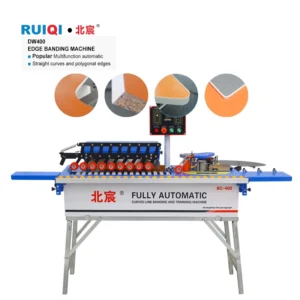
Edge banding machine
DW400 Edge Banding Machine | Technical Guide
DW400 Manual Edge Banding Machine, 3800W Total Power, 0.3–3mm Edge Thickness —...
View Details<p><strong>DW702 Automatic Edge Banding Machine, 3800W Total Power, 0.3–3mm Edge Thickness Range</strong> — compact-format unit integrating trimming, polishing, and vacuum hold-down in a single pass.</p> <ul> <li><strong>Dual 800W trimming</strong> and 180W polishing motors deliver finished edges on MDF, particleboard, and plywood</li> <li>Voltage configurable at 220V/380V or matched to local frequency; control panel available in English, Spanish, or other languages on request</li> <li>Air supply 0.4–0.8MPa, 1000ml glue pot, minimum sheet 25×10cm</li> <li>Fully assembled on arrival — request the specification sheet and factory test record to confirm feed speed and panel thickness range for your substrate</li> </ul>

<p><strong>DW702 Automatic Edge Banding Machine, 3800W Total Power, 0.3–3mm Edge Thickness Range</strong> — compact-format unit integrating trimming, polishing, and vacuum hold-down in a single pass.</p> <ul> <li><strong>Dual 800W trimming</strong> and 180W polishing motors deliver finished edges on MDF, particleboard, and plywood</li> <li>Voltage configurable at 220V/380V or matched to local frequency; control panel available in English, Spanish, or other languages on request</li> <li>Air supply 0.4–0.8MPa, 1000ml glue pot, minimum sheet 25×10cm</li> <li>Fully assembled on arrival — request the specification sheet and factory test record to confirm feed speed and panel thickness range for your substrate</li> </ul>
Quality Assured
Multi-stage QC inspection
Custom Config
Voltage, logo, language
Global Shipping
100+ countries served
After-Sales Support
Remote & spare parts
Voltage-customizable configuration — the DW702 is wired to match your local supply frequency before dispatch, preventing the costly dead-on-arrival scenario that plagues cross-border machinery purchases.
| Parameter | Value |
|---|---|
| Model | DW702 |
| Product Type | Automatic Edge Banding Machine |
| Total Power | 3800W |
| Voltage | 220V / 380V / customizable to local supply |
| Edge Power | 20W |
| Transmission Power | 140W |
| Trimming Power | 800W × 2 |
| Polishing Power | 180W × 2 |
| Vacuum Power | 1200W |
| Edge Banding Thickness | 0.3–3mm |
| Edge Banding Height | 0–50mm |
| Minimum Sheet Length | 25cm |
| Minimum Sheet Width | 10cm |
| Glue Pot Capacity | 1000ml |
| Air Source Pressure | 0.4–0.8MPa |
| Product Size | 120 × 55 × 110cm |
| Product Weight | 105kg |
| Feed Speed | (basis to be confirmed) |
| Panel Thickness Range | (basis to be confirmed) |
| Control System | (basis to be confirmed) |
| Language Options | Chinese and English standard; other languages customizable |
| Plug Options | EU, USA, AU, UK |
| Assembly State | Fully assembled |
| Application | Material or Output |
|---|---|
| Cabinet door and carcass edge banding | MDF and particleboard with PVC or melamine edge strips |
| Custom furniture panel finishing | Plywood and blockboard with veneer or polymer banding |
| Polymer door profile edging | Polymer door blanks with compatible thermoplastic strips |
| Small-batch joinery production | Solid wood panels up to the machine's height and thickness limits |
| Workshop upgrading from manual to automated edging | Mixed substrate environments requiring frequent material changeovers |
Confirming voltage and frequency before pricing prevents a machine that physically cannot run in your facility.
I have watched containers arrive at ports in South America and Southeast Asia with edge banders wired for 380V/50Hz, only to discover the local grid runs 220V/60Hz. The motors spin at the wrong speed, the glue pot does not reach operating temperature, and the trimming cutters chatter across the panel face. Rewinding motors on-site is rarely practical and usually voids the warranty [NEED_CITE: voltage and frequency standards by export market]. With the DW702, voltage is a configurable parameter rather than a fixed assumption, but you still need to state your exact supply before the wiring loom is built.
The DW702 carries dual 800W trimming motors and dual 180W polishing motors arranged for a single-pass finish. For a small-to-medium cabinet workshop running primarily 18mm particleboard with 0.4mm PVC, this motor pairing handles trimming and polishing in one feed cycle. When you shift to 25mm blockboard with 2mm solid-wood lipping, the trimming motors must work through significantly more material volume per linear meter. Understanding this relationship between automatic edge banding machine specifications and your actual panel mix determines whether this configuration holds tolerance or begins to leave witness marks on the edge face.
The 0.3–3mm edge banding thickness range covers the most common workshop materials: thin PVC for cost-sensitive cabinet runs, melamine strips for color-matched carcass panels, and veneer banding for visible furniture faces. What this range does not cover is heavy solid-wood lipping above 3mm, which requires a dedicated lipping machine with heavier feed pressure and larger trimming cutters. If your production schedule includes both thin polymer edging and occasional thick timber lipping, you need to decide whether the DW702 serves as your primary edger or fills a secondary role alongside a heavier unit [NEED_CITE: edge banding material compatibility standards].
Total connected load sits at 3800W, with the 1200W vacuum system accounting for nearly a third of that draw. The vacuum hold-down keeps lighter panels flat against the feed chain during edge application, which matters when you are running 6mm MDF skins or thin plywood backs that tend to lift under feed pressure. Before ordering, check whether your workshop panel board can supply a dedicated circuit at the confirmed voltage, and whether the air compressor delivering 0.4–0.8MPa has sufficient reserve capacity to run the pneumatic cylinders without pressure drop when other machines in the line cycle simultaneously.
Several parameters critical to production planning are not yet published in the current source data: feed speed in meters per minute, panel thickness range, and control system type. Feed speed determines your linear throughput and directly affects whether this machine keeps pace with an upstream panel saw or becomes the bottleneck in a two-person cell. Panel thickness range tells you whether 8mm drawer sides and 25mm shelving can both pass through without manual adjustment between batches. Until these values are confirmed on the formal specification sheet, treat any capacity estimate as provisional [NEED_CITE: machinery specification disclosure requirements for industrial equipment].
Sending a sample of your actual substrate — not a generic MDF coupon from the supplier's showroom — is the only way to discover how the glue pot temperature interacts with your specific board density and edge strip adhesive layer. Recycled-content particleboard absorbs glue differently than virgin-fiber board, and a setting that produces a clean bond on one substrate leaves a visible glue line on another. Buyers who skip this step and rely on brochure specifications alone often find themselves adjusting parameters on the factory floor while production deadlines slip.
Voltage and plug configuration are confirmed against your local grid before the machine enters final assembly, not after it leaves the factory. The four-stage quality check includes a pre-shipment test run on material you specify, with recorded results provided before the crate is sealed. Engineer-led configuration review within 24 hours means you receive a written specification matched to your stated panel range, not a generic quotation. Language options on the control panel are set before dispatch so your operators can read the interface from the first hour of commissioning.
Provide the substrate types and panel thicknesses you run most frequently, along with the edge banding materials and thicknesses in your current specification library. State your local voltage, phase configuration, and supply frequency so the wiring diagram is finalized before assembly. Confirm the language you need on the control interface and whether you want to ship sample material to the factory for a pre-delivery test run.
Q: How do I verify the actual edge banding tolerance on the DW702 before accepting delivery? A: Request a factory test record showing measured edge overhang and trimmed flush values on panels processed from your own substrate. Specify the measurement method and sampling frequency you expect. The pre-shipment verification stage is the appropriate point to review these results before the machine is crated.
Q: The DW702 lists 220V/380V customization — how do I confirm correct wiring for my local frequency? A: Provide your exact voltage, phase, and frequency in the inquiry stage. The electrical schematic supplied before shipment will reflect the confirmed configuration. This prevents motor speed mismatches and glue pot heating issues that arise when a machine built for 50Hz operates on a 60Hz supply.
Q: What panel thickness range does the DW702 accept, and how does it compare within the product family? A: The panel thickness range is not yet published in the current specification source. Request the confirmed minimum and maximum values on the formal specification sheet. Higher-tier models in the same family typically extend the upper limit for thicker shelving and structural panels.
Q: Can the control panel language be set to a single language before the machine ships? A: Yes. Chinese and English are standard, with other languages configurable during assembly. Specify your preferred language at the quotation stage so the interface labels, error messages, and parameter menus are finalized before the control panel is installed.
Q: How do I arrange a sample edge-banding test using my own substrate before placing the order? A: Ship a representative panel sample and your preferred edge banding material to the factory before the order is finalized. The test run uses your material on the DW702, and the finished sample is returned to you for evaluation before you commit to production specifications.
20+ Years Experience
Trusted by 100+ countries worldwide
Full OEM/ODM
Custom logo, voltage & panels
Lifetime After-Sales
12-month warranty + spare parts
25-45 Day Lead Time
Flexible MOQ, on-time delivery
Fill in your requirements and our team will respond with a formal quotation within 24 hours. We speak English and Spanish.
Response within 24 hours on business days
Or WhatsApp us for instant reply
Serving 100+ countries globally
DW400 Manual Edge Banding Machine, 3800W Total Power, 0.3–3mm Edge Thickness —...
View DetailsProducts DescriptionPortable edge banding machine. light and portable. is a useful equipment...
View DetailsFX-20 Multifunction Edge Banding Machine, 2500W, 0.3–3mm Band Thickness, Curved & Straight...
View DetailsDW400 Automatic Edge Banding Machine, 0.3–3mm Edge Thickness, 220V/380V Customizable — compact...
View DetailsOur global sales team is ready to assist. Get a formal quotation, technical specs, and OEM/ODM options within 24 hours.