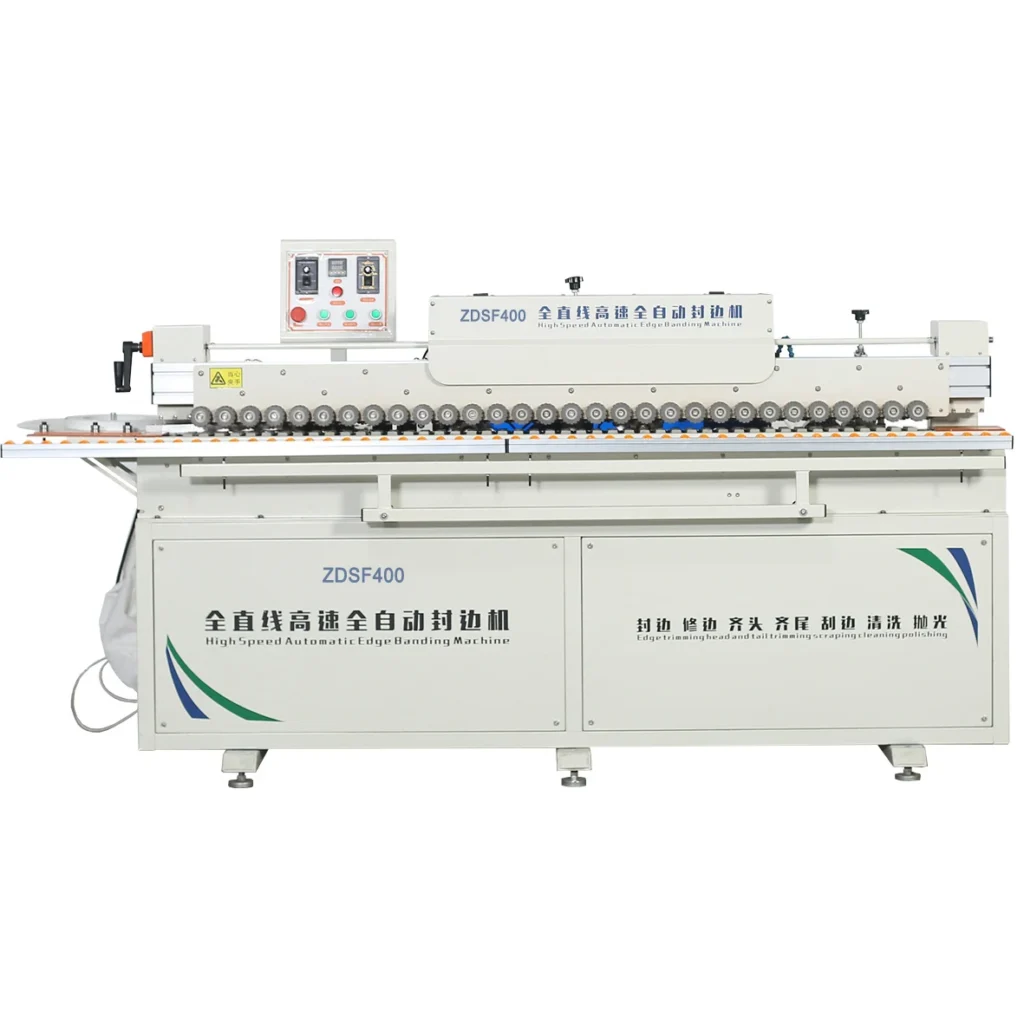
Precision-Verified Tolerance — every ZDSF400 edge banding machine specification is documented and testable on your actual panel material before dispatch.
Technical Specifications
| Parameter |
Value |
| Model |
ZDSF400 |
| Product Type |
Straight Line Automatic Edge Banding Machine |
| Function Stations |
Gluing, End Cutting, Trimming, Scraping, Polishing, Vacuuming |
| Edge Type |
Straight Line |
| Rated Voltage |
220V (frequency to be confirmed for destination market) |
| Rated Power |
3 kW |
| Rated Air Pressure |
0.4–0.6 MPa |
| Strip Thickness |
1–3 mm |
| Sheet Thickness |
10–55 mm |
| Feed Speed |
0–14 m/min |
| Conveyer Belt Speed |
0–14 m/min |
| Glue Pot Capacity |
1000 ml |
| Heating Power |
800W (5–10 min heat-up) |
| Trimming Power |
800W × 2 motors (24,000 rpm) |
| Polishing Power |
180W × 2 motors (5,500 rpm) |
| Suction Power |
550W |
| Overall Dimensions (L×W×H) |
240 × 70 × 120 cm |
| Machine Weight |
370 kg |
| Warranty |
1 year |
| Assembly State |
Partially assembled; user assembly required for some items per manual |
Application Suitability
| Application |
Material or Output |
| Custom cabinet door and carcass edge banding |
MDF and particleboard panels 10–55 mm thick with PVC or veneer strips |
| On-site home decoration furniture fabrication |
Plywood and blockboard with 1–3 mm straight edge strips |
| Small joinery workshop transitioning from manual banding |
Panel stock processed in single-piece or short-run straight-line runs |
| Repair and rework of pre-assembled furniture edges |
Straight sections where portable 220V power is the only available supply |
Why the Voltage Question Should Come Before the Price on the ZDSF400 Edge Banding Machine
A machine rated at 220V may still be incompatible with your local supply if the frequency does not match.
I have watched workshops receive woodworking equipment that powered on but ran trimming motors at the wrong speed because the local grid was 60 Hz while the machine was wound for 50 Hz. The ZDSF400 edge banding machine specifications list 220V, but frequency confirmation is a separate step that must happen before production begins. When a trimming motor spins at the wrong RPM, the edge finish degrades and the strip lifts within days [NEED_CITE: voltage and frequency standards by export market]. This is not a defect — it is a specification mismatch that could have been caught at the quotation stage.

Matching Feed Speed to Your Daily Panel Volume
The 0–14 m/min feed speed range on the ZDSF400 edge banding machine determines how many linear meters of panel edge you can process per shift. A workshop running standard cabinet carcass panels at the upper end of that range will move through a day's batch noticeably faster than one limited to the lower setting. The conveyer belt speed tracks the feed speed directly, so panel tracking remains consistent across the entire station sequence from gluing through polishing.
Verifying Trim Quality Before the Machine Leaves the Factory
The twin 800W trimming motors running at 24,000 rpm are the primary determinant of edge finish quality. Higher RPM allows a cleaner cut on denser PVC strips and reduces the risk of chipping on melamine-faced particleboard. Requesting a factory test record that documents the actual trim finish on your specified strip thickness and panel material is the most reliable way to confirm the ZDSF400 edge banding machine specifications translate into acceptable output quality on your shop floor [NEED_CITE: CE machinery directive requirements for industrial equipment].
How Sheet Thickness and Glue Temperature Interact
The 10–55 mm sheet thickness range covers most furniture-grade panel stock, but the interaction between panel thickness, glue pot temperature, and strip material is where failures happen. The 800W heating element brings the 1000 ml glue pot to operating temperature in 5–10 minutes. Thicker panels absorb heat faster from the glue film, which can result in incomplete bonding if the operator does not adjust the temperature upward for high-density substrates. Understanding this relationship before commissioning prevents the kind of edge-lift failures that only show up after the furniture has been in use for several weeks.
What Happens When Specifications Are Assumed Instead of Confirmed
Workshops that purchase edge banders without verifying the sheet width capacity or control panel language often discover the gap during installation. A machine set up with a control interface the operator cannot read stalls commissioning until a replacement panel or overlay is sourced. Similarly, buying a machine whose working width falls short of your largest panel means certain pieces must still be edged by hand — eliminating the productivity reason for the purchase in the first place [NEED_CITE: common commissioning delays in imported woodworking machinery].
Why Technical Buyers Source This Model Through Our Configuration Process
In-house manufacturing with a patented cutting mechanism means the trimming station performance is built into the machine rather than added as an aftermarket modification. Every ZDSF400 edge banding machine undergoes four-stage quality control covering incoming material inspection, in-process checks, finished product verification, and pre-shipment testing. Voltage and frequency customization from 110V to 440V is confirmed at the quotation stage so the machine arrives ready for your local electrical standard. Engineer-led configuration recommendations ensure the station arrangement matches your specific panel material and strip combination. Factory visits are welcomed so you can witness a test run on your own panel stock before committing to the order.
Documentation & Verification
- CE declaration of conformity covering the ZDSF400 straight-line edge bander
- Machine specification sheet with confirmed voltage, frequency, and station configuration
- Factory test record documenting trim tolerance on your specified panel and strip material
- Electrical schematic matching the confirmed voltage and plug configuration for your market
- Operation and maintenance manual provided in the operator's agreed language
Installation, Commissioning & Support
- Requires a dedicated 220V circuit with capacity for the 3 kW rated power draw plus startup surge
- Compressed air supply at 0.4–0.6 MPa must be connected before first glue pot heat-up
- Partially assembled on arrival; user assembly of auxiliary items guided by included manual or video
- First commissioning includes glue temperature calibration matched to your specific strip and panel combination
- Trimming and polishing station spare parts identified in the included parts list with reorder codes
- Daily vacuuming station maintenance required to prevent glue dust buildup around the 550W suction unit
What to Include When Requesting a Quotation
Provide your panel material type, sheet thickness range, and the edge strip material and thickness you intend to run. Specify your local voltage and frequency so the motor winding and control transformer can be confirmed before production. If you have existing upstream saws or downstream boring machines, share their feed height and throughput so the ZDSF400 edge banding machine can be evaluated for line compatibility.
Frequently Asked Questions
Q: How do I verify the actual edge banding tolerance on my specific panel material and strip thickness?
A: Request a factory test record that documents a run on your exact panel substrate and strip combination. The record should show trim finish quality and glue adhesion results at the operating temperature and feed speed you plan to use in production. This is the only way to confirm the ZDSF400 edge banding machine specifications translate to your actual working conditions.
Q: Is the 220V rating compatible with my local voltage and frequency, and can it be customized?
A: The standard rating is 220V, but frequency must be confirmed separately for your market. Voltage customization from 110V to 440V is available as a standard option. Confirm both values at the quotation stage so the correct motor winding and transformer are installed before the machine ships.
Q: What control system and operator language options are available for the ZDSF400?
A: The control system and available language options are confirmed during the specification review stage. Request that the operator interface language be documented on the machine specification sheet before production begins so there is no mismatch at commissioning.
Q: How does the 0–14 m/min feed speed translate to daily output for my panel volume and shift pattern?
A: Throughput depends on panel length, the number of edges per panel, and loading time between pieces. Share your typical panel dimensions and shift duration so an engineer can estimate linear meters per shift based on a realistic operating speed within the 0–14 m/min range.