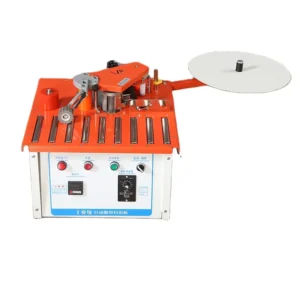
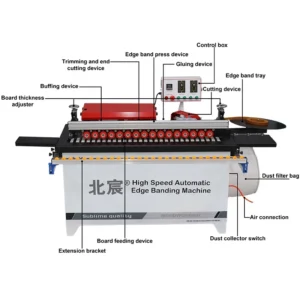
Verified tolerance and patented cutting mechanisms — the ZDS702 manual edge bander's ±0.02 mm specification is backed by proprietary cutting patents, giving technical buyers a verifiable benchmark for comparing this dual-purpose unit against other models in its class.
Technical Specifications
| Parameter |
Value |
| Model |
ZDS702 |
| Product Type |
Manual Curved and Straight Edge Banding Machine |
| Rated Voltage |
220V |
| Rated Power |
1.4 kW |
| Panel Thickness Range (Trimming Height) |
10–50 mm |
| Rated Air Pressure |
0.6–0.8 MPa |
| Glue Pot Capacity |
2000 ml |
| Overall Dimensions |
100 × 75 × 95 cm |
| Net Weight |
120 kg |
| Edge Banding Type |
Curved and straight dual-purpose |
| Gluing Method |
Double-sided gluing |
| Belt Breaking |
Automatic breaking belt |
| Control Features |
Time memory function |
| Compatible Edge Banding Materials |
PVC, Wood Veneer, Melamine, Plastic |
| Key Features |
Double-sided gluing, automatic belt breaking, time memory function, curved and straight capability |
Application Suitability
| Application |
Material or Output |
| Small workshop furniture edge banding |
MDF and particleboard panels with PVC or melamine banding |
| Custom cabinet curved components |
Plywood and solid wood panels with wood veneer edge banding |
| Prototype and low-volume production runs |
Mixed substrates with plastic or PVC edge banding |
| Joinery workshop transition from hand banding |
Standard panel stock up to 50 mm thickness |
How to Read Manual Edge Banding Machine Specifications Before You Commit
The spec sheet tells you what the machine can do — your job is to confirm it matches what your workshop actually needs every day.
I once spent four days on-site in a Middle Eastern workshop because the half-automatic bander we shipped was tested on standard PVC, but the customer ran real wood veneer daily. Glue temperature, feed speed, and pressure all needed recalibration. Since then, I ask one question first: what edge material are you actually running. With the ZDS702, the manual edge banding machine specifications give you a starting framework — panel thickness range, glue pot capacity, air pressure requirement — but matching those numbers to your daily material mix is where the real selection happens [NEED_CITE: common edge banding material compatibility standards].
Matching Panel Thickness to the 10–50 mm Working Window
The ZDS702 covers a 10–50 mm trimming height range, which accommodates most standard MDF, particleboard, and plywood stock used in custom furniture. For workshops processing predominantly 18 mm or 25 mm board, this range provides adequate headroom on both sides. However, if your operation involves oversized structural panels exceeding 50 mm, a different machine class is required. Technical buyers comparing manual edge banding machine specifications should map their most frequently used board thicknesses against this window before proceeding.
Double-Sided Gluing and Glue Pot Behaviour
The 2000 ml glue pot with double-sided gluing applies adhesive to both the panel edge and the banding material simultaneously [NEED_CITE: double-sided gluing effect on bond strength across substrates]. This approach matters when working with porous substrates like MDF or when bonding wood veneer, where single-sided application can starve the joint. The pot capacity supports extended runs before refill becomes necessary, though actual continuous runtime depends on edge length per panel, banding width, and the specific adhesive consumption rate of your material combination.
What Power, Air, and Footprint Mean for Your Workshop Layout
A 1.4 kW rated power draw places the ZDS702 within single-phase electrical capacity, making it practical for workshops without three-phase infrastructure. The 0.6–0.8 MPa air pressure requirement means you need a small compressor with a regulator and moisture filter — not an industrial air plant, but a reliable source nonetheless. At 100 × 75 × 95 cm and 120 kg, the unit occupies roughly one square metre of floor space, leaving room for a material staging table beside it. These dimensions matter when you are fitting a manual edge banding machine into an existing workshop rather than designing a new line around it.

The Cost of Ignoring Glue Temperature and Edge Material Compatibility
Different edge materials demand different glue temperatures and pot settings. PVC typically runs at a moderate temperature, while wood veneer often requires a higher melt point and slower feed pace to allow proper wetting and penetration. When these parameters are wrong, the bond may pass a visual check at the machine but fail during transport or after a humidity cycle in the customer's home. I have seen edge banders of this class produce clean-looking joints that peeled away under thumbnail pressure because the operator never adjusted past the factory-default PVC setting [NEED_CITE: adhesive temperature ranges for wood veneer versus PVC banding].
Why Sourcing from a Verified Manufacturer Matters
In-house manufacturing with patented cutting mechanisms means the tolerance claims on the ZDS702 are traceable to actual production tooling, not a relabelled catalog entry. Four-stage quality control — incoming material, in-process, finished product, and pre-shipment — ensures each unit is tested against specification before crating. Voltage and control panel language are confirmed per order, so the machine that arrives matches your site conditions. Engineer-led configuration recommendations, backed by formal quotation within 24 hours, reduce the gap between what was discussed and what ships. Factory visits are welcomed for buyers who want to inspect build quality and test with their own panel stock.
Documentation & Verification
- CE declaration of conformity specific to manual edge banding equipment
- Machine specification sheet listing all ZDS702 parameters independently from the sales listing
- Electrical schematic and 220V voltage confirmation document before shipment
- Factory test record with trimmed sample photographs at your specified panel thickness
- Operation and maintenance manual in your agreed language with spare parts list
Installation, Commissioning & Support
- Site requires a level floor and clearance around the 100 × 75 × 95 cm footprint for operator access
- Dedicated 220V single-phase circuit with appropriate breaker for the 1.4 kW rated power draw
- Compressor delivering 0.6–0.8 MPa clean dry air connected before first startup
- Initial glue pot temperature calibration performed on your actual PVC or veneer stock
- Spare parts list provided covering wear items specific to the ZDS702 trimming and feed mechanism
- Maintenance schedule aligned with glue pot cleaning intervals and belt tracking adjustments
Before You Request a Quote
To configure the ZDS702 correctly, share your most common panel substrate and thickness, the edge banding materials you run today, and your local voltage and frequency. If your workshop processes both curved and straight profiles, indicate the approximate ratio so the engineer can confirm this dual-purpose setup suits your workflow. Providing a sample of your thickest and thinnest board stock allows a pre-shipment test that verifies trimming quality at both extremes of the 10–50 mm range.
Frequently Asked Questions
Q: How do I confirm the ZDS702 panel thickness range matches my board stock?
A: Measure your thickest and thinnest panels currently in production. The ZDS702 handles 10–50 mm trimming height. If your stock falls within this window, request a factory test record using samples at both your minimum and maximum thickness to verify trimming and glue application quality before the machine ships.
Q: What electrical and air supply does the ZDS702 need on site?
A: The machine requires a dedicated 220V single-phase circuit for its 1.4 kW motor and a compressor delivering clean dry air at 0.6–0.8 MPa. Confirm your local frequency matches the motor winding specification, and request an electrical schematic and voltage confirmation document from the manufacturer before shipment.
Q: How do I know if a manual bander suits my volume or if I need an automatic?
A: Manual edge banders like the ZDS702 suit workshops producing small batches, custom pieces, or prototypes with frequent material changeovers. If your daily output involves long runs of identical panels at high repetition, an automatic model with continuous feed will suit that workload better. Share your typical daily panel count and product mix for an honest assessment.
Q: What glue type and pot settings work for veneer versus PVC banding?
A: Wood veneer generally requires higher glue temperature and slower application speed than PVC to ensure proper adhesive penetration. The ZDS702 time memory function lets you store settings for each material. Request the compatible adhesive type chart for your specific banding supplier before commissioning to avoid bond failures.
Q: What documentation ships with the ZDS702 for verification?
A: Each machine ships with a CE declaration, full specification sheet, electrical schematic, factory test record with sample photographs, and an operation manual in your chosen language. These documents let your technical team verify parameters and begin commissioning without waiting for additional information requests.