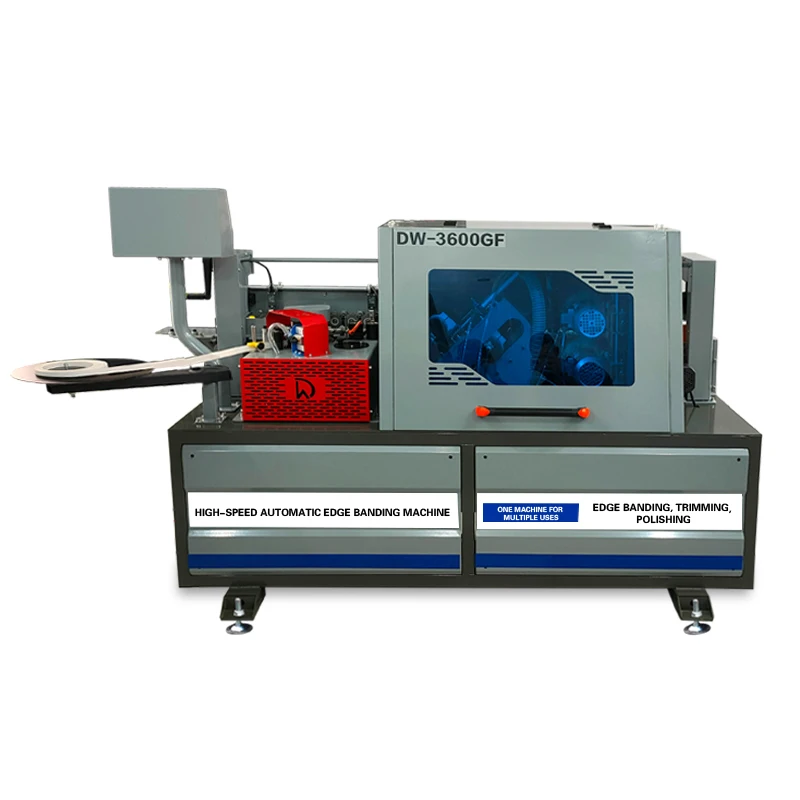
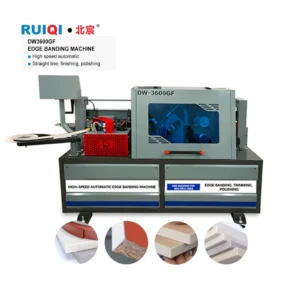
Precision-First Configuration — every DW3600 parameter maps directly to a verifiable production outcome, so technical buyers can evaluate this compact edge bander on rated numbers rather than marketing claims.
Technical Specifications
| Parameter |
Value |
| Model |
DW-3600GF |
| Product Type |
Full Automatic Compact Edge Banding Machine |
| Total Power |
4.9 kW |
| Voltage & Frequency |
380V three-phase four-wire (frequency to be confirmed: 50Hz or 60Hz) |
| Control System |
PLC or relay logic (to be confirmed) |
| Overall Dimensions (L×W×H) |
2200 × 650 × 1250 mm |
| Net Weight |
320 kg |
| Feed Speed |
0–14 m/min |
| Edge Banding Height Range |
0–50 mm |
| Edge Band Thickness Range |
0.3–3 mm |
| Minimum Panel Length |
200 mm |
| Panel Thickness Range |
Minimum and maximum to be confirmed |
| Edge Banding Motor |
160 W |
| Transmission Motor |
180 W |
| Trimming Stations |
Dual trimming, 800 W × 2 at 24,000 r/min |
| Polishing Stations |
Dual polishing, 400 W × 2 |
| Standard Function Chain |
Gluing, trimming, front and rear trimming, scraping, polishing, vacuuming |
| Air Supply Requirement |
0.4–0.6 MPa |
| Language Options |
Chinese and English standard; Spanish and other languages on request |
| Plug Options |
EU / USA / AU / UK |
| Certification |
CE |
| Assembly State |
Fully assembled |
| Key Features |
Compact footprint, dual trimming and polishing stations, multi-language control panel, interchangeable plug standards |
Application Suitability
| Application |
Material or Output |
| Custom cabinet door edge finishing |
MDF and particleboard with 0.4–2.0 mm PVC banding |
| Small-batch shelving production |
Plywood panels with veneer edge strips |
| Joinery workshop upgrade from manual banding |
Solid wood and blockboard with PVC or ABS banding |
| Drawer front and side panel processing |
Melamine-faced board with thin PVC edging |
| Sample room and prototype runs |
Mixed substrates requiring quick changeover between band thicknesses |
Why the Voltage Question Should Come Before the Price on Any DW3600 edge banding machine specifications Sheet
A machine that does not match your local frequency will stall or burn out before the first panel clears the polishing station.
I once helped a South American buyer who received a 50 Hz unit on a 60 Hz grid. The trimming motors oversped, the edge finish deteriorated within hours, and the entire production week was lost while the factory scrambled for replacement windings. When you review DW3600 edge banding machine specifications, the voltage and frequency confirmation must arrive as a formal document before production begins, not as an afterthought in the packing list. [NEED_CITE: CE machinery directive requirements for industrial equipment]

Mapping Feed Speed to Daily Panel Volume
The 0–14 m/min feed speed range is driven by a 180 W transmission motor, which sets the realistic throughput ceiling for a workshop running single-shift operation. At the upper end of this range, the feed track can move panels past the gluing and trimming stations without dwell marks, provided the board length stays above the 200 mm minimum. Matching this speed to your daily cut list prevents bottlenecks between the panel saw and the bander.
Trimming Power and Edge Finish Quality
Dual trimming stations rated at 800 W each and spinning at 24,000 r/min determine how cleanly the machine strips excess PVC or veneer from the panel edge. When the cutters engage a 3 mm thick band on a high-density particleboard core, the wattage headroom prevents chatter marks that would otherwise appear as visible ridges on the finished edge. [NEED_CITE: woodworking dust extraction and finish quality correlation]
How Board Thickness Range Affects Downstream Assembly
The DW3600 edge banding machine specifications list an edge banding height range of 0–50 mm and a band thickness range of 0.3–3 mm, but the panel thickness range requires confirmation before you lock in your order. If the pressure beam cannot accommodate your thickest shelf stock, the panel will ride too low through the trimming stations, leaving an uneven top edge that fails visual inspection during cabinet assembly.
The Hidden Cost of Skipping a Factory Test Run
When a machine arrives without a verified test record on your specific substrate, the first week of production becomes a costly calibration exercise. Glue temperature, feed pressure, and trimmer offset all need adjustment for the particular board density and banding material in your shop. [NEED_CITE: adhesive bonding failures on particleboard versus MDF substrates]
Why Procurement Starts with Configuration Verification
Every DW-3600GF leaving the factory carries a proprietary cutting mechanism that holds verified tolerance on straight edges, and the four-stage QC process covers incoming material inspection through pre-shipment verification. Engineers prepare a configuration proposal that confirms voltage, plug type, and control language before the order enters production. Voltage customization from 110 V to 440 V is standard, so no transformer workaround is needed once the machine is on your floor. Factory visits are available for buyers who want to see the precision-ground components and assembly line before signing off.
Documentation & Verification
- CE declaration of conformity matched to the DW-3600GF serial number
- Machine specification sheet listing confirmed voltage, frequency, and plug standard
- Electrical schematic showing internal wiring and circuit breaker ratings
- Factory test record run on buyer-supplied panel and edge band material
- Operation and maintenance manual translated into the agreed working language
- Spare parts list with part numbers for trimmer cutters, polishing wheels, and feed rollers
Installation, Commissioning & Support
- Verify a dedicated 380 V three-phase circuit rated for at least 4.9 kW before delivery
- Confirm floor levelness across the 2200 × 650 mm footprint to prevent feed track twist
- Machine ships fully assembled; only dust extraction ducting and air line need connection
- First-run commissioning includes glue temperature calibration for your specified banding material
- Operators receive hands-on training using the multilingual control panel in the chosen language
- Spare polishing wheels and trimming cutters included for initial production cycles
What to Include in Your Specification Request
To receive an accurate configuration proposal for the DW-3600GF, provide the panel materials you process most often along with their typical thickness range, the edge banding materials and thicknesses in your cut list, and your facility's confirmed voltage and frequency. If your workshop runs a specific feed height from an upstream panel saw, note that dimension so the infeed table can be matched accordingly.
Frequently Asked Questions
Q: What panel thickness range does the DW3600 support compared to larger models?
A: The exact minimum and maximum panel thickness for the DW-3600GF is confirmed during the quotation stage based on your substrate. Larger models in the product family accommodate thicker stock for high-volume panel processing lines. The engineer configuration proposal will state the verified range alongside feed speed and trimming clearance.
Q: How do I confirm voltage, frequency, and plug type before ordering?
A: Submit your facility's electrical supply details during the inquiry stage. The engineering team issues a voltage confirmation document and electrical schematic that match your local grid standard. Plug options include EU, USA, AU, and UK configurations, and frequency is locked to either 50 Hz or 60 Hz before production begins.
Q: Which edge banding materials work within the 0.3–3 mm thickness range?
A: The dual trimming stations and adjustable glue system handle PVC, ABS, and natural veneer strips within the rated thickness range. Thinner melamine and paper-based banding may require lower feed speeds and adjusted glue temperature. A sample test run on your actual banding material verifies the finish before you commit to a production order.
Q: How is edge banding tolerance verified before shipment?
A: Each unit goes through a pre-shipment test using panels supplied or specified by the buyer. The factory test record documents trim quality, scraping finish, and polishing result on the agreed substrate. Tolerance is measured with calibrated instruments and reported alongside the serial-numbered specification sheet included in the shipping documentation.
Q: How does the feed speed translate into daily panel output for my workshop?
A: At 0–14 m/min feed speed, actual throughput depends on panel length, loading cadence, and the number of edges per workpiece. The 180 W transmission motor maintains consistent feed across the speed range. Share your daily cut list and shift pattern during the inquiry so the engineer can project realistic output matched to your upstream panel saw capacity.