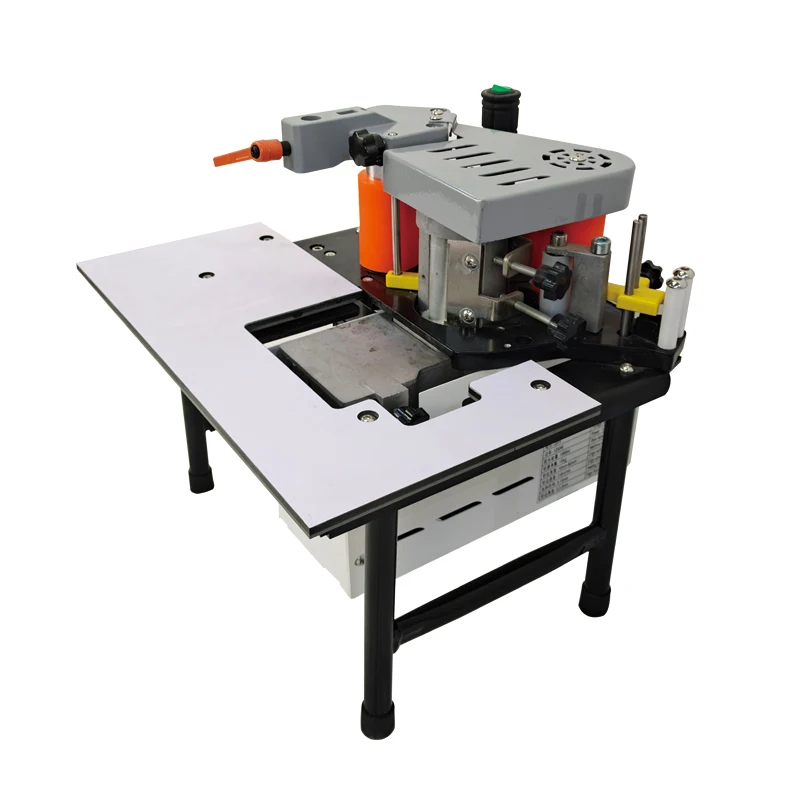
Voltage-Matched Configuration — the ST-30 portable edge bander ships with confirmed 220V or 380V setup, plug standard, and frequency matched to your site power before production begins.
Technical Specifications
| Parameter |
Value |
| Model |
ST-30 |
| Product Type |
Portable Edge Banding Machine |
| Total Power |
1000W |
| Voltage Options |
220V / 380V / Customizable |
| Frequency |
50Hz / 60Hz (confirm at order) |
| Edge Banding Height |
0–50 mm |
| Edge Banding Thickness |
0.3–3 mm |
| Minimum Sheet Length |
25 cm |
| Minimum Sheet Width |
3 cm |
| Glue Pot Capacity |
1000 ml |
| Air Source Pressure |
0.5–0.8 MPa |
| Edge Power |
20W |
| Suitable Edge Tape |
ABS, PVC, Melamine, Veneer |
| Edge Profile |
Straight and Curved |
| Overall Dimensions (L×W×H) |
38×35×35 cm |
| Net Weight |
12 kg |
| Plug Options |
EU, USA, AU, UK |
| Control Language |
Chinese, English; customizable to Spanish, French, and others |
| Certification |
CE, ISO 9001 (company-level) |
Application Suitability
| Application |
Material or Output |
| Custom cabinet door edge finishing |
MDF and particleboard with PVC or ABS tape |
| Small-batch curved panel edging |
Plywood and shaped solid wood components with veneer |
| On-site interior fit-out trimming |
Melamine-faced boards with matching melamine tape |
| Joinery workshop short-run production |
Solid wood panels with veneer or ABS banding |
| Furniture component rework and repair |
Pre-cut panels requiring localized edge re-banding |
Why Voltage Confirmation Matters Before You Commit to Portable Edge Bander Specifications
A portable edge bander that arrives with the wrong voltage configuration is dead weight on your workshop floor until an electrician rewires it or you source a transformer — neither of which is cheap or fast.
I once spent two days in a Lagos workshop watching a brand-new edge bander sit idle because it was wired for 380V three-phase while the facility only had single-phase 220V available. The operator had no transformer, no electrician on call, and a delivery deadline that had already passed. The buyer had compared Portable Edge Bander specifications across three suppliers and picked the lowest price without a single question about the local power grid. That machine eventually ran, but only after a custom step-up transformer was shipped in from another city at considerable cost and delay [NEED_CITE: voltage and frequency standards by export market].
Verifying Power Compatibility at the Specification Stage
When reviewing Portable Edge Bander specifications, the voltage and frequency line is where most procurement failures originate. The ST-30 is configurable across 220V and 380V with plug options for EU, USA, AU, and UK standards, but the correct combination must be locked in before production. A 60Hz market receiving a 50Hz motor will experience thermal stress and reduced torque over time, while a three-phase unit delivered to a single-phase site simply will not start.
Mapping Edge Tape Range to Your Material Inventory
The edge banding thickness range of 0.3–3 mm and height range of 0–50 mm define exactly which panel stock this machine can process. Thinner melamine tape at 0.3 mm suits laminated particleboard for cabinet carcasses, while 3 mm ABS handles high-wear surfaces on worktops and shelving. If your production mix includes panels thicker than 50 mm or edge tape outside this range, a portable unit will not cover your requirement and a larger automatic machine becomes necessary.
Understanding What Minimum Sheet Dimensions Mean in Practice
The stated minimum sheet length of 25 cm and width of 3 cm set the lower boundary for component-level edge banding. This matters for workshops producing small drawer sides, shelf brackets, or decorative trim pieces where full-size automatic feeders cannot grip the workpiece. The portable form factor allows the operator to bring the machine to the panel rather than feeding the panel through a fixed station — useful for one-off repairs and on-site interior decoration work where moving large panels through a stationary edge bander is impractical [NEED_CITE: portable edge banding use cases in joinery workshops].

Reading the Air Supply Requirement
The 0.5–0.8 MPa air pressure range tells you what compressor capacity the ST-30 expects. Below 0.5 MPa, the pneumatic pressure on the edge tape against the panel drops, leading to incomplete glue contact and visible gaps along the bond line. Above 0.8 MPa risks damaging the internal seals and valves over time. Before ordering, confirm your workshop compressor can sustain pressure within this band under continuous use, not just at peak output — a compressor that fluctuates under load will produce inconsistent edge bonding across a production run.
What Happens When Specification Gaps Surface After Delivery
Machines quoted without a confirmed voltage match, language setting, or plug type routinely arrive at the destination port with at least one incompatibility. An English-speaking operator facing a Chinese-only control panel will delay commissioning until someone can translate the interface or the supplier ships a replacement display board. A UK plug on a machine bound for a facility wired with EU sockets means an adapter or rewiring job before the first panel can be edged. These are not engineering failures — they are specification gaps that could have been closed during the quotation stage [NEED_CITE: common commissioning delays from specification mismatches in imported machinery].
Why Technical Verification Belongs in the Selection Process
In-house manufacturing with patented cutting mechanisms ensures tolerance is built into the machine rather than claimed on paper. The four-stage QC process — incoming material, in-process, finished product, and pre-shipment verification — catches assembly faults before the crate is sealed. Engineer-led configuration means the voltage, plug, language, and edge tape compatibility are confirmed against your actual workshop conditions, not guessed from a catalog. Factory test records on your specific panel material are available before the machine leaves the production floor. The full specification sheet, electrical schematic, and voltage confirmation document travel with the shipment so nothing depends on verbal promises after the container is loaded.
Documentation & Verification
- CE declaration of conformity covering the ST-30 portable edge bander
- Electrical schematic confirming voltage, frequency, and plug type for your market
- Factory test record showing edge banding results on your specified panel material
- Machine specification sheet with all parameters for cross-reference against your production requirements
- Operation and maintenance manual in the agreed control language
Installation, Commissioning & Support
- Connect to a dedicated circuit matching the confirmed 220V or 380V supply with appropriate breaker rating
- Supply clean, dry compressed air at 0.5–0.8 MPa through a filtered regulator to protect pneumatic seals
- Load glue into the 1000 ml pot and allow full heat-up before the first test pass on scrap material
- Verify edge tape feed alignment for both straight and curved profiles using sample panels before production begins
- Review the supplied spare parts list and stock recommended consumables for your expected production volume
What to Include in Your Specification Inquiry
Send your panel material type and thickness range, the edge tape materials you run most often, and your workshop voltage and frequency. If you are integrating the ST-30 into an existing line, note the upstream and downstream equipment so feed direction and workspace can be confirmed. Specify the control language your operators require and whether you need a sample edge banding test on your own panel stock before shipment.
Frequently Asked Questions
Q: How do I confirm the correct voltage and frequency for my market before ordering the ST-30?
A: Provide your local supply voltage, phase configuration, and frequency at the inquiry stage. The electrical schematic and voltage confirmation document are prepared before production so you can verify compatibility with your electrician before the machine ships. Plugs are matched to EU, USA, AU, or UK standards based on your destination.
Q: Which panel thickness and edge tape combinations can the ST-30 handle?
A: The machine accommodates panel thicknesses up to 50 mm with edge tape from 0.3 mm to 3 mm. Suitable tape materials include ABS, PVC, melamine, and veneer. Both straight and curved edge profiles are supported within these ranges.
Q: How do the minimum sheet dimensions affect small component edge banding?
A: The 25 cm minimum length and 3 cm minimum width define the smallest panel the ST-30 can process. This covers most cabinet components, drawer sides, and trim pieces. For panels smaller than these dimensions, manual edge banding methods remain necessary.
Q: What language options exist for the control panel and documentation?
A: Chinese and English are standard. Spanish, French, and other languages can be configured at the point of order. The operation and maintenance manual is supplied in the same language as the control interface to ensure consistency during operator training.
Q: Can I request a sample edge banding test on my own panel material before shipment?
A: Yes. Send a sample of your panel stock and preferred edge tape to the factory. A test run is performed and results are documented in the pre-shipment factory test record, which is shared with you before the machine is crated for dispatch.