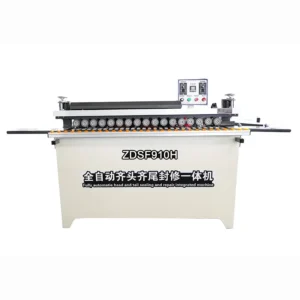
In-house tolerance verification — the ZDSJCX-880S edge bander specification sheet is backed by factory test records on your actual panel stock before any shipping crate is closed.
Technical Specifications
| Parameter |
Value |
| Model |
ZDSJCX-880S |
| Product Type |
Fully Automatic Edge Banding Machine with Pre-Milling and Corner Rounding |
| Overall Dimensions (L×W×H) |
8.82 × 1.07 × 1.85 m |
| Total Weight |
3200 kg |
| Total Installed Power |
47.1 kW |
| Voltage |
380 V (frequency to be confirmed at order) |
| Air Pressure Requirement |
0.6–0.8 MPa |
| Vacuum Extraction Ports |
Ф100 × 6 |
| Panel Thickness Range |
18–22 mm (basis to be confirmed) |
| Edge Banding Thickness Range |
0.5–0.8 mm (basis to be confirmed) |
| Maximum Edge Banding Width |
58 mm (basis to be confirmed) |
| Minimum Sheet Width |
150 mm |
| Minimum Sheet Length |
300 mm |
| Conveying Speed |
6–8 m/min |
| Machining Profile Capability |
15+ profiles including J type, C type, oblique straight, semi-pass, water drop, rhombus, triangle |
| Function Stations |
15 stations including pre-milling, glue application, edge banding, end trimming, rough trimming, fine trimming, corner rounding, scraping, buffing |
| Control System |
To be confirmed at order (PLC / CNC options available) |
| Operator Language |
Configurable — to be specified before production |
| Standards & Certification |
CE and ISO 9001 documentation available on request |
Application Suitability
| Application |
Material or Output |
| Custom cabinet door edge finishing |
MDF and particleboard with PVC or melamine banding |
| Wardrobe carcass panel processing |
Plywood panels with veneer or thin PVC edge strips |
| Office furniture component banding |
Chipboard and blockboard with 0.5–0.8 mm edge material |
| Joinery workshop batch production |
Solid wood panels requiring pre-milling before edge application |
| Retail fixture and shelving fabrication |
Melamine-faced board with matching ABS or PVC edging |
Why the Voltage Question Beats the Price Question Every Time
Confirming local voltage and frequency before the proforma invoice is signed prevents a machine that cannot run on arrival.
I have watched crated edge banders sit on factory floors for weeks because the 380 V / 50 Hz wiring inside the cabinet did not match the buyer's 60 Hz grid, and the variable frequency drives threw faults the moment the conveyor motor engaged. A few hours spent verifying the edge banding machine specifications against the local utility standard would have avoided the downtime and the transformer rental that followed [NEED_CITE: voltage and frequency standards by export market]. The ZDSJCX-880S is configurable across common industrial voltages, but that configuration must be locked in before assembly begins, not discovered during commissioning.

Mapping Feed Speed to Your Daily Panel Volume
The 6–8 m/min conveying speed on the ZDSJCX-880S places it in the mid-throughput tier, suited to workshops running mixed batches of cabinet components rather than long identical runs. When you evaluate edge banding machine specifications, feed speed directly governs how many linear meters of edging you can apply per shift. A panel that is 600 mm long passing through at 8 m/min completes its cycle in roughly four to five seconds, meaning the operator's loading rhythm and the upstream saw's cutting output must keep pace to avoid idle conveyor time.
Fifteen Function Stations and What Each One Earns
A 15-station configuration covers the full sequence from pre-milling through buffing, which matters when your edge profile list includes corner rounding, scraping, and fine trimming. The pre-milling station squares the panel edge before glue contact, removing saw marks that would otherwise telegraph through thin melamine banding. Corner rounding stations handle the transition where two edges meet at a radius, a step that entry-level machines leave to manual hand work. When comparing edge banding machine specifications across suppliers, verify which stations are physically present in the frame rather than listed as software-enabled options [NEED_CITE: common station configurations in automatic edge banders].
Reading the Numbers That Actually Affect Assembly Downstream
Panel thickness range, minimum sheet dimensions, and edge banding width are the three figures that determine whether the ZDSJCX-880S fits your current product mix. The stated 18–22 mm panel thickness range suggests a machine tuned for standard cabinet-grade board; if your workshop also runs 10 mm drawer bottoms or 25 mm shelving, that range must be verified and possibly widened through adjustment or confirmation with the factory. The 150 mm minimum sheet width and 300 mm minimum sheet length define the smallest offcut you can feed through, which affects yield when nesting software produces narrow filler panels. Total power at 47.1 kW means the main breaker and dedicated circuit must be sized to handle continuous draw plus the start-up surge of the pre-milling motors. Six Ф100 vacuum extraction ports require a dust collection system with sufficient static pressure to maintain capture velocity at every hood simultaneously. The 0.6–0.8 MPa air pressure requirement is standard for pneumatic clamping and glue pot pressure systems, but the compressor must deliver clean, dry air to avoid moisture contamination in the glue line.
The Cost of Skipping the Specification Cross-Check
When a buyer selects an edge bander based on a single headline figure and ignores the rest of the sheet, the mismatch surfaces on the first production day. I have seen 2 mm PVC thick-strip orders run on machines whose glue pot recovery rate could not keep up with the feed speed, producing panels with cold glue joints that peeled during assembly. Undersized air supply causes pneumatic pressure units to lose contact mid-pass, leaving banding that lifts at the leading edge [NEED_CITE: typical edge banding adhesion failures traced to utility supply]. These are not warranty claims; they are configuration errors that a thorough review of edge banding machine specifications would have caught before the deposit was wired.
What the Factory Brings to the Specification Sheet
Every ZDSJCX-880S leaves the floor with a four-stage quality check covering incoming components, in-process assembly, finished machine function, and pre-shipment verification under load. Patented cutting mechanisms in the trimming stations hold tolerance that is documented in the factory test record, not just claimed in the brochure. Voltage, operator language, and control system type are confirmed in writing before production starts, so the machine that arrives matches the grid, the operator, and the existing workshop infrastructure. Engineer-led configuration review ensures the station list matches your edge profile requirements without carrying unused stations that add maintenance burden. Full OEM and private-label capability means distributors can specify branding and documentation packages that match their market.
Documentation & Verification
- Machine specification sheet listing every confirmed parameter including voltage and frequency
- Electrical schematic with circuit breaker sizing and cable cross-section recommendations
- Factory test record run on your specified panel thickness and edge banding material
- Operation and maintenance manual written in the agreed operator language
- Spare parts list with OEM part numbers and recommended first-order quantities
- CE declaration of conformity and ISO 9001 certificate included in the shipping dossier
Installation, Commissioning & Support
- The 8.82 m length requires clear floor span and level concrete slab rated for 3200 kg static load
- A dedicated 47.1 kW circuit with correctly sized breaker must be in place before delivery
- Six Ф100 vacuum ports need ducting routed to a collector with adequate static pressure capacity
- Pneumatic supply at 0.6–0.8 MPa must include a dryer and inline filter upstream of the machine
- Commissioning includes first-run parameter tuning on your actual panel stock and banding material
- Operator training covers station adjustment, glue temperature setting, and daily maintenance checkpoints
What to Prepare Before Requesting a Quotation
Share your most common panel material, thickness range, and the edge banding profiles you run in a typical week so the station configuration can be matched to real output rather than a catalog maximum. Confirm your workshop's available voltage and frequency, the language your operators read, and whether existing dust collection and compressed air infrastructure can absorb the ZDSJCX-880S utility demand. If your product mix includes unusually narrow or short panels, provide those minimum dimensions so feedability can be verified before order confirmation.
Frequently Asked Questions
Q: How do I confirm the panel thickness range actually covers my board stock?
A: Request a factory test run using samples of your thinnest and thickest panels with your chosen edge banding material. The test record documents glue adhesion, trimming quality, and corner rounding accuracy at each thickness, giving you verifiable proof rather than a catalog claim before you commit to the purchase order.
Q: What voltage and frequency documentation arrives before the machine ships?
A: An electrical schematic and voltage confirmation document are issued after you provide your local grid standard. This document specifies the configured voltage, frequency, breaker rating, and cable sizing so your electrician can prepare the supply circuit before the crate arrives at your factory door.
Q: Can individual function stations be deactivated for simpler edge profiles?
A: The 15-station configuration allows operators to bypass stations not needed for a given job, such as skipping corner rounding when running straight-edge melamine banding. This flexibility reduces wear on unused tooling and shortens setup time when switching between profile types across different production batches.
Q: What control system and language options are available for the operator interface?
A: The control system type and operator language are confirmed during the specification review stage before production begins. You specify the language your floor staff reads, and the interface, alarm messages, and maintenance prompts are configured accordingly so commissioning is not delayed by translation gaps.
Q: How should I plan floor space and utility connections before delivery?
A: Use the 8.82 × 1.07 m footprint plus operator clearance on the infeed and outfeed sides to reserve floor area. Ensure the 380 V supply circuit, 0.6–0.8 MPa compressed air line with dryer, and six Ф100 dust extraction ducts are all routed and tested before the machine is positioned to avoid installation delays.