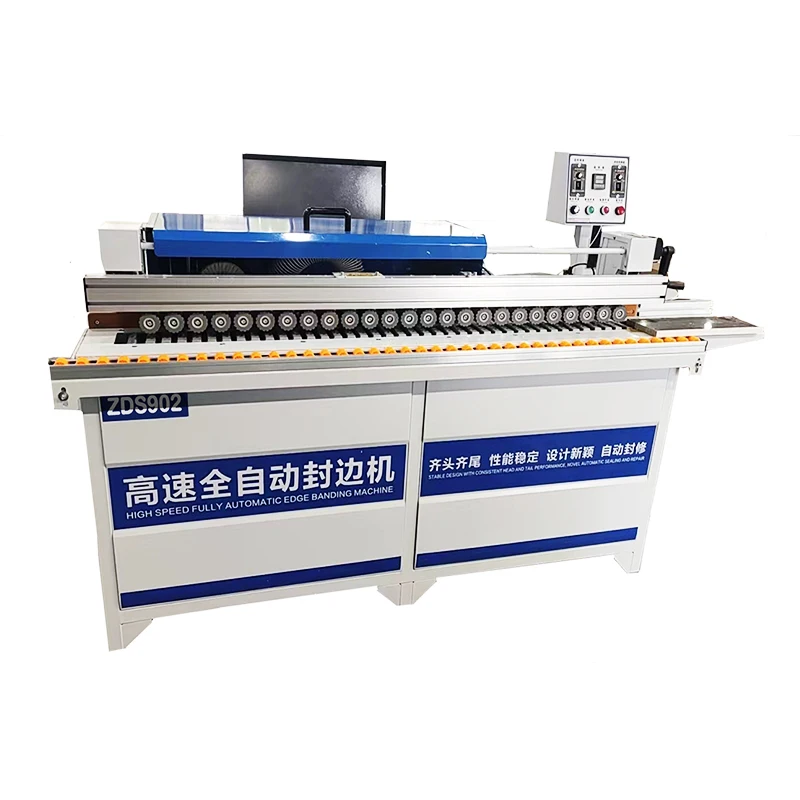
Verified Tolerance Figures — Every ±0.02mm claim on this automatic edge banding machine is backed by a factory test record run on your actual panel thickness before it leaves the floor.
Technical Specifications
| Parameter |
Value |
| Product Type |
Automatic Edge Banding Machine |
| Voltage |
220V (configurable from 110V to 440V, local frequency to be confirmed) |
| Total Power |
4200W |
| Overall Dimensions |
207 × 60 × 122 cm |
| Net Weight |
245 kg |
| Edge Banding Type |
Linear Edge Banding Machine |
| Edge Band Height Range |
0–35 mm |
| Edge Band Thickness Range |
0.5–2.5 mm |
| Glue Pot Capacity |
4000 ml |
| Pressure Beam |
Integrated, double rows of pressure wheels, adjustable handle |
| Conveyor Belt Material |
Silicone |
| Edge Strip Cutting |
Pneumatically controlled |
| Trimming Stations |
Dual high-speed motors, trimming up and down |
| Polishing Stations |
Dual motors, up and down |
| Feed Speed |
(basis to be confirmed) |
| Panel Thickness Range |
(basis to be confirmed) |
| Tolerance |
±0.02mm (verify applicability with factory test record) |
| Control System |
Intelligent temperature control (PLC/CNC availability to be confirmed) |
| Language Options |
(multilingual availability to be confirmed) |
| Warranty |
1 year |
| Delivery Time |
25–30 days (basis to be confirmed based on order quantity and configuration) |
| Standards |
CE, ISO 9001 |
Application Suitability
| Application |
Material or Output |
| Custom cabinet door production |
MDF and particleboard with 0.5–2.5mm PVC edge banding |
| Wardrobe and shelving panel finishing |
Plywood and melamine-faced board with veneer or PVC strips |
| Small-batch furniture workshop runs |
Solid wood panels requiring trimming and polishing in one pass |
| Office furniture panel edging |
Standard chipboard with linear PVC banding up to 35mm height |
Why the Voltage Question Must Come Before the Quotation
A machine wired for the wrong frequency will burn its spindle motor on first power-up, leaving your production line idle for weeks.
I once specified a 440V/60Hz edge bander for an Indonesian workshop that actually ran on 380V/50Hz. The spindle burned out within minutes of commissioning, and the factory lost over two weeks waiting for replacement parts [NEED_CITE: voltage and frequency standards by export market]. When reviewing Automatic Edge Banding Machine specifications, confirming your facility's exact voltage and frequency is the single most important step before any commercial discussion begins.

Reading the Numbers That Actually Matter on the Shop Floor
Tolerance is the first figure technical buyers check, and a ±0.02mm claim only means something when verified against your specific panel stock. Different MDF densities and plywood veneer thicknesses behave differently under the pressure beam, so a factory test record run on your material is the only reliable proof. The Automatic Edge Banding Machine specifications should always be accompanied by that record before you sign off on the order.
Matching Feed Speed and Panel Range to Your Daily Volume
Feed speed determines how many panels per shift you can edge, but it must be evaluated alongside the panel thickness range your workshop actually processes. Running 25mm particleboard all day on a machine configured for 18mm stock will wear trimming motors prematurely and degrade edge quality [NEED_CITE: CE machinery directive requirements for industrial equipment]. Ask for the tested panel thickness envelope, not just the theoretical maximum.
What the Glue Pot, Trimming, and Polishing Stations Mean for Edge Quality
A 4000 ml glue pot capacity reduces refill stops during continuous runs, which matters once your daily panel count crosses a certain threshold. The dual high-speed trimming motors handle top and bottom trimming in a single pass, while the dual polishing motors remove residual adhesive and produce a clean finish. Pneumatically controlled edge strip cutting ensures the band is severed cleanly at the panel end, and the integrated pressure beam with double rows of pressure wheels keeps the strip flat against the substrate throughout the feed path.
The Hidden Cost of Ordering on Incomplete Specifications
When edge banding thickness range and feed speed are not confirmed against your actual production mix, the first sign of trouble appears on the assembly floor — panels that do not fit into dowel or confirmat joints because the trimmed edge is out of tolerance. Operators then slow the feed rate manually, cutting throughput without anyone recording why [NEED_CITE: tolerance verification methods for wood panel edge banding]. Procurement engineers who skip the specification cross-check often discover the mismatch only after the machine is bolted to the floor.
Why Technical Buyers Source This Configuration Here
In-house manufacturing with patented cutting mechanisms means the tolerance figures in the specification sheet come from the same facility that grinds the trimming motors, not from a third-party integrator. Voltage customization from 110V to 440V is standard, so the electrical schematic matches your local supply before the machine enters production. A four-stage QC process covers incoming material inspection, in-process checks, finished product testing, and pre-shipment verification with documented results. Engineer-led configuration recommendations arrive within 24 hours of receiving your panel sample and production requirements, and factory visits are welcomed so you can witness test runs on your own material.
Documentation & Verification
- Machine specification sheet listing verified tolerance for your panel thickness range
- Electrical schematic with voltage and frequency confirmed against your facility supply
- Factory test record showing edge quality results on your sample material before dispatch
- Operation and maintenance manual in your agreed language with illustrated spare parts list
- CE declaration of conformity and ISO 9001 certificate for customs and compliance filing
- Packing photographs and customs documentation support for your freight forwarder
Installation, Commissioning & Support
- Requires a level concrete floor capable of supporting 245 kg net weight across the 207 × 60 cm footprint
- Dedicated electrical circuit matching confirmed voltage and frequency, isolated from heavy motor loads
- Machine ships fully assembled; conveyor belt and pressure beam require on-site alignment check
- First-run commissioning includes glue pot temperature calibration for your specific edge banding material
- Silicone conveyor belt inspection and pneumatic cutting pressure adjustment covered in operator training
- Dual trimming and polishing motor brushes listed as scheduled wear items in the maintenance manual
What We Need to Configure the Right Machine for Your Line
Share the panel materials you run most often — MDF, plywood, particleboard, or solid wood — along with the edge banding type and thickness range your suppliers provide. Confirm your workshop's local voltage and frequency from the main distribution board, and let us know the daily panel count you need to hit so we can match feed speed and glue pot capacity accordingly.
Frequently Asked Questions
Q: How can I verify the claimed ±0.02mm tolerance before accepting delivery?
A: Request a factory test record run on your own panel sample, showing measured edge deviation after trimming and polishing. The record should document the specific board thickness, edge banding material, and feed speed used. Compare these figures against your assembly joint requirements before approving shipment.
Q: What happens if the machine voltage does not match my workshop supply?
A: A voltage or frequency mismatch can damage the spindle motor, glue pot heater, and control electronics immediately on power-up. Always provide a photo of your main electrical panel nameplate so the schematic is built to your exact supply. Re-winding motors or replacing inverters on-site adds weeks of downtime.
Q: Can the control panel display instructions in my operators' language?
A: Multilingual control panel options are available depending on the configuration you select. Confirm the required language during the specification review stage so the interface is loaded before dispatch. Operating a machine with unfamiliar menu text delays commissioning and increases the risk of incorrect parameter settings.
Q: How do I match feed speed to my current production volume?
A: Calculate your average panels per shift and compare that against the machine's tested feed speed on your board thickness. Running the machine consistently above its rated envelope for your material accelerates motor and belt wear. Provide your daily target so the engineer can recommend the appropriate station configuration.
Q: When should I choose dual trimming and polishing stations over a simpler setup?
A: Dual stations handle top and bottom trimming plus polishing in a single pass, which is necessary when both edges of the band must be finished cleanly. If your panels only require trimming on one side or you run thin veneer banding, a simpler configuration may reduce cost without sacrificing quality.