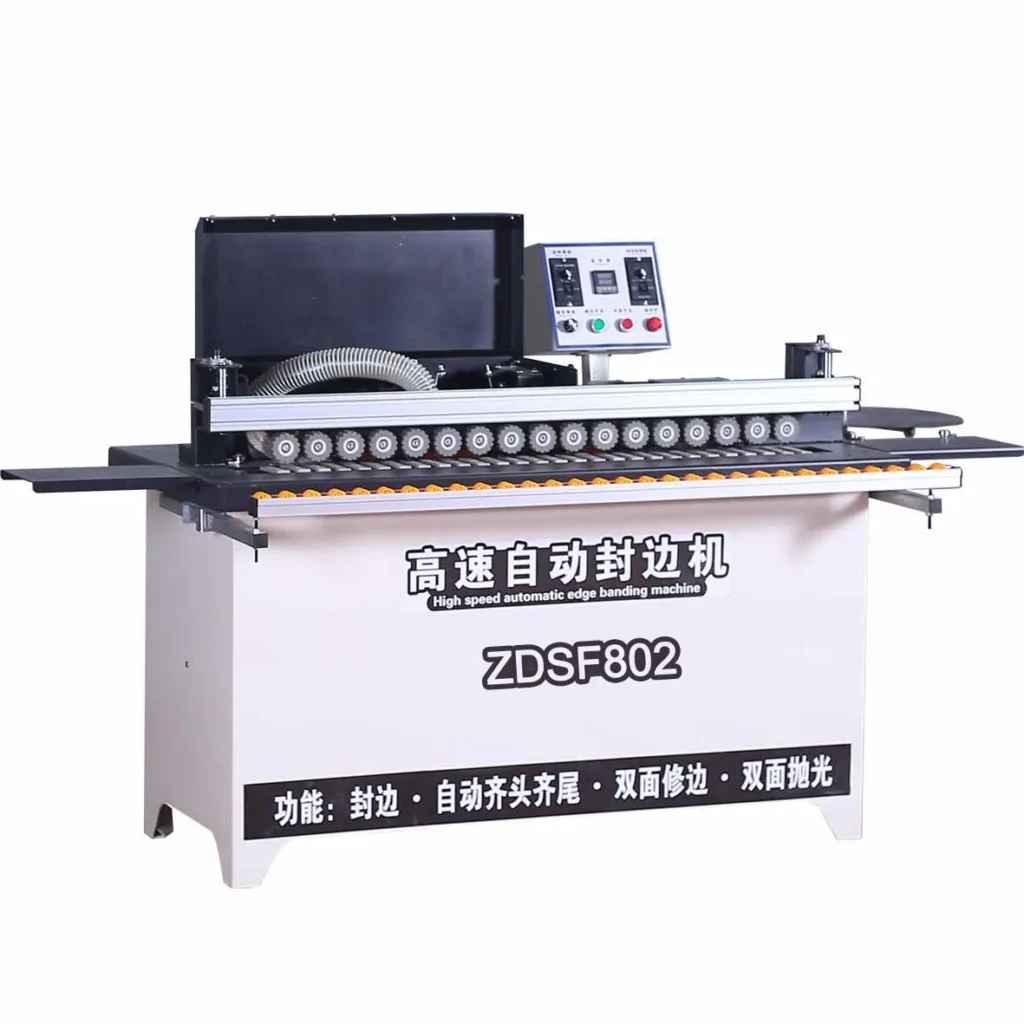
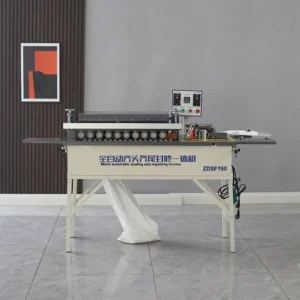
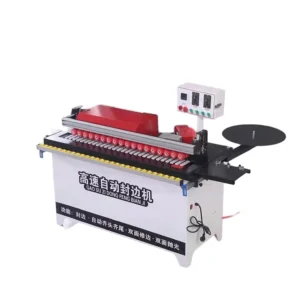
Voltage-Frequency Matching — ZDS802 configuration confirmed against destination grid standards before build, not after arrival.
Technical Specifications
| Parameter |
Value |
| Model |
ZDSF802 |
| Product Type |
Automatic Edge Banding Machine |
| Function |
Automatic plate feeding, end cutting, upper and lower polishing, automatic head and tail trimming, integrated dust collector |
| Edge Type |
Straight line |
| Rated Voltage |
220V (source value — confirm frequency and local voltage compatibility) |
| Rated Power |
4 kW |
| Trimming Power |
800W × 2 |
| Polishing Power |
180W × 2 |
| Suction Power |
1200W |
| Heating Power |
1000W (heat-up time 5–10 min) |
| Feed Speed |
0–10 m/min |
| Conveyor Belt Speed |
0–10 m/min |
| Strip Thickness Range |
0.5–2.5 mm |
| Sheet Thickness Range |
10–50 mm |
| Glue Pot Capacity |
4000 ml |
| Rated Air Pressure |
0.4–0.6 MPa |
| Overall Dimensions |
130 × 65 × 75 cm |
| Machine Weight |
150 kg |
| Control Panel |
Digital display of glue pot temperature, independent switches |
| Pressure Beam |
Integrated pressure beam with double-row pressure wheels |
| Conveyor Belt Material |
Silicone |
| Belt Breaking Method |
Pneumatically controlled |
| Assembly State |
Partially assembled, some assembly required per user manual |
Application Suitability
| Application |
Material or Output |
| Custom furniture panel edge banding |
MDF, particleboard, plywood with PVC or veneer strips |
| Cabinet door and carcass production |
Standard sheet stock 10–50 mm thickness |
| Small-to-medium joinery workshop runs |
Straight-line components at 0–10 m/min feed rate |
| Interior fit-out panel processing |
Laminated boards requiring clean edge finish |
Why Voltage Must Be Confirmed Before the ZDS802 Automatic Edge Banding Machine Ships
A machine rated at 220V may not match the actual frequency and phase configuration at your workshop.
I have watched workshops receive edge banders that powered on but ran the conveyor at the wrong speed or overheated the glue pot within the first hour — all because the local grid frequency did not match what the motor was wound for. The ZDS802 automatic edge banding machine specifications list 220V as the rated voltage, but that single number tells you nothing about whether 50Hz or 60Hz applies at your facility, or whether your supply is single-phase or split-phase [NEED_CITE: voltage and frequency standards by export market]. When a 50Hz motor runs on 60Hz, the conveyor belt speed shifts, the feed rate drifts, and trimming quality degrades before anyone notices the root cause.

Matching Feed Speed to Panel Throughput Requirements
The 0–10 m/min variable feed speed on this unit directly determines how many linear meters of edging a workshop can complete per shift. At the lower end, slower speeds give the glue more open time on porous substrates like raw particleboard. At the upper range, operators running pre-laminated MDF with thin PVC strips can push throughput higher without sacrificing adhesion. The key is knowing where your typical daily mix falls on that spectrum before selecting the operating point.
Glue Pot Capacity and Batch Continuity
The 4000 ml glue pot capacity means operators processing standard cabinet components can run extended batches without stopping to refill. For a small workshop running two or three cabinet sets per day, this volume typically covers a full morning session. The digital temperature display lets the operator monitor the melt condition in real time, which matters when switching between EVA and PUR-based adhesives with different working temperatures.
Reading the Specification Sheet Against Your Production Reality
The ZDS802 automatic edge banding machine specifications reveal a unit built around a 130 × 65 × 75 cm footprint and 150 kg weight — dimensions that fit into workshops where floor space is constrained but a full manual edge banding process is no longer sustainable [NEED_CITE: workshop space planning for small furniture manufacturers]. The 10–50 mm sheet thickness range covers most cabinet carcass and door panel stock. The 0.5–2.5 mm strip thickness range handles PVC, ABS, and thin wood veneer edging without requiring a separate machine for each material. Dual trimming motors at 800W each provide upper and lower cutting action, which determines how cleanly the strip terminates at panel ends. The pneumatically controlled belt breaking method and integrated 1200W dust collector address two issues that affect daily operation: strip management at panel transitions and airborne particle control in enclosed workshop environments.
When Specified Tolerances Fail at Assembly
Panels that look acceptable on the banding machine can fail during cabinet assembly if edge trimming leaves inconsistent overhang or the glue bond weakens under clamping pressure. I have seen situations where the strip thickness used in production differed from the sample run, and the pressure wheel setting was never adjusted — the result was visible glue lines and panels that would not seat flush in dowel joints [NEED_CITE: edge banding quality standards for furniture assembly]. These problems surface days after production, not on the machine itself.
Why the ZDS802 Automatic Edge Banding Machine Fits the Specification-Driven Buyer
The four-stage quality control process covers incoming material inspection through pre-shipment verification, meaning the unit you receive has been tested under documented conditions. Voltage and frequency can be confirmed and adjusted during build rather than discovered on arrival. The engineer-led configuration process delivers a formal quotation within 24 hours that includes the exact specification sheet for the model being quoted. In-house manufacturing with patented cutting mechanisms means tolerance claims are traceable to the machine's actual mechanism, not a general company statement.
Documentation & Verification
- Machine specification sheet with verified ZDS802 parameter values for your configuration
- Electrical schematic confirming voltage, frequency, and phase for destination country
- Factory test record using your specified panel and strip thickness combination
- CE declaration of conformity referencing the specific ZDS802 unit serial number
- Operation and maintenance manual written in the agreed operator language
- Spare parts list identifying consumables and wear components by part number
Installation, Commissioning & Support
- Level floor section required for the 130 × 65 × 75 cm footprint with clearance for panel infeed and outfeed
- Dedicated electrical circuit matching confirmed voltage and frequency for the 4 kW total rated power
- Partially assembled delivery — pressure beam, conveyor, and dust collector connections require on-site completion per manual
- First-run parameter setting for glue pot temperature, feed speed, and pressure wheel tension based on actual strip stock
- Operator training on digital temperature display reading and independent switch control sequence
- Silicone conveyor belt inspection schedule and pneumatic belt-breaking mechanism maintenance intervals
What to Include in Your Inquiry
Provide the panel materials you process most often, including substrate type and typical thickness range within the 10–50 mm capacity. State your local voltage and frequency so the electrical system is configured correctly before the machine leaves the factory. Indicate whether your operators need the control panel labels and manual in a specific language for commissioning.
Frequently Asked Questions
Q: How do I verify the edge banding tolerance this machine delivers against my assembly requirements?
A: Request the factory test record before shipment, which documents trimming results on your specified panel and strip combination. Tolerance verification depends on the exact material pairing, so a sample run using your actual stock is more reliable than a general specification claim. Confirm that the test was performed on the specific ZDSF802 unit being shipped.
Q: The voltage is listed as 220V — can this machine be configured for different local standards?
A: Voltage and frequency must be confirmed during the quotation stage so the motor windings, heating element, and control transformer match your supply. The manufacturer supports configuration across a range of voltages. Request the electrical schematic showing the final wiring arrangement before production begins to avoid incompatibility on arrival.
Q: How does the 0–10 m/min feed speed translate to panels-per-hour in a cabinet workshop?
A: Throughput depends on panel length, strip material, and whether operators are loading manually or using an upstream feed system. At typical cabinet component lengths, the variable feed speed allows adjustment based on glue open time requirements. Provide your average panel dimensions and daily volume target for an engineer-led throughput estimate.
Q: What strip and panel thickness combinations does this model handle without requiring mechanical adjustment?
A: The ZDSF802 covers 10–50 mm sheet thickness and 0.5–2.5 mm strip thickness within its design range. Switching between significantly different strip thicknesses may require pressure wheel and trimming position adjustments. Confirm your full material range during configuration so the machine ships with the correct setup for your most common combination.
Q: How should this machine be matched with upstream panel saws and downstream boring stations?
A: The 0–10 m/min feed speed and 130 × 65 × 75 cm footprint define where this unit fits in a line. Throughput matching requires knowing the output rate of your panel saw and the cycle time of downstream operations. Share your current equipment list and target workflow for a line-layout recommendation that avoids bottlenecks.