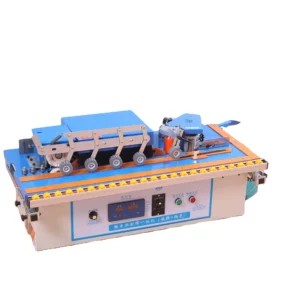
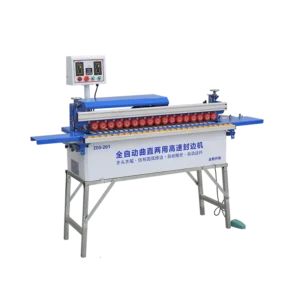
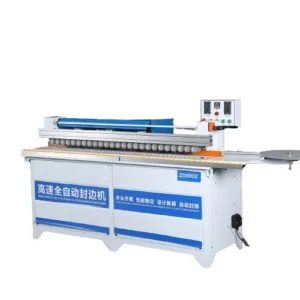
Engineer-Led Configuration — the DW902 High-speed Fully Automatic Edge Banding Machine is matched to your panel thickness, substrate, and line throughput before a quotation is issued, not after.
Technical Specifications
| Parameter |
Value |
| Model |
DW902 |
| Product Type |
High-speed Fully Automatic Edge Banding Machine |
| Function Sequence |
Gluing, Trimming, End cutting, Scraping, Polishing |
| Voltage |
220V (frequency and target market standard to be confirmed) |
| Total Power |
3300W |
| Board Thickness Range |
0–50 mm |
| Edge Strip Thickness Range |
0.5–3 mm |
| Glue Pot Capacity |
4000 ml |
| Overall Dimensions (L×W×H) |
175 × 60 × 112 cm |
| Net Weight |
240 kg |
| Trimming Configuration |
Double high-speed trimming motors, upper and lower |
| Polishing Configuration |
Upper and lower polishing motors |
| Edge Strip Cutting |
Pneumatically controlled (pressure requirement to be confirmed) |
| Conveyor Belt |
Silicone material |
| Pressure Beam |
Integrated, double rows of pressure wheels, handle-adjustable |
| Feed Speed |
(basis to be confirmed) |
| Control System |
(basis to be confirmed) |
| Warranty |
One year |
Application Suitability
| Application |
Material or Output |
| Custom cabinet door and carcass edge finishing |
MDF and particleboard with PVC edge banding |
| Plywood shelving and storage unit edging |
Plywood panels with veneer or PVC strip |
| Solid wood furniture component banding |
Solid wood panels up to 50 mm thickness |
| Joinery workshop transition from manual to machine |
Mixed board substrates, 0.5–3 mm strip |
| Small-batch panel processing for fit-out contractors |
Board thickness range 0–50 mm across varied orders |
Why Voltage Must Be Settled Before the DW902 Leaves the Factory
Confirming the local electrical standard against the stated 220V rating prevents a machine that powers on but cannot hold thermal stability at the glue roller.
The DW902 High-speed Fully Automatic Edge Banding Machine specifications list 220V, but frequency — 50 Hz or 60 Hz — is not stated. A glue pot heater and trimming motor behave differently across frequency standards, and the thermal profile at the gluing station directly affects bond integrity on PVC and veneer strips. I have walked into workshops where the machine ran, but the glue line showed intermittent adhesion failure on particleboard because the heater element was cycling at the wrong interval for the local supply [NEED_CITE: voltage and frequency standards by export market]. Resolving this before production means the electrical schematic matches the destination country, not just the nameplate.

Reading the Station Sequence Against Your Substrate Mix
The six-stage function sequence — gluing, trimming, end cutting, scraping, and polishing — covers the full edge finishing cycle within a 175 cm footprint. For a workshop processing both MDF and plywood in the same shift, the double high-speed trimming motors handle upper and lower edge removal in one pass, which matters when switching between substrates that produce different chip loads. The scraping station follows trimming to clean the residual adhesive line, a step that becomes more critical on porous substrates like particleboard where glue squeeze-out is more visible.
What the Glue Pot Capacity Means for Continuous Shifts
A 4000 ml glue pot reduces the frequency of manual refills during a production run, but the practical interval depends on strip width, board feed rate, and glue application thickness. On a run of standard 22 mm particleboard shelving with 0.8 mm PVC, the pot sustains continuous operation across a typical batch before requiring a top-up. The silicone conveyor belt and double-row pressure wheel beam maintain consistent panel registration through the gluing zone, which is where most edge adhesion variation originates on entry-level machines [NEED_CITE: edge banding adhesion failure modes on particleboard substrates].
How Board Thickness and Pressure Beam Design Interact
The 0–50 mm board thickness range covers everything from 3 mm MDF back panels to 50 mm solid wood worktops, but the pressure beam must be adjusted for each changeover. The handle-adjustable integrated beam with double rows of pressure wheels allows the operator to dial in clamping force without tools. For thin boards under 10 mm, excessive pressure causes panel deflection at the trimming station, producing a chamfer rather than a flush cut. For boards above 40 mm, insufficient pressure allows the panel to lift at the gluing station, resulting in a visible gap between strip and substrate. The trimming and polishing stations each use separate upper and lower motors, so the cut quality is maintained independently of the polishing finish regardless of where the board sits in the thickness range.
What Happens When an Underspec Machine Meets Production Volume
A joinery workshop moving from manual edge banding to machine-assisted output often underestimates the thermal and mechanical load of sustained operation. The trimming motors on a machine designed for intermittent use overheat when asked to process several hundred linear meters of PVC in a single shift, and the edge quality degrades from the twentieth panel onward. I have seen edge banders in this class produce clean cuts in the morning and visible chatter marks by mid-afternoon because the motor duty cycle was never matched to the actual daily throughput [NEED_CITE: motor duty cycle and thermal management in continuous edge banding operations]. The consequence is not a catastrophic failure but a gradual increase in reject panels and rework time that the original purchase comparison never accounted for.
Why This Machine Gets Specified the Way It Does
The DW902 sits within a product family that extends from entry-level to full-function pre-milling models, so a workshop can scale throughput by moving to a higher-tier machine in the same family without retraining operators on a different control philosophy. Voltage and control panel language are confirmed before production rather than assumed from a catalogue default, which avoids the situation where a machine arrives with a display the operator cannot read. The factory test record includes sample panels processed in the buyer's target material and thickness, so edge quality is verified against actual substrate before the crate is sealed. A four-stage QC process covers incoming component inspection through pre-shipment verification, and the pneumatic utility requirements are documented in the electrical schematic so the buyer's compressor can be sized correctly before delivery.
Documentation & Verification
- Machine specification sheet listing tolerance, feed speed, and motor ratings per station
- Electrical schematic with voltage and frequency confirmed against your local supply standard
- Factory test record on your specified panel material and thickness before dispatch
- Operation and maintenance manual in the agreed language with illustrated troubleshooting
- Pneumatic pressure requirement sheet for compressor and line sizing at your facility
- Packing photographs and customs documentation support for your import process
Installation, Commissioning & Support
- 175 × 60 cm footprint requires a level floor with clearance on both sides for panel infeed and outfeed
- 3300W total power draw requires a dedicated 220V circuit with appropriate breaker rating
- Machine ships requiring assembly; silicone conveyor belt tension and pressure beam alignment set on site
- Glue pot first heat cycle and temperature stabilization verified before production panels are fed
- Trimming motor upper and lower offset calibrated against your specific board and strip combination
- Pneumatic line connected and pressure verified at the edge strip cutting device before first run
What We Need to Configure the DW902 for Your Line
To issue a formal quotation within one working day, share the board substrates you process most frequently, the edge strip materials and thicknesses in your standard orders, and the daily linear meter volume your current workflow demands. Confirm your local voltage and frequency standard, the language required on the control panel, and whether the DW902 will operate as a standalone station or feed into a downstream boring or drilling setup. If you have a specific panel dimension that represents your highest-volume order, we can run a sample test before shipment.
Frequently Asked Questions
Q: How do I verify edge banding tolerance on the DW902 before accepting delivery?
A: Specify the exact board material, thickness, and edge strip you use in production, and request a factory test record with measured samples. The pre-shipment verification includes processed panels shipped with the machine so you can measure edge overhang, trimming flush, and glue line visibility against your own quality standard upon arrival.
Q: What if my local supply is 60 Hz but the machine is listed at 220V?
A: The frequency affects heater cycling at the glue pot and motor RPM at the trimming and polishing stations. Confirm both voltage and frequency before production so the electrical components match your supply. The electrical schematic provided with the machine documents the as-built configuration for your local electrician to verify on site.
Q: How do the six function stations affect edge quality on different substrates?
A: Gluing applies the adhesive layer, trimming removes excess strip flush to the board surface, end cutting squares the strip at panel ends, scraping cleans residual adhesive, and polishing buffs the edge. On MDF, trimming produces a clean cut with minimal chip-out, while particleboard requires sharper trimmer settings due to its coarser core structure.
Q: What compressor capacity does the pneumatic edge strip cutter require?
A: The pneumatically controlled cutting device requires a stable line pressure, which is confirmed during the specification stage and documented in the pneumatic requirement sheet. Undersized compressors cause inconsistent cut timing at the end cutting station, resulting in uneven strip ends that require manual trimming downstream.
Q: How do I match DW902 throughput with my panel saw and boring machine?
A: Share your upstream panel saw cycle time and downstream boring machine feed rate so the DW902 feed speed can be evaluated against your line balance. A mismatch causes either idle time at the edge bander or a queue of unbanded panels accumulating between stations, both of which reduce effective daily output.