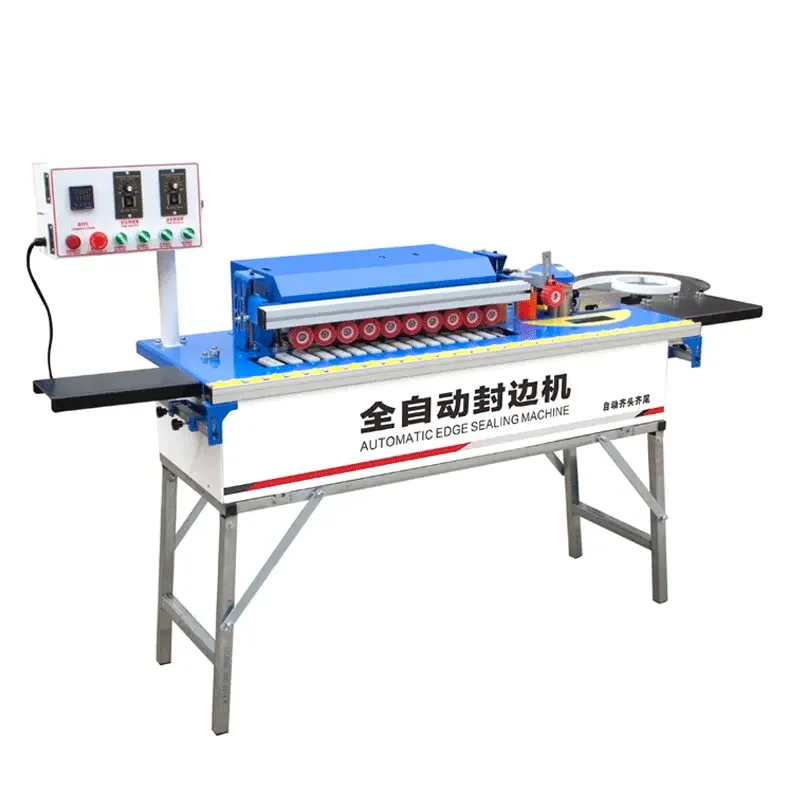
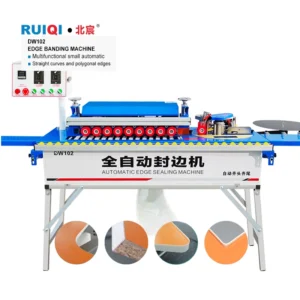
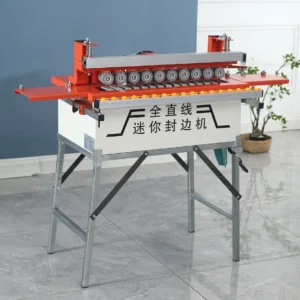
Verified Configuration Match — Every DW102 Automatic Edge Banding Machine ships only after local voltage, frequency, and panel material are confirmed against factory test records, eliminating on-site commissioning failures.
Technical Specifications
| Parameter |
Value |
| Model |
DW102 |
| Product Type |
Automatic Edge Banding Machine |
| Rated Power |
3800W |
| Voltage & Frequency |
220V / 380V / customizable (frequency to be confirmed per market) |
| Overall Dimensions (L×W×H) |
128 × 47 × 69 cm |
| Net Weight |
75 kg |
| Minimum Sheet Length |
25 cm |
| Minimum Sheet Width |
5 cm |
| Edge Banding Height |
0 – 50 mm |
| Edge Banding Thickness |
0.3 – 3 mm |
| Panel Thickness Range |
0 – 50 mm |
| Glue Pot Capacity |
1000 ml |
| Trimming Power |
650W × 2 |
| Polishing Power |
180W × 2 |
| Vacuum Power |
1200W |
| Edge Power |
20W |
| Transmission Power |
60W |
| Air Source Pressure |
0.5 – 0.8 MPa |
| Key Features |
Curved and straight edge banding, edge trimming, polishing, automatic head and tail cutting, vacuum hold-down |
| Language Options |
Chinese, English; other languages customizable |
| Certification |
CE (per company profile — verify per unit); ISO 9001 |
Application Suitability
| Application |
Material or Output |
| Cabinet door and carcass edge finishing |
MDF, particleboard, plywood with PVC or melamine edge banding |
| Small-format furniture component banding |
Solid wood panels and blockboard up to 50 mm thickness |
| Curved profile edge treatment |
Polymer door panels and shaped MDF substrates |
| Workshop-scale production runs |
Double-sided adhesive tape bonding on veneer and thin PVC strips |
| Joinery and custom furniture output |
Panels with minimum 25 cm length and 5 cm width |
Why the Voltage Question Should Come Before the Automatic Edge Banding Machine Specifications
Confirming local voltage and frequency before production prevents a machine that cannot run on arrival.
I once watched a furniture workshop in West Africa lose four full production days because the edge bander arrived wired for a supply the local grid could not deliver. The glue pot never reached temperature, the trimming motors stalled under load, and the entire line sat idle while an electrician reconfigured the incoming panel. That delay cost more than the machine's shipping. When reviewing Automatic Edge Banding Machine specifications, voltage and frequency confirmation must happen before the order enters production, not after the crate is opened. [NEED_CITE: voltage and frequency standards by export market]
The DW102 supports 220V and 380V configurations with further customization available, but the correct setting depends on your facility's actual supply — not the national standard on paper. Frequency matters equally; a 60 Hz motor on a 50 Hz grid runs hotter and slower, degrading trimming quality over a shift.

Station-Level Power Distribution Across the DW102
Understanding how power is allocated to each station helps a technical buyer predict edge quality across different materials. The DW102 assigns 650W to each of its two trimming motors, which is the threshold needed for clean cuts on 3 mm PVC without chipping the substrate edge. The polishing stage runs at 180W × 2, sufficient for buffing residual adhesive from melamine and veneer strips without burning the banding surface.
The 1200W vacuum system holds panels against the fence during feed, which is particularly relevant when banding narrow stock down to 5 cm wide. Without adequate vacuum, thin workpieces drift during trimming, producing visible step lines on the finished edge.
Mapping Automatic Edge Banding Machine Specifications to Panel Compatibility
The 0.3 – 3 mm banding thickness range covers the three most common edge materials in furniture manufacturing: thin melamine tape at the lower end, PVC through the middle range, and thicker acrylic or ABS at the upper limit. Each material demands different glue pot temperatures and feed pressures, which the DW102 accommodates through adjustable settings. [NEED_CITE: edge banding material properties and adhesion requirements]
The 0 – 50 mm panel thickness range aligns with standard MDF, particleboard, and plywood stock used in cabinet and furniture production. The minimum sheet dimensions — 25 cm length and 5 cm width — define the smallest workpiece the machine can process, a critical check for workshops cutting narrow drawer sides or small shelf brackets.
Trimming, Polishing, and Glue Pot Capacity in Practice
The dual 650W trimming stations perform head and tail cutting as well as flush trimming in a single pass. This configuration means the operator feeds the panel once and receives a finished edge, reducing handling time on small-batch runs. The glue pot holds 1000 ml, which is adequate for continuous runs on standard-width panels without mid-shift refilling. For workshops running thicker banding materials that consume more adhesive, monitoring pot level becomes part of the operator's routine.
The 1200W vacuum and 0.5 – 0.8 MPa air supply requirement mean the machine needs a dedicated compressor line. Sharing compressed air with pneumatic tools on the same circuit can cause pressure drops that affect trimming cylinder response, resulting in inconsistent end cuts. Plan your air routing accordingly. [NEED_CITE: compressed air system design for woodworking machinery]
What Happens When Feed Height and Throughput Are Mismatched
Buying an edge bander without verifying how its feed rate aligns with upstream saws and downstream boring machines creates a bottleneck that no specification sheet warns about. The panel sits between stations waiting for the next operator to clear it, or the bander idles while the saw catches up. In a workshop I visited in South Asia, a single edge bander was fed by two panel saws, but its throughput could not absorb their combined output. The factory added a second shift just to clear the backlog — a cost that never appeared in the machine's purchase price. [NEED_CITE: production line balancing principles in furniture manufacturing]
The DW102's compact footprint and 75 kg weight make it practical for small workshops, but its throughput must be evaluated against your existing cutting and drilling stations before committing. Matching feed rates across stations prevents work-in-progress accumulation and keeps panels moving through the line.
What the DW102 Delivers as a Configurable Platform
The machine arrives configured for the voltage and frequency your facility actually uses, verified against an electrical schematic before production begins. This prevents the on-site rewiring that delays commissioning and voids warranty coverage on electrical components.
Operator language on the control panel is set to your specification — English as standard, with additional languages available so your floor staff can read fault codes and parameter adjustments without translation delays.
The 0.3 – 3 mm banding thickness capability means a single DW102 handles PVC, melamine, and veneer without requiring separate machines or changeover kits for each material.
Pre-shipment testing uses your actual panel samples, confirming trimming quality, glue adhesion, and edge finish before the machine leaves the factory rather than discovering mismatches on your floor.
Documentation & Verification
- CE declaration of conformity verified against the DW102 unit serial number
- Electrical schematic with confirmed voltage and frequency for your facility supply
- Factory test record documenting trimming and polishing results on your panel material
- Operation and maintenance manual in the agreed operator language
- Itemized spare parts list with part numbers for ongoing procurement
Installation, Commissioning & Support
- The 128 × 47 × 69 cm footprint requires a level floor with clearance for panel infeed and outfeed on both sides
- Dedicated electrical circuit matching the confirmed 220V or 380V configuration with appropriate breaker rating for the 3800W total load
- 0.5 – 0.8 MPa compressed air line routed independently from other pneumatic tools to maintain stable trimming cylinder pressure
- Glue pot initial temperature calibration performed during commissioning against your specific banding material and panel substrate
- Spare trimming cutters and polishing wheels identified from the parts list for first replenishment order
Preparing Your DW102 Inquiry
To receive an accurate configuration and quotation, share your primary panel material type, the edge banding materials you run, and your local voltage and frequency. Include the smallest and largest panel dimensions in your production mix so the minimum sheet size limits can be verified against your workpieces. If you plan to integrate the DW102 with existing saws or boring machines, note their model and throughput so feed rate compatibility can be assessed before the order is confirmed.
Frequently Asked Questions
Q: What panel thickness and edge banding thickness does the DW102 accept?
A: The machine handles panel thickness from 0 to 50 mm and edge banding from 0.3 to 3 mm. This covers standard MDF and particleboard at 16–25 mm with PVC or melamine tape, as well as thicker plywood and blockboard with veneer or ABS banding. Verify unusual material combinations with a sample test before ordering.
Q: How is voltage configured for my local electrical supply?
A: The DW102 is built to your confirmed voltage — 220V, 380V, or a custom specification — and the frequency (50 Hz or 60 Hz) is documented on the electrical schematic before production. This prevents motor overheating and control system faults caused by supply mismatch after delivery.
Q: What trimming and polishing stations are included as standard?
A: Standard configuration includes two 650W trimming motors for head-and-tail cutting and flush trimming, plus two 180W polishing motors for final edge finishing. The vacuum system at 1200W and automatic edge cutting are also included. No additional stations are required for basic straight and curved banding operations.
Q: How does the DW102's throughput relate to upstream panel saw output?
A: Throughput depends on operator feed rate and panel size rather than a fixed cycle time. Before ordering, compare the number of panels your saw produces per hour with the banding cycle your operators can sustain on the DW102. This identifies whether one bander can absorb your saw output or if line balancing requires adjustment.
Q: What control panel language options are available?
A: Chinese and English are standard. Additional languages can be configured so your operators read parameters, fault messages, and adjustment prompts directly. Specify the required language during the quotation stage to ensure the control panel is programmed before shipment.