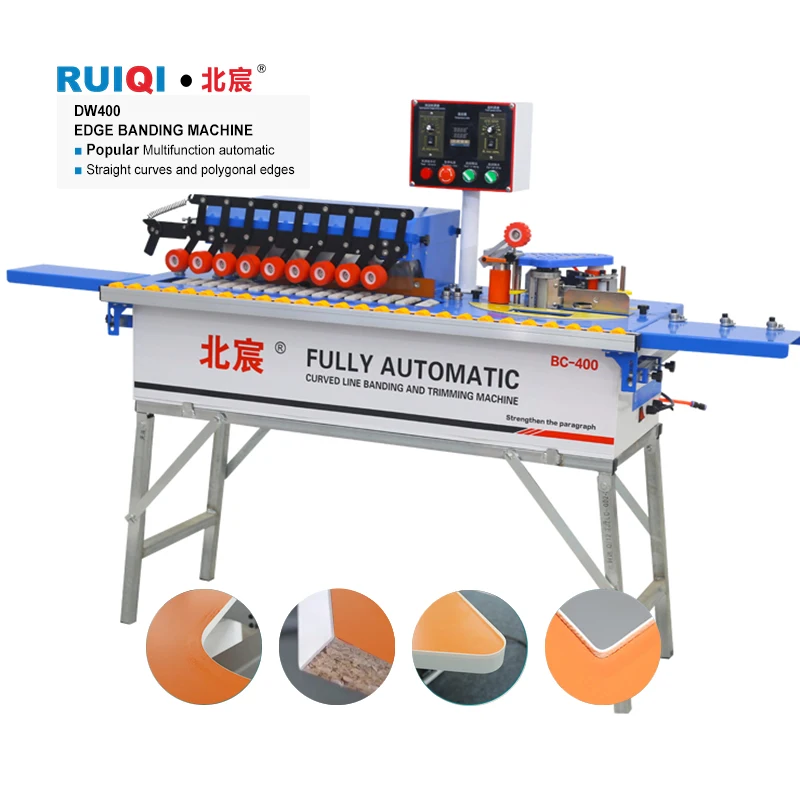
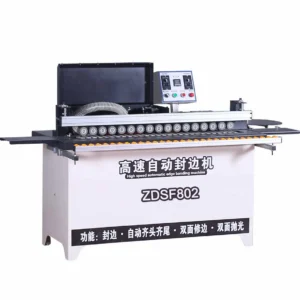
Voltage Confirmed Before Production — DW400 automatic edge banding machine ships only after electrical schematic matches your local grid, avoiding commissioning stalls on arrival.
Technical Specifications
| Parameter |
Value |
| Model |
DW400 |
| Product Type |
Automatic Straight Edge Banding Machine |
| Total Power |
3800W |
| Trimming Power |
650W × 2 |
| Polishing Power |
180W × 2 |
| Edge Power |
20W |
| Transmission Power |
60W |
| Vacuum Power |
1200W |
| Voltage Options |
220V / 380V / Customization |
| Air Source Pressure |
0.5–0.8 MPa |
| Glue Pot Capacity |
1000 ml |
| Edge Banding Height |
0–50 mm |
| Edge Banding Thickness |
0.3–3 mm |
| Minimum Sheet Length |
25 cm |
| Minimum Sheet Width |
10 cm |
| Product Size (L×W×H) |
116 × 47 × 69 cm |
| Product Weight |
70 kg |
| Language Options |
Chinese, English; Spanish and others customizable |
| Plug Options |
EU, USA, AU, UK |
| Assembly State |
Fully assembled, wooden case packed |
Application Suitability
| Application |
Material or Output |
| Cabinet door edge finishing |
MDF and melamine-faced particleboard |
| Furniture panel straight-edge banding |
Plywood and blockboard up to 50 mm thickness |
| Custom wardrobe and shelving production |
PVC and veneer edge banding 0.3–3 mm |
| Polymer door frame trimming |
Polymer composite panels |
| Small-batch joinery components |
Solid wood panels with straight edges |
Why the Voltage Question Should Come Before the Price on an Automatic Edge Banding Machine
A machine wired for the wrong frequency will not run at rated feed speed, and no amount of on-site adjustment fixes that.
I spent my first year in Middle East furniture plants watching perfectly good edge banders sit idle because the quoted voltage never matched the workshop supply. One cabinet factory in Amman received a 380V/50Hz unit while their line ran on 440V/60Hz — the trimming motors overheated within the first shift, and the glue pot never reached stable temperature. The Automatic Edge Banding Machine specifications sheet should always state confirmed voltage and frequency, not just list options [NEED_CITE: voltage and frequency standards by export market]. When the DW400 is quoted, the electrical schematic is matched to your grid before production starts, not after the crate arrives.

Trimming Station Configuration and Edge Finish Consistency
The DW400 carries dual 650W trimming motors positioned for upper and lower edge cuts in a single pass. This two-motor layout matters when you run MDF and particleboard back to back — the upper trimmer handles the overhang while the lower motor cleans the bottom edge, leaving a uniform flush finish without a second manual pass. For automatic edge banding machine specifications buyers comparing station counts, the dual trimming setup on this unit covers the most common straight-edge requirement in cabinet and furniture panel work.
Glue Pot Capacity and Adhesive Feed Stability
A 1000 ml glue pot paired with a dedicated 1200W vacuum system keeps adhesive flow steady across longer runs. On smaller glue pots, operators stop frequently to refill, and temperature swings between refills cause inconsistent bonding — especially on particleboard with higher moisture content. I learned this the hard way when a client running recycled board found that edge adhesion failed on every third panel until we stabilized the pot temperature. The DW400 vacuum-assisted feed reduces that thermal gap, though you still need to confirm your board moisture level before setting the glue temperature [NEED_CITE: adhesive bonding performance relative to substrate moisture content].
Panel Thickness, Edge Banding Range, and What They Mean Downstream
The 0–50 mm panel thickness range covers standard MDF, plywood, and particleboard used in cabinet carcasses and wardrobe doors. The 0.3–3 mm edge banding thickness handles PVC, melamine strip, and thin veneer — but running 3 mm PVC on a 10 mm thin panel demands careful pressure wheel adjustment, because excessive force will mark the substrate surface. The minimum sheet dimensions of 25 cm length and 10 cm width set the practical lower limit; anything smaller needs a manual feed jig. Understanding these automatic edge banding machine specifications against your actual panel schedule prevents buying capacity you cannot use or discovering limits mid-production.
The Hidden Cost of Specifying Edge Banders by Price Alone
When an entry-level edge bander is sold into a medium-volume line it was never designed for, the trimming motors run beyond their duty cycle and bearing wear accelerates. I have seen workshops replace trimming cutters every few days because the machine was rated for lighter use, while the production schedule demanded continuous shifts. The pressure wheels also lose concentricity faster under sustained load, leaving visible glue lines on plywood edges that should have been flush. These failures show up weeks after installation, long enough for the buyer to assume the problem is operator error rather than equipment mismatch [NEED_CITE: edge bander duty cycle and motor thermal limits].
Why Sourcing the DW400 Through This Channel
The DW400 is built with proprietary cutting mechanisms covered by patent, and the ±0.02 mm tolerance is verified through four-stage QC including pre-shipment testing. Voltage, plug type, and control panel language are confirmed as standard customization before the order enters production — not treated as optional extras. Each unit ships with a factory test record run on your specified panel thickness range, so you see actual edge quality before the machine leaves the floor. The product family spans from compact models like this to full-function pre-milling edge banders, meaning a workshop can add capacity later without switching suppliers.
Documentation & Verification
- CE declaration of conformity covering the DW400 electrical and mechanical safety scope
- Machine specification sheet with confirmed voltage, frequency, and plug type for your grid
- Electrical schematic matching the quoted configuration before production begins
- Factory test record on your panel thickness and edge banding material before dispatch
- Operation and maintenance manual supplied in the agreed operator language
- Spare parts list with trimming cutter and pressure wheel part numbers identified
Installation, Commissioning & Support
- Requires a dedicated circuit matching the confirmed 220V or 380V supply with correct breaker rating for 3800W total draw
- Compressed air line must deliver 0.5–0.8 MPa clean dry air to the machine inlet for consistent pressure wheel actuation
- Arrives fully assembled in a wooden crate — position on level floor and connect power and air before first run
- Glue pot temperature and trimming motor alignment calibrated during commissioning against your actual board stock
- Trimming cutters and polishing wheels included in initial spare parts set for early replacement planning
- 116 × 47 × 69 cm footprint fits standard workshop aisles with clearance for sheet feed and off-load
What We Need to Configure Your DW400 Correctly
Send your panel material type, typical board thickness range, and the edge banding material you plan to run — PVC, veneer, or melamine strip. Confirm your workshop voltage and frequency so the electrical schematic is locked before production. If your operators need a specific control panel language beyond Chinese or English, note that in the inquiry so it is set at the factory.
Frequently Asked Questions
Q: How do I confirm the correct voltage and frequency for my workshop before ordering?
A: Share your local supply voltage and Hz rating from your electrical contractor or utility bill. The DW400 supports 220V, 380V, and custom configurations. The electrical schematic is matched and confirmed before production starts, ensuring the trimming motors, glue pot heater, and vacuum system all run at rated performance on your grid.
Q: What panel thickness and edge banding material range does the DW400 actually handle?
A: Panel thickness runs from 0 to 50 mm with minimum sheet dimensions of 25 cm by 10 cm. Edge banding thickness covers 0.3–3 mm, suitable for PVC, melamine strip, and thin veneer. If you run recycled board or high-moisture particleboard, share the substrate details so glue temperature and pressure settings are adjusted before testing.
Q: Can the control panel language be set to my operator's language at the factory?
A: The DW400 ships with Chinese or English as standard, and Spanish or other languages are configurable at the factory. Confirm the required language during the quotation stage so the control panel labels and interface are set before dispatch, avoiding commissioning delays caused by unreadable menus.
Q: What documentation is included with shipment?
A: Each DW400 ships with a CE declaration, machine specification sheet, confirmed electrical schematic, factory test record on your panel range, operation manual in the agreed language, spare parts list, and packing photographs. Customs documentation support is also provided to smooth clearance at your port of entry.